2025 UNFCCC delivery highlights
Indigenous performers at COP30
Credit: UNFCCC


"COP30 resolved to decisively transition our climate regime from a three-decade negotiation phase to a new era focused on implementation – going further and faster. Together, we elevated the Global Mutirão from a call to a movement – now enshrined in international law, to formally unite humanity in a global mobilization against climate change”

Letter from the President of COP30/CMP20/CMA7_27 January 2026


What happened at #COP30? Watch here
Annual Report by the secretariat


COP 23 requested the secretariat to prepare an annual report, to be considered at each session of the Subsidiary Body for Implementation following the closure of the preceding financial year (2025), providing information on the secretariat’s activities in the relevant year, programme delivery highlights and financial performance.This report provides a summary of the secretariat’s programme delivery highlights, thematic and technical support, implementation activities under the Paris Agreement, and engagement and action across stakeholder groups, including financial performance and organizational readiness for 2025.

This report complements the note on budget performance for the biennium 2024–2025 as at 31 December 2025 by showing how approved resources have enabled the secretariat to carry out its mandated governance, technical, legal, substantive and operational functions. Together, the two documents provide a transparent and comprehensive account of the secretariat’s resource use and support of Party-driven implementation.

The report has been prepared in a more concise format than in previous years  to enhance the transparency of reporting, with further information available on this annual report web page of the UNFCCC website.

1 Decision 21/CP.23, para. 18.

Serving the intergovernmental process

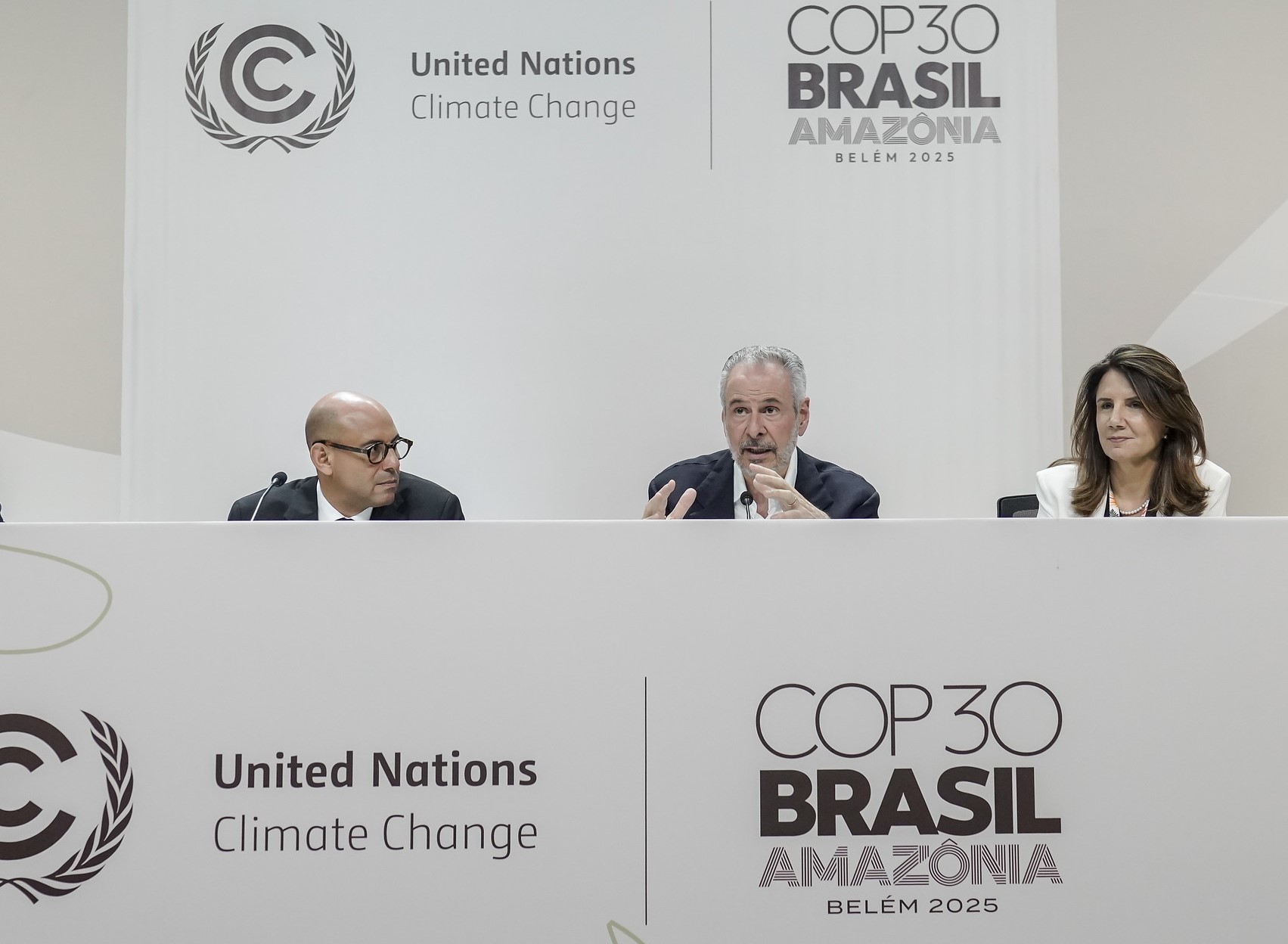
The secretariat serviced a broad range of intergovernmental meetings, workshops, technical sessions and other mandated events throughout 2025 to support the UNFCCC process, including by providing organizational, procedural, technical and documentation support for SB 62, the United Nations Climate Change Conference in Belém and the climate weeks. This support helped Parties to advance negotiations across workstreams, including adaptation, gender, means of implementation, mitigation and transparency.

To deliver comprehensive conference services, the secretariat managed increased complexity across core operational areas such as registration, accreditation, scheduling, document management and on-site logistics. This encompassed managing participant flows, meeting room allocation, security coordination and service delivery in constrained physical infrastructure while strengthening support systems to maintain efficiency and transparency. Prior to and during the sessions, the secretariat facilitated inclusive participation by putting out some 340 official documents and providing visa support, financial assistance and accessibility services, including sign language interpretation and accessible venue arrangements. These efforts were undertaken in a context of significant operational pressure, requiring continuous adjustments to service provision.

The secretariat also supported activities in the UNFCCC process by, inter alia, strengthening coordination among the presiding officers and enhancing support to members of the Bureau of the governing bodies, enhancing the provision of procedural and legal services through, inter alia, dedicated legal briefings and capacity-building for Presidencies, presiding officers and in-house staff aimed at strengthening legal expertise and procedural effectiveness, facilitating high-level engagement at the Belém Conference, improving the process for organizing mandated and technical events, supporting the translation of negotiated outcomes into action and increasing the coherence of proceedings across meetings of the governing and subsidiary bodies.

Summary

Specifically, the secretariat supported negotiations and the organization of mandated events, plenary meetings, coordination meetings for the presiding officers and the Bureau of the governing bodies. It also supported the COP 30 Presidency and the Chairs of the subsidiary bodies in engaging with Parties by organizing consultations with ministers, chairs and coordinators of negotiating groups, and heads of delegation, which contributed to the smooth adoption of the agendas and the timely launch of work at the Belém Conference and the adoption of the Belém Political Package.  

The secretariat facilitated high-level engagement at the Belém Conference by providing advice on the format of the event and on the participation of the Heads of State and Government at the COP 30 Climate Summit. It formalized protocols and procedures governing interactions at the opening meeting, held the high-level segment, at which 131 Party statements were made, and supported more than 75 bilateral meetings attended by senior representatives and observers. The Belém Conference was held in a location of high symbolic importance for the global climate agenda, where hosting a conference of this scale entailed major infrastructure and service adjustments to meet international standards. Despite significant challenges related to the venue, mobility, accommodation and operations, the secretariat ensured continuity of core conference services, supported the functioning of negotiations and enabled high-level engagement under highly complex conditions.

The secretariat supported Parties’ discussions at SBI 62 and 63 on increasing the efficiency of the UNFCCC process by preparing visual overviews of options for streamlining provisional agendas and continued to strategically schedule negotiations and mandated events with a view to improving time management. It also advanced conference delivery through pilots of AI-enabled tools to enhance operational efficiency and by initiating procurement for a new digital event platform aimed at improving participant engagement, real-time information sharing and participant flow management. While they helped to make meeting delivery more adaptive and resilient, these efforts also highlighted the need for sustained investment in operational capacity and digital systems.

Detailed Overview

Providing strategic support to Presidencies, Chairs of Subsidiary Bodies and the Bureau

COP 30 was held in a location of high symbolic importance for the global climate agenda, where the host city undertook an accelerated transformation to meet the requirements of a large-scale multilateral conference. Delivering the conference required rapid adaptation of infrastructure and services to meet international standards for security, accreditation, technology, sustainability and accessibility, including the expansion of venues, deployment of temporary structures and coordinated responses to accommodation, mobility and supply chain pressures in a complex climatic and geographic context. The scale and diversity of participation placed exceptional demands on local systems and conference operations. Despite these unprecedented challenges, the secretariat ensured continuity of core conference services, maintained the functioning of negotiations and supported high-level engagement, demonstrating resilience and adaptability under highly complex conditions.

In parallel, it advanced digital modernization as a strategic priority, including by deploying a modernized registration system for non-sessional meetings, piloting artificial intelligence tools to enhance to enhance operational efficiency and initiating procurement for a new digital event platform aimed at improving participant engagement, real-time information sharing and management of participant flows. These efforts contributed to strengthening the efficiency, inclusivity and resilience of the intergovernmental process while highlighting the growing scale and complexity of conference delivery and the need for sustained investment in operational capacity and digital systems

The secretariat enhanced its support to the Presiding Officers for coordination, coherence and strategic alignment for COP 30 success. Seven meetings of Presiding Officers were convened during the reporting period to provide a platform for structured strategic dialogue among the Presiding Officers and the secretariat on annual priorities and session preparations and coordinated engagement and outreach with Parties and observers.

The secretariat continued supporting the Bureau through effectively organizing seven Bureau meetings during the reporting period. The secretariat also conducted induction workshops for members’ comprehensive overview of the Bureau’s functions, roles and responsibilities and its working modalities.

The secretariat supported the Presidencies and Chairs of the subsidiary bodies in their engagement with negotiating groups and Parties to build political momentum for COP 30 by organizing Heads of delegation consultations and bilateral meetings. This engagement was instrumental to achieve the political agreement for the smooth adoption of the agendas and launch of work of COP 30, CMP 20, CMA 7, the successful conduct of work during the sessions, and the successful adoption of 56 decisions at COP 30, including the Mutirao decision and Belém Political Package.

Enhancing engagement with Parties

Over the course of the year, the secretariat facilitated engagements among negotiating groups, the Chairs of the subsidiary bodies, the UNFCCC management team, and the incoming COP 30 Presidency to foster dialogue and provide clear guidance to pave the way to achieve ambitious outcomes at COP 30.

While the COP 30 Heads of State and Government Summit was managed and delivered by the host country prior to the formal opening of the conference, the secretariat provided guidance to the incoming COP 30 Presidency on formats for high-level roundtables and shared relevant documentation and past communications to support engagement with Parties in the Summit.

During the conference, the secretariat worked closely with the host country’s protocol services to support the official opening of the conference, which was attended by the President of the Federative Republic of Brazil and more than 500 dignitaries from the Brazilian Government.

The secretariat organized and managed the High-Level Segment of the conference held on 17 and 18 November 2025, supporting the delivery of 131 statements by Parties.

In addition, the secretariat coordinated with the office of the President of the General Assembly and the office of the Vice President of the Federal Republic of Brazil to facilitate the participation of Her Excellency Ms. Annalena Baerbock, President of the United Nations General Assembly and His Excellency Mr. Geraldo Alckmin, Vice President of the Federative Republic of Brazil, in the opening of the High-Level Segment.

Over the course of two weeks of the conference, the secretariat facilitated over 75 bilateral meetings with senior Party representatives, including representatives of observer organizations.

In addition, throughout the year, the secretariat, through its RCCs, led a needs assessment exercise by regularly engaging with Parties through regular calls with the designated UNFCCC National Focal Points, surveys also including Designated National Authorities, several interviews and through their interactions at organized regional activities. This was done with a view to enhancing targeted direct country support, may it be of a capacity-building or technical nature.

Enhancing the efficiency of the UNFCCC process

The secretariat continued supporting Parties’ discussion on increasing the efficiency of the UNFCCC process under the SBI agenda item on the Arrangements for Intergovernmental Meetings, including by preparing and making available analytical inputs on approaches and opportunities for improving efficiency (including visualized options for streamlining provisional agendas).

The secretariat continued to implement efforts to increase the efficiency of the UNFCCC process, including increased transparency to Parties on the progress of the negotiations during the sessions, efficient time management and timely issuance of documentation.

The secretariat strengthened planning and organization of mandated events and participation arrangements by supporting scheduling to avoid clashes with negotiations, convening mandated events intersessionally and, where possible, in hybrid format, and clustering events within a relatively short time frame (including during Climate Weeks) to promote broad participation and inclusiveness.

Summary

A new global, biannual format for Climate Weeks was designed and implemented to enhance the coherence of activities across workstreams. Clustering mandated UNFCCC meetings with impact-focused policy-related dialogues also strengthens the link between the intergovernmental process and the response to implementation needs. The first Climate Week for 2025, held in Panama City in May, featured the inaugural Implementation Forum, designed to bring together key stakeholders, and NDC Clinic, intended to provide capacity-building support. The second Climate Week, convened in Addis Ababa in September, expanded participation to a wider range of actors, including Party delegates and representatives of non-Party stakeholders such as subnational government representatives, development banks, the private sector, civil society organizations, youth and Indigenous Peoples, who engaged in mandated events, technical discussions and implementation-focused activities. In this way, the climate weeks supported the translation of negotiated outcomes into real-world solutions.

Detailed Overview

The secretariat launched a redesigned Climate Week format to streamline mandated events and strengthen collaboration between governments and non-Party stakeholders. The inaugural Climate Week, hosted by Panama in May, convened Parties, financial institutions, businesses, civil society, and Indigenous Peoples to advance progress on finance, technology, and carbon markets. Its centrepiece, the first Implementation Forum, focused on translating commitments into action. Additional mandated events included the Sharm el Sheikh Mitigation Work Programme, the UAE Just Transition dialogue, the Global DNA Forum, and the year’s first NDC Clinic. The second Climate Week, held in Addis Ababa in September, expanded participation and emphasized practical pathways for adaptation, finance access, just transitions, and sectoral climate action. Over 40 initiatives were showcased through Implementation Forum labs and workshops. Building on this momentum, Climate Weeks in 2026 will take place in Yeosu, Republic of Korea, and Baku, Azerbaijan, with a continued focus on real economy.  

During the Panama Climate Week, multiple UNFCCC‑mandated processes were convened as part of the wider programme. These included the 5th global dialogue and investment‑focused event under the Sharm el‑Sheikh Mitigation Ambition and Implementation Work Programme (MWP), bringing together MWP co‑chairs, Party delegates, and invited stakeholders (May); the Global DNA Forum on Article 6.4 implementation, which assembled Designated National Authorities (DNAs) from Parties and engaged with the Article 6.4 Supervisory Body; and the third dialogue under the United Arab Emirates Just Transition Work Programme (JTWP), with Parties and observers exchanging on approaches to just transitions (May).The climate week was organized by the UNFCCC with the support of the Government of Panama. In parallel, the NDC Clinics provided practical, country‑tailored capacity‑building to support government focal points from participating Parties in advancing NDC implementation, co‑organized by the UNFCCC secretariat, UNEP, UNDP, and the NDC Partnership.

The Addis Ababa Climate Week continued to provide structured engagement across sectors. The Implementation Forum featured implementation labs, technical roundtables, and workshops designed for governments, subnational authorities, real‑economy actors, civil society, youth, and business, providing opportunities to examine methodologies and consider approaches adaptable to national and regional contexts in energy, agriculture, forestry, and urban systems. The climate week was organized by the UNFCCC with the support of the Government of Ethiopia.

Collectively, the activities organized showed how mandated events (MWP dialogues, JTWP dialogues, Global DNA Forum), capacity‑building platforms (NDC Clinics), and multistakeholder exchanges (Implementation Forum) can be delivered within a unified structure that supports Parties and partners in advancing climate action at national and regional level.

Delivering thematic work
Supporting constituted bodies and work programmes

Summary

Work by the constituted bodies and under work programmes forms a central part of the UNFCCC process, with activities relating to technical guidance, policymaking advice, Party support, while also providing specialized expertise in the areas of mitigation, adaptation, loss and damage, climate technology, response measures, transparency, and climate finance (see table 1). The secretariat supported these bodies and work programmes by facilitating meetings and mandated events, preparing technical inputs and reports, facilitating knowledge exchange and providing the procedural and legal support necessary for ensuring effective deliberations and compliance with mandates.

The secretariat supported Parties in advancing work under the Sharm el-Sheikh mitigation ambition and implementation work programme. Two global dialogues were held on mitigation solutions, including circular economy approaches, in the forestry and waste sectors, alongside two investment-focused events. The secretariat prepared reports for consideration at CMA 7 and continued providing support for work related to reducing emissions from fuels used for international aviation and maritime transport.

On response measures, the secretariat facilitated the discussions that culminated in the identification of priority activities for 2026 under the workplan of the forum on the impact of the implementation of response measures and its KCI for 2026–2030. The secretariat also implemented mandated activities under the forum’s work programme, for 2020-2025, including organizing a global dialogue on mainstreaming response measures in NDCs and managing synergies and trade-offs in implementing response measures to create jobs, enhance co‑benefits and promote equitable approaches to critical minerals; and developing an e-learning module and analytical tools on assessing and addressing the impacts of the implementation of response measures. It continued to support the forum and its KCI by organizing meetings and in-session technical events and preparing technical papers, annual reports and case studies.

The secretariat provided support for matters related to capacity-building, including implementation of the mandates and completion of the deliverables of the PCCB, as well as conducting capacity-building initiatives focused on  fostering collaboration among the PCCB Network members and building the skills and knowledge of Parties and non-Party stakeholders needed to address climate change effectively. In 2025, the secretariat provided capacity-building support through more than 350 activities, including events (e.g. webinars, technical meetings and workshops) and resources (e.g. publications and e-learning modules).

The secretariat continued to work at the science–policy interface by facilitating the consideration of the latest research and scientific findings, including from the IPCC, to inform policy and action. The seventeenth meeting of the research dialogue and Earth Information Day 2025 provided opportunities for policymakers to engage with the scientific and observation community, including in identifying scientific research needs under the Convention and the Paris Agreement.

Key messages from the 2025 ocean and climate change dialogue at SB 62, which addressed three topics – ocean-based measures in the NDCs, the ocean under the global goal on adaptation and the ocean-climate-biodiversity nexus, with means of implementation, especially finance, considered as a cross-cutting issue – served as input to the Belém Conference.

As regards forests and land use, seven Parties submitted REDD+ technical annexes in 2025, and the secretariat supported the COP 30 Presidency’s road map to halting and reversing deforestation by 2030 by facilitating technical coordination and meetings of experts.

Table 1 Overview of secretariat support to constituted bodies and work programmes

Constituted  body or work programme Highlights
Adaptation Committee

The 27th and 28th meetings of the Committee were held and a technical report on mapping existing technical guidance and training materials to support the implementation of the United Arab Emirates Framework for Global Climate Resilience was published

Climate Technology Centre and Network The mandate of the Climate Technology Centre was extended to 2041 and the process for selecting its new host was launched
Compliance Committee of the Kyoto Protocol Four meetings were held and the decision was made for the Committee to hold future meetings only when the need arises, the enforcement branch resolved an outstanding question of implementation and the facilitative branch completed its review of annual review reports
Consultative Group of Experts Nine subregional training workshops, two series of regional webinars, one informal forum and two side events were held to support developing country Parties in implementing MRV under the Convention and the ETF, together reaching about 860 experts on transparency-related matters, and a technical paper on capacity-building needs for implementing MRV and the ETF was published
Executive Committee of the Warsaw International Mechanism for Loss and Damage associated with Climate Change Impacts A guide on sea level rise and a compendium on comprehensive risk management approaches were published, webinars on sea level rise were delivered and a technical session was held at NAP Expo 2025
Facilitative Working Group of the LCIPP Biannual meetings of the FWG were held, Mandated LCIPP events were delivered, including the fifth annual gathering of knowledge holders and practitioners from Indigenous Peoples and local communities and the seventh-generation roundtables, and support was provided to the COP 30 Presidency dialogues and thematic workshop
Glasgow Committee on Non-market Approaches Workshops, exchanges and webinars were held
KCI

Activities were agreed for 2026, and tools and an e-learning module were developed

Least Developed Countries Expert Group

The 47th and 48th meetings of the Group, NAP workshops and NAP Expo 2025 were held, updated technical guidelines on the NAP process were published, 74 NAPs were submitted and the second five-yearly review of progress in the NAP process was concluded (at the Belém Conference)

Nairobi work programme on impacts, vulnerability and adaptation to climate change

The 18th Focal Point Forum, event on adaptation finance were held and reports on monitoring, evaluation and learning systems for adaptation and foresight-guided work on adaptation and finance were published. Practical and actionable knowledge was delivered in collaboration with diverse knowledge holders through the Nairobi network of close to 500 partners, including through the UN Climate Change Universities Partnership Programme.

Informal grouping of work on research, science and ocean

Dialogues were held on the latest research and scientific findings, which included inputs from the IPCC, status of Earth observations, and ocean and climate change

Paris Agreement Implementation and Compliance Committee

Three meetings were held and the Committee initiated consideration of issues related to 171 NDCs and 37 BTRs, of which 50 cases were resolved, issued 256 notifications and 47 responses to Parties, and held dialogues with more than 50 Parties

PCCB

The 9th meeting of the PCCB was held, the 7th Capacity-building Hub took place and the PCCB Network reached 452 members

SCF

Three meetings and the SCF Forum for 2025 were held and technical work on the new collective quantified goal on climate finance was advanced

Supervisory Body

The first set of Article 6.4 mechanism standards was adopted, the first methodology under the mechanism was approved and an interim Article 6.4 registry was launched to facilitate the early operationalization of the mechanism

Technical expert reviews under Article 6, paragraph 2, of the Paris Agreement

The Article 6, paragraph 2, reference manual for the accounting, reporting and review of cooperative approaches was updated, five reviews of Parties’ cooperative approaches (initial reports) under the Article 6, paragraph 2, technical expert review process were completed and 155 experts underwent the training programme on Article 6 technical expert review

TEC

Policy and knowledge products were produced on innovation, resilience, energy systems and use of AI in climate action

United Arab Emirates–Belém work programme indicators for measuring progress achieved towards the targets referred to in paragraphs 9–10 of decision 2/CMA.5

After a year of work, technical experts produced 100 potential indicators in September 2025. Building on those, CMA 7 adopted 59 Belém Adaptation Indicators, and launched the Belém-Addis Vision on Adaptation, initiating a two‑year policy alignment process alongside continued technical refinement.

Detailed Overview

Reducing emissions and addressing impacts of response measures

The secretariat supported the intergovernmental process relating to mitigation, including on the Sharm el-Sheikh mitigation ambition and implementation work programme (SBST/SBI, CMA) and on emissions from fuels used for international aviation and maritime transport.

Under the guidance of co-chairs of the Sharm el-Sheikh mitigation ambition and implementation work programme, Angela Churie Kallhauge (Sweden) and Gao Xiang (China), the secretariat organized two global dialogues one focusing on enabling mitigation solutions in the forest sector, drawing on national and regional experience, and one on enabling mitigation solutions in the waste sector, including through circular economy approaches, and two investment focused events, and published two summary reports and one annual reportfor consideration by CMA 7.

Work on the impacts of the implementation of response measures delivered results across intergovernmental, technical and capacity‑building tracks. The secretariat supported negotiations that culminated in the elaboration of specific 2026 activities as part of the 2026–2030 work programme for the forum and the Katowice Committee on Impacts of the Implementation of Response Measures that was adopted at COP 29.2

Under the guidance of the SB Chairs, the secretariat organized a global dialogue on response measures on advancing the implementation and mainstreaming of response measures in the context of NDCs with specific focus on managing synergies and trade-offs to create jobs, enhance co-benefits, and promote equitable approaches to critical minerals. The report of the global dialogue was published on the UNFCC website. 3

Substantive support was provided to the forum and the KCI, including the organization of the meetings of the KCI, the preparation of KCI’s annual reports, technical papers and case studies, as well as the delivery of in‑session events and technical sessions. Capacity‑building was further advanced through the development of an e‑learning module and the dissemination of analytical tools, enhancing Parties’ capacity to assess the socio‑economic impacts of response measures and to inform just transition approaches, including decent work, economic diversification and inclusion considerations.

1 FCCC/SB/2025/11
Contained in Annex to decisions 16 /COP.29, 3/CMP.19 and 22/CMA.6
3 FCCC/SB/2025/8

Capacity-building
(i) Capacity-building sub-division initiatives

The secretariat supported matters related to capacity-building, supporting the mandates and deliverables of the Paris Committee on Capacity-building (PCCB), as well as dedicated capacity-building initiatives and projects that focus on empowering stakeholders, fostering collaboration, and building the necessary skills and knowledge to address climate change effectively.

A variety of activities were implemented in the context of the 2025-2026 annual focus area, on "Capacity-building for designing holistic investment strategies, bankable projects and stakeholder engagement to strengthen the implementation of NDCs and NAPs in developing countries". Aligned with the annual focus area of the PCCB, the 14th Durban Forum, held in June 2025, covered the overarching theme of effective capacity-building for mobilizing finance.

At its 9th PCCB meeting held in June 2025, the PCCB discussed its flexible workplan for 2025–2029 which was adopted intersessional. Under the oversight of the PCCB, the secretariat organized the 7th Capacity-building Hub at COP 30, bringing together 41 organizations to deliver 31 sessions. With 452 members, the PCCB Network remained a key platform for strengthening coherence and coordination in capacity‑building efforts, delivering five member‑led webinars and launching the Energy Cluster.

The Fellowship Capacity Award Programme to Advance Capabilities and Institutional Training supported five fellows from Small Island Developing States (SIDS) and Least Developed Countries (LDCs) to work with teams at the UNFCCC secretariat in Bonn.

Under the Youth4Capacity Programme, activities included the delivery of four ‘Becoming…’ webinars, the organization of flagship events at SB 62 and COP 30, targeted regional capacity‑building initiatives including through the RCCs, the launch of the Language of Climate Action campaign, and the roll‑out of the Climate Catalysts Mentorship Programme in partnership with the UNDP Youth4Climate initiative.

Under the Rio Conventions Joint Capacity‑building Programme, a series of webinars was implemented to strengthen the capacities of relevant national institutions, policymakers, and practitioners.

(ii) Capacity-building components, projects, programmes and initiatives across the secretariat

The secretariat and its RCCs formally launched the Capacity-Building for Negotiators (CB4N) initiative to enhance the capacity of Parties to engage effectively in the UNFCCC negotiation process.

The CB4N initiative responds directly to the mandate to support Party delegates, in particular youth delegates, in building their capacity to engage in the negotiation process, and to make training and other relevant materials available on the UNFCCC website.1 

Specifically, the CB4N initiative will deliver regionally tailored training programmes, accessible capacity-building tools, and practical learning opportunities aimed at enhancing the capacity of Parties to engage effectively in the intergovernmental process.

Under the Article 6 Capacity Building (A6CB) Programme, the UNFCCC supports Parties and stakeholders in engaging with Article 6 of the Paris Agreement, helping them leverage market and non-market mechanisms to reduce greenhouse gas emissions effectively.

To maximize the benefits of Article 6, capacity-building initiatives provide practical guidance, training, and peer-learning opportunities, building a shared understanding of how to engage with Article 6 in a high-integrity way and ensuring cooperative approaches drive sustainable development and ambitious climate action.

In 2025, the A6CB Programme, including through the UNFCCC Regional Collaboration Centers (RCCs) and global partnerships, delivered a broad range of targeted, graduated online and in-person events, services, products, and tools. E.g .regional-, national-, and global level workshops, dialogues, clinics, webinars, and roundtables, incl. the A6.4 training day and Capacity Building partner dialogue during the June Climate Meetings (SB 62). At the Climate Weeks, interactive Implementation Labs were delivered plus a 2-day deep-dive workshop on Unlocking Finance and Accelerating NDC Implementation through Carbon Markets.

In 2025, tailor-made, hands-on country support was complemented and reinforced by regional- and global knowledge products, such as interactive e-learning modules, user friendly explainers, videos, recording series, overview- and summary reports, and eFAQs.

The built-in evaluation surveys illustrate highest satisfaction rates of the users while also underlining the continuously high demand for further A6CB products, events, and advisory services.

The Legal Affairs division provides capacity-building activities for a broad range of stakeholders involved in the UNFCCC process, including incoming Presidencies, presiding officers, negotiators, secretariat staff, observer organizations and parliamentarians, often in collaboration with partners such as the Inter-Parliamentary Union (IPU) and UNEP.


FCCC/SBI/2025/11, paragraph 209 (b)

Advancing implementation of the Paris Agreement

Parties require ongoing technical, procedural and capacity-building support for implementing their commitments under the Paris Agreement and strengthening collective climate ambition. In 2025, the secretariat’s efforts focused on maintaining or operationalizing platforms that support Parties in meeting their obligations under the Paris Agreement, such as the Article 6 cooperation mechanisms, the ETF and the arrangements that support Parties in preparing, updating and implementing their NDCs.

Summary

NDCs remain the primary vehicle through which Parties communicate and operationalize their climate commitments under the Paris Agreement. Ensuring that NDCs are of a high quality and effectively implemented, is, therefore, essential. The 2025 NDC synthesis report covered 86 NDCs from 113 Parties, informing the support needed for Parties in operationalizing their NDC commitments and promoting peer exchange on effective approaches to developing and enhancing NDCs. In 88 per cent of the NDCs submitted as at 30 September 2025 Parties reported being informed by the outcomes of the first global stocktake, and in 80 per cent Parties specified how those outcomes shaped the development of the NDC components on mitigation, adaptation, means of implementation, response measures, loss and damage, and international cooperation. To support NDC preparation and implementation, the secretariat organized, together with the RCCs and partners (e.g. German Agency for International Cooperation, NDC Partnership, United Nations Development Programme and United Nations Environment Programme), four regional NDC clinics across Africa, Asia and the Pacific, and Latin America and the Caribbean with a focus on facilitating the mobilization of finance and engaging the private sector. Additionally, the RCCs launched 13 direct technical support projects to address priority needs set out in the NDCs. The secretariat also supported negotiations relating to the global stocktake, including on refining the modalities of the dialogue on how the outcomes of the global stocktake are informing the preparation of NDCs and of related documentation for consideration at CMA 7. Further, the secretariat supported the Consultative Group of Experts in co-organizing nine subregional hands-on workshops to assist developing country Parties in preparing their BTRs and aligning their BTRs and NDCs, to build capacity for conducting technical expert reviews under the ETF and to facilitate peer learning.

Detailed Overview

The secretariat provided guidance and continued support to  Parties in advancing work following the first Global Stocktake (GST), including organizing the second annual GST dialogue, as referenced in paragraph 187 of decision 1/CMA.5held in June 2025. According to the 2025 NDC Synthesis Report2 88 per cent of nationally determined contributions (NDCs) submitted by 30 September 2025 were informed by the first GST, and 80 per cent of those NDCs specifying how GST outcomes shaped their mitigation, adaptation, means of implementation, response measures, loss and damage, and international cooperation components.

The secretariat also assisted GST-related negotiations. At CMA 7, Parties concluded negotiations on the scope and modalities of the UAE dialogue on implementing GST outcomes, which will be held alongside the first regular sessions of the subsidiary bodies in 2026 and 2027. Parties took note of  the 2024 and 2025 annual GST dialogue summary reports, while deciding that the dialogue will conclude dialogue at SB 64 and that the resumption of the dialogue will be considered in the considerations of the outcomes of the second GST. Parties also agreed on certain refinements to the procedural and logistical elements of the overall GST process, as outlined in decision 19/CMA.13 which will guide the second GST process starting at CMA 8 in November 2026.

The secretariat facilitated the consideration of the latest climate research into the UNFCCC process. During the seventeenth research dialogue and the 2025 Earth Information Day, Parties and stakeholders considered new findings from the IPCC and Earth observation communities, including advances in climate attribution, tipping points, and the nexus between climate change and sustainable development. The discussions also considered the role of observations data for supporting climate action and means to sustain long term observations, data access and sharing.

The secretariat also advanced ocean‑based climate action by supporting the 2025 Ocean and Climate Change Dialogue at SB62, co‑facilitated by Ulrik Lenaerts (Belgium) and Ambassador Carlos Cozendey (Brazil). The Dialogue addressed, with key messages presented at the COP30 high-level opening plenary, ocean in the NDCs and the GGA, , and enhancing ocean–climate–biodiversity synergies, with finance highlighted as a key cross‑cutting need. The secretariat further supported efforts to strengthen inter‑agency cooperation and contributed to preparations for the 2025 United Nations Ocean Conference.

NDCs: Enhancing coordinated support for preparation and implementation

In response to the mandate of decision 1/CMA.5, the secretariat and its RCCs working together with UNDP, UNEP, NDC partnership, GIZ and other partners organised four regional NDC clinics covering Latin America and Caribbean, Africa and Asia Pacific regions. The events provided a platform to address barriers in the preparation and implementation of NDCs, including exchanging information on mobilizing finance for NDC implementation and engaging the private sector in the implementation process. The events were attended by national focal points coordinating NDC implementation and mobilizing finance for NDCs as well as non-Party stakeholders, private sector representatives, development partners and financial institutions engaged in the process.

The secretariat and its RCCs continued to engage with multilateral and regional development partners in their efforts to collaborate on improving the support to Parties on new NDC preparation and implementation processes. Interagency meetings in the margins of the meetings of subsidiary and governing bodies as well as quarterly regional coordination meetings, joint intelligence gathering and dissemination efforts on the NDC process as well as capacity building efforts and knowledge products targeting the NDC preparation and implementation process are clear examples of this. In the context of this effort, the RCCs also launched 13 direct technical support projects to bridge immediate gaps in support to help countries with urgent needs in their NDC preparation process.

FCCC/PA/CMA/2023/16/Add.1
2 FCCC/PA/CMA/2025/8
3 FCCC/PA/CMA/2018/3/Add.2

Summary

Climate finance enables developing countries to undertake mitigation and adaptation action and supports the shift from high-emission development pathways towards sustainable development. The secretariat supports the full range of intergovernmental climate finance processes that guide cooperation, reporting and coherence across the UNFCCC climate finance architecture. At the Belém Conference the secretariat provided substantive and technical support to negotiators, with deliberations resulting in the adoption of 13 finance-related decisions as part of the Belém Political Package and finance-related outcomes under decision 1/CMA.7, entitled “Global Mutirão: Uniting humanity in a global mobilization against climate change”.

The secretariat also supported the advancement of work under Article 9, paragraph 5, of the Paris Agreement (producing a compilation and synthesis and organizing an in-session workshop and the summary report thereon) and the work of the SCF (organizing three meetings of the SCF and the 2025 SCF Forum, on accelerating climate action and resilience through financing for sustainable food systems and agriculture, as well as delivering preparatory work on assessing progress towards the new collective quantified goal on climate finance and conducting dialogues with the operating entities of the Financial Mechanism). Further, it supported the organization of two workshops under the Sharm el-Sheikh dialogue on the scope of Article 2, paragraph 1(c), of the Paris Agreement and its complementarity with Article 9 of the Paris Agreement, as well as the delivery of a synthesis report covering all work conducted under the dialogue in 2023–2025.

As interim secretariat of the Fund for responding to Loss and Damage, the UNFCCC secretariat, jointly with the Green Climate Fund secretariat and the United Nations Development Programme, supported the organization of three meetings of the Board of the Fund for responding to Loss and Damage. As for the “Baku to Belém Roadmap to 1.3T”, the secretariat facilitated consultations with Parties and non-Party stakeholders and reviewed 227 submissions on this matter. It further supported the CMA 6 and CMA7 Presidencies in the development of a catalogue tool of initiatives, concepts and best practices and preparation of the report on the “Baku to Belém Roadmap to 1.3T”. The Needs-based Finance project strengthened Parties’ understanding of country-level climate finance needs and barriers to its access and helped countries to engage with climate finance providers in closing their climate finance gaps. Building on this project, an initiative titled Climate Finance for Countries Facing Conflict and Severe Humanitarian Needs facilitated the provision of support to five such countries, identifying entry points for accessing climate finance in the context of significant institutional capacity constraints.

Detailed Overview

Throughout the year, the secretariat provided analytical, procedural, and coordination support to the intergovernmental process on climate finance across agenda items under COP 30, CMA 7, CMP 20, SB 62, and SB 63. Activities included preparing briefing notes, facilitating negotiations, synthesizing Parties’ views to develop draft decision text, and promoting coherence across finance workstreams. At COP 30 in Belém, Parties adopted 13 finance decisions as part of the Belém Political Package, along with finance-related outcomes under the Global Mutirão, providing a comprehensive set of measures to enhance commitments and implementation.

The secretariat supported Parties in advancing work on  Article 9, paragraph 5, of the Paris Agreement. The secretariat prepared a compilation and synthesis of the third  biennial communications1 and supported the organization of the third biennial in-session workshop, producing a summary report of discussions. At CMA 7, the secretariat assisted the  Presidency in organizing the third high-level ministerial dialogue on climate finance, which assembled 48 ministers, government representatives, and non-Party stakeholders to discuss actionable solutions for scaling finance, with a focus on adaptation and resilience.

The secretariat supported the Standing Committee on Finance (SCF) in fulfilling mandates from COP 29 by organizing three SCF meetings and, in collaboration with the Government of Italy and FAO, convening the SCF Forum on accelerating climate action and resilience through financing for sustainable food systems and agriculture. The secretariat also held three webinars with operating entities of the Financial Mechanism to present draft guidance and facilitate dialogue in preparation for COP 30. Additionally, a technical expert session was conducted to address information, data, sources, and approaches for monitoring the new collective quantified goal on climate finance (NCQG),  clarify the technical scope of NCQG elements, review available methodologies, and identify information gaps to be addressed before 2028.  

The secretariat continued its engagement with the operating entities of the Financial Mechanism – the Green Climate Fund (GCF), the Global Environment Facility (GEF), and the Fund for responding to Loss and Damage (FRLD) – as well as with the Adaptation Fund (AF), to facilitate the implementation of guidance from Parties and to promote coherence between the intergovernmental process and the funds’ governance processes. This engagement included secretariat’s participation in the meetings of Boards and Council  and replenishment negotiation meetings, provision of technical inputs and advice to the respective Fund secretariat on guidance-related matters and coordination with the Fund secretariats  on reporting to the COP and CMA. The secretariat also facilitated exchanges between Parties and the operating entities to support the preparation of draft guidance by the SCF and enhance mutual understanding of evolving policy priorities and operational developments.

In collaboration with the GCF and UNDP, the secretariat acted as the interim secretariat for the Board of the FRLD, supporting three Board meetings in Barbados and the Philippines in 2025 and facilitating capacity-building for the new independent secretariat. Interim support concluded in October 2025 and was acknowledged with appreciation by Parties at COP 30 and CMA 7.  

Under the guidance of co-chairs of the Sharm el-Sheikh Dialogue on the scope of Article 2, paragraph 1(c), and its complementarity with Article 9, of the Paris Agreement, Gabriela Blatter (Switzerland) and Mohamed Nasr (Egypt), the secretariat supported two workshops in 2025 and prepared the annual report synthesizing work undertaken during 2023–2025 for consideration at CMA 7. The workshops reviewed approaches to Article 2, paragraph 1(c), its complementarity with Article 9, and reflected on three years of dialogue, identifying commonalities and differences in understanding as well as implementation challenges and opportunities.

In supporting the Baku to Belém Roadmap, throughout 2025, the secretariat supported the CMA 6 and CMA 7 Presidencies in the development of the workplan and the organization of consultations with Parties, non-Parties stakeholders. 227 submissions received during the consultation process demonstrate existing initiatives, best practices, and potential approaches to scaling up climate finance. The secretariat also produced a catalogue tool to enable knowledge exchange among stakeholders. The secretariat, under the guidance of the Presidencies, supported the development of the report of the Roadmap (Executive Summary). This roadmap reflects a key shift to implementation, presenting a coherent action framework reflecting initiatives, concepts and leverage points to facilitate all actors coming together to scale up climate finance in the short- to medium-term. It also outlines measures to increase concessional finance, reduce debt burdens, create fiscal space, and mobilize private capital through innovative instruments. These efforts helped Parties identify gaps, opportunities and priority areas for accelerated implementation

The Needs-based Finance project under Decision 4/CP28 continues to strengthen understanding of country-level climate finance needs and barriers to access, while translating analysis into practical approaches to support effective mobilization and use of climate finance. Through ongoing technical engagement with Parties and with partners, the project is helping countries to better articulate priorities, identify financing gaps, and enhance readiness to engage with available climate finance channels.

The Finance for Conflict Affected High-human Need (FINCOAHN) initiative continues to build on the NBF foundation by extending tailored support to five countries facing conflict, fragility and severe humanitarian challenges, where access to climate finance remains particularly constrained. The initiative is supporting the development of context-specific diagnostics and early pipelines, helping participating countries to identify realistic entry points for accessing climate finance under highly constrained institutional conditions.

1 FCCC/CP/2025/2–FCCC/PA/CMA/2025/3
2 FCCC/PA/CMA/2025/5
Para 4 of decision 4/CP30 and 8/CMA.7.

Summary

The secretariat continued to support work on technology development and transfer under the UNFCCC process, including that of the Technology Mechanism, particularly the TEC. At SB 62 and the Belém Conference, as well as intersessionally, the secretariat provided procedural and substantive support to Parties, resulting in the adoption of the Belém Technology Implementation Programme and extension of the term of the Climate Technology Centre to 2041 (with revised functions and a process for the selection of its new host). The secretariat also initiated the third independent review of the Climate Technology Centre and Network and the evaluation of the Poznan strategic programme on technology transfer. Under the TEC rolling workplan for 2023–2027, the secretariat supported the development of TEC policy recommendations and knowledge products on national systems of innovation, resilient buildings and infrastructure, renewable energy in the context of just transition, decarbonization of hard-to-abate sectors, technology needs assessments and action plans, and opportunities, risks and challenges related to using AI in climate action in developing countries. Under the Technology Mechanism Initiative on AI for Climate Action, the secretariat hosted, with the support of the Korea International Cooperation Agency, the Technology Mechanism AI for Climate Action Award 2025 and organized the inaugural TEC AI for Climate Action Forum. The secretariat also maintained TT:CLEAR and updated it to include the latest comprehensive information on technology needs assessments and technology action plans.

Detailed Overview

In 2025, Parties adopted the Belém Technology Implementation Programme as well as decisions on revised functions and the extension of the term of the Climate Technology Centre (CTC) until 2041 and on the launch of a process for the selection of the new host of the CTC. The secretariat also launched the third independent review of the CTCN and the evaluation of the Poznan strategic programme on technology transfer.

The secretariat supported the implementation of the Technology Mechanism joint work programme 2023-2027, including through contributing to five regional forums for national designated entities (NDEs) for climate technology, and carrying out the Technology Mechanism  Initiative on Artificial Intelligence for Climate Action, among others. Under the Initiative, with support from the Korea International Cooperation Agency, the secretariat hosted the Technology Mechanism AI for Climate Action Award and organized the inaugural TEC AI for Climate Action Forum.

The secretariat also supported the implementation of the TEC rolling workplan 2023-2027 by organizing two TEC meetings and two joint sessions of the TEC and the CTCN Advisory Board. Core outputs of the work of the TEC in 2025 included policy recommendations, knowledge products and targeted dialogues and events, including on national systems of innovation, buildings and infrastructure, renewable energy with aspects of just transition, decarbonization of hard-to-abate industries, technology needs assessments (TNA) and technology action plans, and opportunities, risks and challenges of artificial intelligence for climate action in developing countries among others. 

Stakeholder engagement and knowledge-sharing was strengthened to disseminate the work of the Technology Mechanism and the TEC under and outside the Convention and Paris Agreement, including through organizing high-profile events, such as a Technology Lab at the Implementation Forum during Panama Climate Week; facilitating targeted engagement of Members of the TEC in international fora and events; and supporting the TEC with the provision of inputs to key processes on support for climate technologies, including those related to the SCF and the operating entities of the Financial Mechanism.

The secretariat also maintained and further developed TT:CLEAR, the UNFCCC home for climate technology, including a comprehensive update of latest information on TNAs and technology action plans.

Summary

Article 6 of the Paris Agreement provides a framework for enabling international cooperation, and its operationalization requires coordinated technical, procedural and capacity-building support across all three workstreams (Article 6, paragraphs 2, 4 and 8). Under Article 6, paragraph 2, the secretariat updated the reference manual for the accounting, reporting and review of cooperative approaches, completed 5 reviews of initial reports and launched 11 additional reviews of initial reports, covering more than 30 Parties. A total of 155 experts completed their training on technical expert reviews, and the Registry System Administrators Forum met three times to advance progress towards developing interoperability standards of registry systems involved in Article 6 tracking arrangements. A dialogue on how cooperative approaches support ambition and an information session on Article 6, paragraph 2, were also convened at SB 62 and 63 respectively. Under Article 6, paragraph 4, Parties advanced their readiness to participate in the Article 6.4 mechanism, strengthening the institutional, regulatory and technical arrangements needed to host mitigation activities. As part of the readiness process, 44 Parties submitted their host Party participation requirements to the Supervisory Body. The Supervisory Body adopted new standards governing how Article 6.4 mechanism activities must be implemented, approved the first methodology for measuring solid waste mitigation, launched an interim registry for the Article 6.4 mechanism and accredited more than 10 auditors who will be responsible for validating and verifying Article 6.4 mechanism activities. The secretariat supported the organization of the Designated National Authorities Forum and the Article 6 (Carbon Markets) Implementation Lab, held as part of the Implementation Forum launched at the first Climate Week for 2025. Under Article 6, paragraph 8, the secretariat supported the organization of meetings of the Glasgow Committee on Non-market Approaches at SB 62 and 63, organized workshops and world café exchanges, and delivered over 10 webinars involving more than 160 participants, alongside providing tailored support under the RCCs. Across all Article 6 workstreams, training days, Implementation Labs and a deep-dive event on unlocking finance and accelerating NDC implementation were held under the capacity-building work programme for implementing Article 6 of the Paris Agreement.

Detailed Overview

The operationalization of Article 6 advanced significantly across all quarters. Under Article 6.2 of the Paris agreement, to enable countries to effectively and accurately report the information regarding Article 6 cooperation, the Article 6 manual was updated in April 2025. Technical expert reviewers assessed Article 6.2 cooperation countries’ initial reports, and published review reports to enhance transparency on bilateral cooperation among Parties using Article 6. During the year 2025, secretariat completed review of 5 countries cooperative approaches and launched the review for another seven reports comprising of over thirty countries with an aim to complete the review process by Q2 2026. Online training was delivered to 155 experts to support the Article 6 Technical Expert Review and increase pool of experts to undertake A.6 reviews.

The Registry system administrator’s forum (RSA) met thrice and is preparing the final version of the interoperability standards for National registries to inform and/or transact with the international registry established under UNFCCC.

At SB 62 and 63, the Ambition Dialogue focused on ambition and cooperation, allowing the Article 6 community to share experiences, challenges, and capacity-building needs. An Article 6.2 information session provided updates on infrastructure, the international registry, reporting, and review.

During Climate Week in Panama, the inaugural Global Designated National Authority (DNA) Forum for Article 6.4 – the Paris Agreement Crediting Mechanism (PACM) – gathered more than 130 participants to deepen their understanding of DNA roles, and the opportunities and benefits of the PACM over other schemes. The Article 6/Carbon Markets Lab fostered cross-stakeholder dialogue to build a pipeline of bankable PACM activities. At the second Climate Week, around 150 participants joined sessions on mobilizing finance for NDCs and implementing Article 6, organized with support from three UNFCCC Regional Collaboration Centers.

Under Article 6.8, the secretariat organized Glasgow committee on non-market-based approaches (GCNMA) meetings in the SB 62 and SB 63, including in session workshops and world café covering many topics under non-market-based approaches. During the year, more than ten Article 6.8 webinars were organized, and over 160 participants engaged in understanding the NMAs, participation in NMA platform and strengthening the understanding and capacity. Based on country requests, the secretariat and UNFCCC Regional Collaboration Centres provided tailored training and bilateral outreach, covering both technical and procedural aspects.

Under Article 6.4 of the Paris agreement (Paris Agreement crediting mechanism (PACM) the supervisory body of the mechanism has submitted its annual report on implementation to the CMA. During the year 2025 it has adopted several standards to implement the centralized mechanism and adopted first GHG mitigation impact evaluation methodology dealing with solid waste management. The interim registry was launched, and over ten independent auditors were accredited. By providing verified, mandate‑linked information throughout these processes, the secretariat strengthened the external stakeholder perspective—helping governments, partners, private‑sector actors and funders view the organization as a dependable and effective facilitator of Article 6 implementation, and therefore a partner for collaboration and investment.

Under the Article 6 Capacity Building (A6CB) Programme, the UNFCCC supports Parties and stakeholders in engaging with Article 6 of the Paris Agreement, helping them leverage market and non-market mechanisms to reduce greenhouse gas emissions effectively.

To maximize the benefits of Article 6, capacity-building initiatives provide practical guidance, training, and peer-learning opportunities, building a shared understanding of how to engage with Article 6 in a high-integrity way and ensuring cooperative approaches drive sustainable development and ambitious climate action.

The A6CB Programme, incl. through the UNFCCC Regional Collaboration Centres (RCCs) and global partnerships, delivered a broad range of targeted, graduated online and in-person events, peer learning, services, products, and tools. E.g .regional-, national-, and global level workshops, dialogues, clinics, webinars, and roundtables, incl. the A6.4 training day and Capacity Building partner dialogue during the June Climate Meetings (SB 62). At the Climate Weeks, interactive Implementation Labs were delivered plus a 2-day deep-dive workshop on Unlocking Finance and Accelerating NDC Implementation through Carbon Markets.

Tailor-made, hands-on country support, also provided through the RCCs was complemented and reinforced by regional- and global knowledge products, such as interactive e-learning modules, user-friendly explainers, videos, recording series, overview- and summary reports, and eFAQs.  

Summary

Technical and policy work advanced across adaptation, loss and damage, and knowledge-to-action areas. Under the United Arab Emirates–Belém work programme on indicators for measuring progress achieved towards the targets referred to in paragraphs 9–10 of decision 2/CMA.5, under the global goal on adaptation, the secretariat coordinated technical work leading to the finalization of 100 potential adaptation indicators, of which 59 were adopted at CMA 7,1 and the establishment of the Belém–Addis vision on adaptation as a two-year policy alignment process to progress alongside further technical work on metadata and methodologies for the indicators. The secretariat supported the Least Developed Countries Expert Group in updating the technical guidelines for the NAP process and assisted Parties in assessing progress in NAP formulation and implementation at the Belém Conference. As at 31 December 2025, 74 developing countries had submitted NAPs. The secretariat also supported the Adaptation Committee in advancing technical work and producing knowledge products. Regarding loss and damage, assisted by its four thematic expert groups, the Executive Committee of the Warsaw International Mechanism for Loss and Damage associated with Climate Change Impacts advanced policy support and amplified knowledge on context-specific approaches to averting, minimizing and addressing loss and damage. The secretariat supported Parties’ understanding of adaptation progress and needs through analytical support and synthesis work, maintaining NAP Central and the adaptation communications registry and contributing inputs to the synthesis reports on BTR1s and NDCs. The Nairobi work programme continued to serve as the UNFCCC knowledge-to-action hub for adaptation and resilience by delivering timely, understandable and actionable knowledge tailored to the evolving needs of Parties, particularly developing country Parties, for scaling up adaptation action and strengthening resilience to climate change impacts across systems and communities. Practical knowledge and actionable know-how were generated and delivered under the Nairobi work programme, including in areas of adaptation finance, monitoring, evaluation and learning for adaptation and subregional adaptation action through the Lima Adaptation Knowledge Initiative. The secretariat also supported the work under the LCIPP, as highlighted in table 1, incorporating the diverse knowledge systems, worldviews and lived realities of Indigenous Peoples and local communities in relevant work in the UNFCCC process. This is in line with Article 7, paragraph 5, of the Paris Agreement, which provides that adaptation action should be based on and guided by the best available science, as appropriate, traditional knowledge, knowledge of Indigenous Peoples and local knowledge systems.

1 Decision 12/CMA.7.

Detailed Overview

Technical and policy work under the UNFCCC advanced in 2025 across adaptation, loss and damage, and knowledge to action areas. Under the United Arab Emirates–Belém work programme of the Global Goal on Adaptation (GGA), technical experts finalized and published 100 potential indicators and a technical report addressing the 11 targets of the UAE Framework for Global Climate Resilience. At CMA 7, Parties adopted 59 Belém Adaptation Indicators, reporting on which will inform the global stocktake and established the two-year Belém–Addis Vision on Adaptation to guide continued work on policy alignment, indicator metadata and associated methodologies.

In parallel, the Adaptation Committee, together with the CGE and the Least Developed Countries Expert Group (LEG), mapped existing technical guidance and training materials relevant to supporting implementation of the UAE Framework. The LEG also updated the technical guidelines for National Adaptation Plans (NAPs) to reflect decision 2/CMA.5 and the latest scientific information. Following consultations in March 2025 and during Global Climate Week in Panama, the revised guidelines were finalized and launched at NAP Expo 2025.

COP 30 concluded the second five-yearly review of progress in the formulation and implementation of NAPs. As of 31 December 2025, 74 developing country Parties had submitted NAPs, identified gaps and needs, including those periodically gathered by RCCs will guide further work, with the next assessment scheduled for COP 35.

The secretariat supported the first year of implementation of the Local Communities and Indigenous Peoples Platform (LCIPP) Baku Workplan (2025–2027), including gatherings of knowledge holders, youth round table discussions, and contributor briefings during COP 30, to strengthen engagement of Indigenous Peoples and local communities including to promote ethical and equitable engagement with traditional knowledge and Indigenous knowledge systems.

On loss and damage, the WIM Executive Committee published a technical guide on sea level rise and a compendium on comprehensive risk management, conducted capacity-building activities, and completed the third review of the WIM at CMA 7. Progress in operationalizing the Loss and Damage Fund included the establishment of the Barbados Implementation Modalities, initiation of a call for funding requests, and financial pledges totalling approximately USD 817 million.

Under the Nairobi work programme, the secretariat convened the 18th Focal Point Forum and published summary reports on monitoring, evaluation and learning systems and on foresight guided adaptation and finance. The secretariat also maintained adaptation related online platforms and contributed to major synthesis reports supporting Parties’ assessment of adaptation progress and needs.

Summary

Transparency is essential for tracking collective progress and ensuring accountability under the Paris Agreement. Transparency-related measures include providing data to inform decision-making, designing stronger climate policies over time and channelling resources to where they are most needed. The secretariat continued to support reporting and review processes under the ETF. By the end of 2025, 128 Parties had submitted BTRs, of which 50 had undergone technical expert review. A total of 42 Parties included in Annex I to the Convention had submitted annual GHG inventories, and two working group sessions of the facilitative, multilateral consideration of progress had been convened. All three ETF reporting tools were upgraded, including to improve their usability and interoperability with the IPCC inventory software. Recognizing the importance of the provision of support to developing countries for implementing the ETF, the secretariat organized, in collaboration with partners, 21 in-person technical support events, attended by 740 experts from 118 developing countries, and 19 virtual events addressing different technical aspects of the ETF, attended by around 2,250 participants. Further, the secretariat expanded its training for reviewers (including for the voluntary review of BTR adaptation components), with more than 1,300 experts certified as at 31 December 2025. As for GHG inventories, the secretariat applied a contingency Excel-based approach to screening the information reported in the common reporting tables. It also prepared the first BTR synthesis report, covering nearly 75 per cent of global emissions in 2020 and providing an initial picture of countries’ varied progress towards the Paris Agreement goals. Seven Parties submitted REDD+ technical annexes together with their BTRs, and the concept of the REDD+ community of practice was introduced during an event. In collaboration with Microsoft, EY and Nedamco Africa, the secretariat advanced the development of the UNFCCC Climate Data Hub as an authoritative, centralized platform providing access to secure and analytically robust climate data for ETF implementation.

Detailed Overview

The secretariat facilitated Parties' implementation the Enhanced Transparency Framework (ETF) under the Paris Agreement. By the end of the year, the first 125 biennial transparency reports (BTRs) were submitted, with Technical Expert Reviews (TERs) conducted for 47 Parties. Two sessions of the Facilitative Multilateral Consideration of Progress (FMCP) provided a platform for Parties to engage in a peer learning exercise, exchange lessons learned, identify effective practices, and address challenges in climate data collection and reporting.

Support efforts prioritized strengthening national institutional arrangements, data management systems, methodological understanding, and technical capacity. Tailored guidance, updated reporting tools, and direct assistance enabled Parties to meet ETF requirements and leverage transparency as a foundation for more effective climate action by informing policies, identifying support needs and evidence-based NDCs.

Collaborating with partners such as the CGE, the secretariat delivered technical support to over 2,800 experts from 148 developing countries. All three ETF reporting tools were upgraded to enhance usability and interoperability, especially with the IPCC GHG inventory software. Capacity-building initiatives were expanded through both in-person and online training sessions.

To support the TER process, the secretariat expanded reviewer training, including for the voluntary review of information related to climate change impacts and adaptation contained in BTR’s , updated review guidance, and certified more than 1,300 experts. The secretariat also received 2025 annual GHG inventories from 42 Annex I Parties and conducted simplified reviews using a streamlined, stepwise approach. In the absence of an automated tool, a contingency Excel based solution was developed to automate the initial assessment, focusing exclusively on information reported in the Common Reporting Tables (CRTs).

Seven Parties submitted REDD+ technical annexes with their BTRs, and the secretariat introduced the concept of a REDD+ Community of Practice to facilitate structured knowledge sharing.

The first BTR synthesis report covering nearly 75 per cent of global 2020 emissions was prepared,, highlighting progress in mitigation, adaptation, and support, as well as enablers and barriers. The report will serve as a key input  to inform the Global Stocktake.

Through the #Together4Transparency initiative, the secretariat maintained broad engagement with Parties and stakeholders, helping to keep political momentum for the implementation of the ETF.

In collaboration with Microsoft, EY, and NEDAMCO Africa, the secretariat advanced the Climate Data Hub, an authoritative platform designed to provide secure, accessible, and analytically robust climate data, developed in line with UN data governance standards.

Enabling Inclusive and impactful climate action including through the regional collaboration centres

Summary

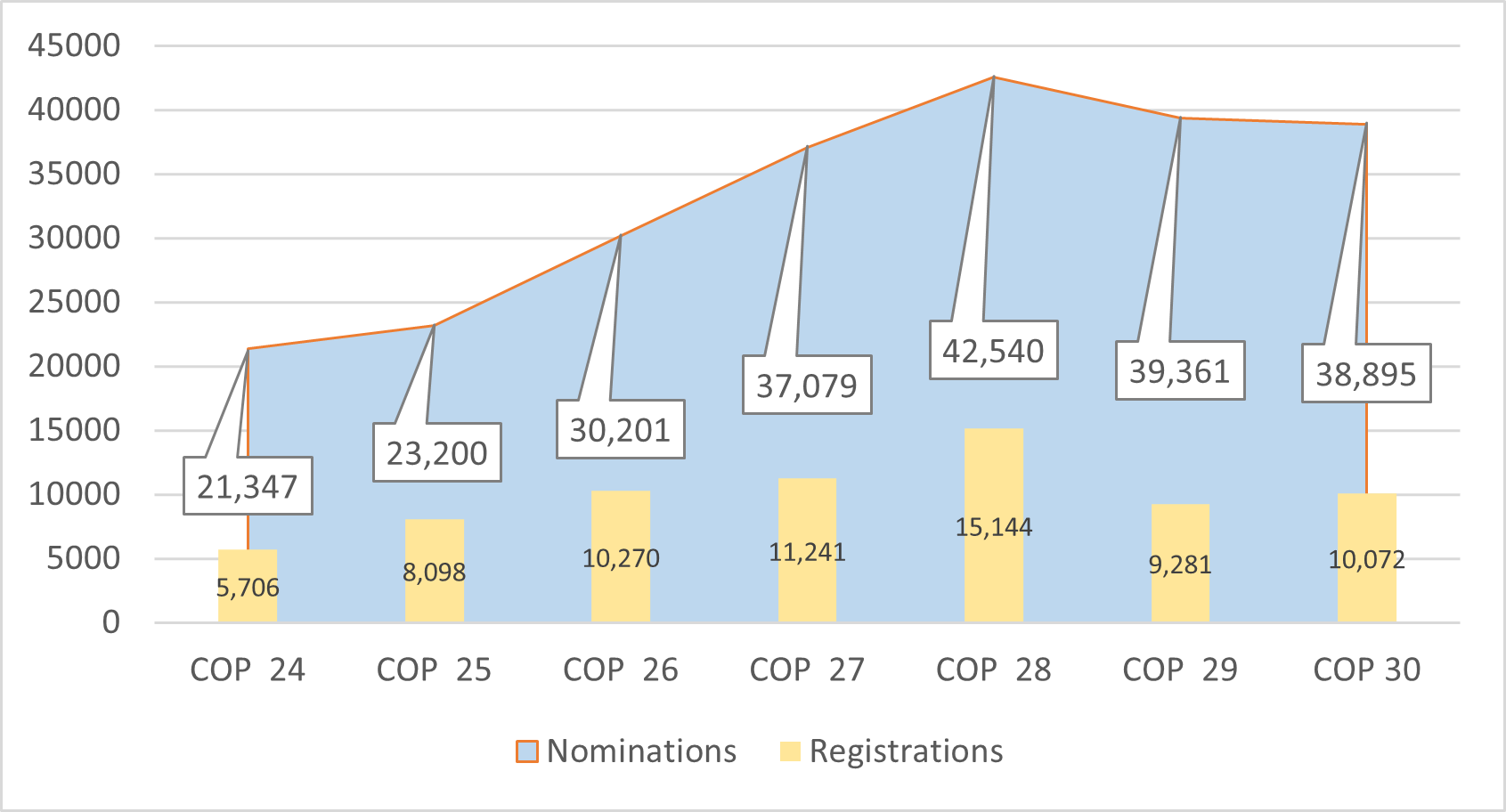
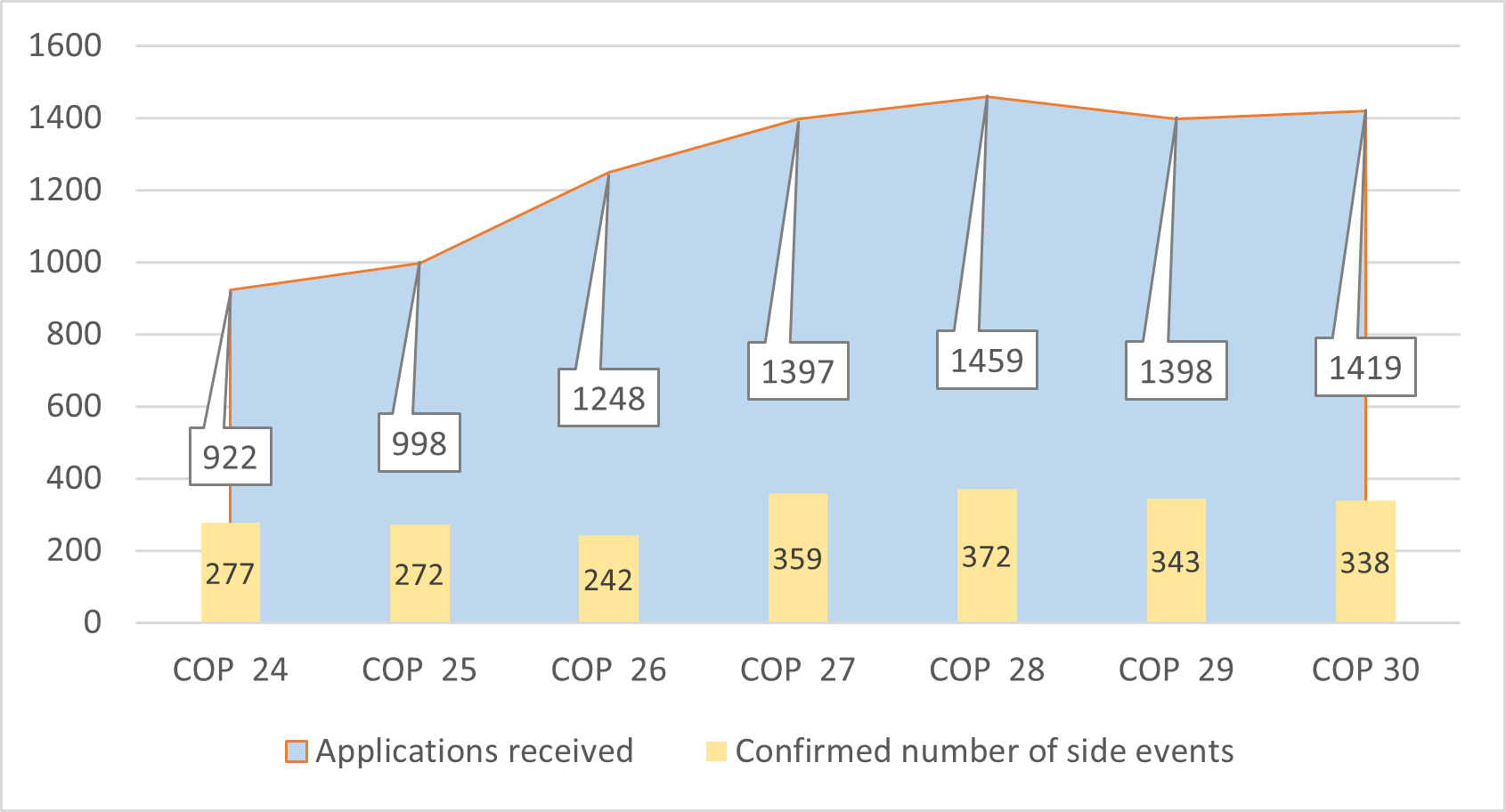
The secretariat enabled inclusive and impactful climate action by supporting the COP 30 Presidency, the climate high-level champions and the Marrakech Partnership for Global Climate Action; strengthening non-Party stakeholder engagement; and translating the outcomes of global negotiations into regional and sectoral action (see table 2). Work focused on supporting the development of the five-year vision for the Global Climate Action Agenda 2026–2030, holding high-visibility events, facilitating the engagement of observer organizations in the UNFCCC process in a context marked by continuously high demand for participation (see figures 1 and 2) and ensuring large-scale stakeholder participation in GCA to ensure inclusivity and representation of diverse perspectives. The secretariat also initiated the redevelopment of the GCA portal with the aim of enhancing its functionality as a reliable central repository of climate action data from non-Party stakeholders related to mitigation, adaptation, resilience and means of implementation.

Figure 1: Registrations compared to nominations of observer organizations (excluding United Nations organizations)

Registrations compared to nominations of observer organizations (excl. UN system)
Credit: UNFCCC

Figure 2: Side event applications compared to confirmed side events

SE COP
Credit: UNFCCC

To support the development of the new gender action plan,1 the secretariat conducted two technical workshops and supported the engagement of Parties and observers at those workshops. This work led to the adoption at the Belém Conference of the Belém gender action plan for 2026–2034, designed to drive sustained, long-term and gender-responsive climate policy and action at all levels.

The secretariat supported the integration of ACE into the work of constituted bodies and work programmes, enhancing coherence of efforts and coordinated action. Activities included delivering events, supporting ACE national focal points and stakeholders in fostering public engagement and empowerment through the ACE toolbox. The secretariat also delivered events aimed at building the leadership skills of children and youth and facilitating their meaningful engagement in climate policymaking and action; in this context it provided support to the COP 29 and 30 Presidency youth climate champions.

The secretariat’s communications served as the primary source of information for Parties, stakeholders and the public, enabling them to follow the UNFCCC process and engage in climate action effectively amid growing challenges of disinformation. For example, it produced global press releases in all United Nations official languages for key products, news articles, speeches and digital products, distributing them on the UNFCCC website and via social media channels. It also facilitated interviews and press briefings and made press conference facilities available to Parties and observer organizations during sessions, supporting engagement in the UNFCCC process.

The RCCs provided coordination support and expert contributions to more than 300 capacity-building events; provided technical assistance in relation to NDCs, long-term low-emission development strategies, operationalizing Article 6 of the Paris Agreement, and transparency- and adaptation-related matters; and developed over 90 knowledge products. In addition, they facilitated regular meetings among regional partners to coordinate work on NDCs, Article 6 and adaptation, and strengthened their involvement in the work of United Nations Issue-based Coalitions on Climate Change and Resilience across the regions covered by the RCCs (Asia and the Pacific, Caribbean, East and Southern Africa, Latin America, Middle East and North Africa and South Asia, and West and Central Africa), including by providing capacity-building sessions for resident coordinators and development cooperation offices. Furthermore, the RCCs continued mapping Parties’ gaps and needs by gathering data from regular consultations with national focal points and other contact points established under the Convention and the Paris Agreement.

1 As per decision 7/CP.29, paragraph 13.

Table 2 Highlights in the delivery of inclusive and impactful climate action in 2025

Theme/Area of work 2025 Delivery Highlights
GCA and engagement of non-Party stakeholders

The COP 30 Presidency and climate high-level champions were supported in developing the five-year vision for the Global Climate Action Agenda 2026–2030; a high-level event on GCA was held; the Yearbook of Global Climate Action 2025 was published; efforts began to redevelop the GCA portal; more than 4,000 observer organizations had been admitted to the UNFCCC process as at 31 December 2025; and support was provided for 123 side events at SB 62, 338 side events at the Belém Conference, 100 exhibits engaging observer organizations and 126 advocacy actions organized by observer organizations


Social inclusion, just transition and community engagement

A global dialogue was delivered on integrating response measures into NDCs; technical papers, case studies, an e-learning module and tools were produced; support was provided for the adoption of the Belém gender action plan for 2026–2034; accessibility measures were implemented at SB 62 and COP 30; mandated and other activities and events were held under the ACE Hub and Youth4Capacity initiative; support was provided for the Presidency youth climate champions; and work under the Baku Workplan of the Local Communities and Indigenous Peoples Platform was advanced at knowledge holder gatherings and youth round tables

Provision of timely and factual information

The UNFCCC social media channels had a combined 3.57 million followers as at 31 December 2025; more than 200 journalists were accredited for SB 62 and more than 3,900 for COP 30; press conferences and key events were livestreamed and made available on demand; support was provided for ensuring global participation; media advisories, daily schedules and summary materials were disseminated to support accurate and timely reporting; and the functionality of the UNFCCC website was improved, with an AI-powered document finder piloted

Digital and data systems

Digital transformation and modernization advanced through deployment of the interim registry for the Article 6.4 mechanism; the Initiative Self‑Service Portal, which allows users to raise and track system-related issues, was delivered as part of the redevelopment of the GCA portal; the initial version of the UNFCCC Climate Data Hub was launched; and legacy systems were decommissioned

1 As per decision 7/CP.29, paragraph 13.

Detailed Overview

Global climate action gained momentum, with the secretariat supporting the COP 30 Presidency, the Climate High-level Champions and the Marrakech Partnership for Global Climate Action (GCA) in engaging with non-Party stakeholders on accelerating implementation, in particular in developing the five-year vision for the Global Climate Action Agenda for 2026-2030, which structures the Climate Action Agenda along the six axes of the agreed GST. At COP 30, the secretariat helped provide a platform for cities, regions, businesses, investors, and civil society groups to collaborate on and showcase practical climate solutions, as captured in the outcomes report on the Global Climate Action Agenda at COP 30. In addition to delivering the high-level GCA event at COP 30, the secretariat also published the Yearbook of Global Climate Action 2025, which presents progress made in climate action since 2015 and in recent years, as well as progress on a set of indicators proposed to keep track of future advances.

Furthermore, the redevelopment of the GCA portal was initiated, helping to enhance transparency among NPS, track progress toward climate commitments, and strengthen recognition of leadership in implementation across states, regions, cities, businesses, and civil society.

Engagement of observers in the UNFCCC process remained high, and critical for ensuring inclusivity and representation of diverse perspectives. By year-end, more than 4,000 organizations had been admitted, reflecting strong global commitment to climate solutions. While the secretariat made efforts to improve the geographical balance of admitted organizations, imbalance persists. As recognized by Parties as an essential part of the UNFCCC process4 , the secretariat also facilitated 123 side events at SB 62; and 338 side events and 100 exhibits at COP 30, engaging more than 1,600 Parties and observer organizations and exploring a wide range of climate topics, including perspectives on gender, Indigenous Peoples and youth leadership; as well as 126 advocacy actions organized by admitted observer organizations.

The secretariat continued to lead empowerment initiatives that foster inclusive climate action by and for all. Following the extension of the enhanced Lima work programme at COP 29, and the decision to initiate the development of a new gender action plan, the secretariat delivered two highly interactive technical workshops. In addition, the secretariat supported Parties’ and observers’ engagement in the process through multiple formats including regional workshops, trainings, information sessions, informal networking meetings and convenings that allowed technical level discussions, coordination and trust building. This led to the adoption at COP 30 of the Belém gender action plan for 2026-2034 , designed to drive sustained, long-term gender-responsive climate policy and action at all levels.

Work on Action for Climate Empowerment (ACE), including through convening the annual ACE Dialogue 2025 and the COP 30 Presidency ACE Event, contributed to fostering public engagement and empowerment by promoting integration of ACE across the work of constituted bodies, enhancing climate policy coherence and coordinated action at all levels, and counteracting mis- and disinformation in support of information integrity. Activities delivered under the ACE Hub were instrumental in strengthening national ACE focal points and showcasing the role of subnational governments and other key stakeholders in advancing just transitions through the ACE toolbox. Additional events aimed at strengthening children and youth leadership through building capacities, knowledge, and skills were delivered under the ACE Hub and Youth4Capacity projects. The secretariat also supported to the COP 29 and COP 30 Presidency Youth Climate Champions (PYCCs) by providing strategic advice to help develop their workplans, support their stakeholder engagement, and organize including through its RCCs in-person and virtual global and regional events to facilitate the meaningful engagement of children and youth in climate policy and action.

The secretariat’s communications sub-division served as a primary source of information for Parties, stakeholders and the public, enabling them to follow the process and engage in climate action effectively, amid growing challenges of disinformation and the call for upholding information integrity on climate change. This was achieved by producing communication materials, including global press distributions in all UN languages around key products such as synthesis reports, news articles, speeches, science-based explainer content, multimedia assets, social media content and digital product on the UNFCCC website and social media accounts, with 3.57 million followers across channels.

Enhanced website functionalities and the successful piloting of an AI-powered document finder helped improve accessibility of timely and factual information about the UNFCCC process and sessions, with a feedback survey showing high rates of user satisfaction.

To ensure equitable access to news media from around the world, the secretariat facilitated interviews, press briefings, spokesperson engagement and rapid clarification of factual matters throughout the year. The secretariat accredited more than 200 journalists during SB 62 and more than 3,900 journalists during COP 30. The secretariat also supported both in-person and virtual engagement at those sessions, including making press conference facilities available to all Parties and observer organizations. Press conferences and key events were livestreamed and made available on demand, supporting global participation across time zones. Media advisories, daily schedules and summary materials were disseminated to support accurate and timely reporting.

The RCCs continued to foster ambitious and inclusive climate action at the regional level, by (co-)organizing and supporting over 300 capacity building events and the producing over 90 knowledge products spanning across focus areas (e.g., NDCs and LT-LEDs, Article 6 of the Paris Agreement and Adaptation, etc.). In doing so, they collaborated with over 70 UN entities and other organizations. In addition, they strengthened coordination with the UN system, through participation in the UN Issue Based Coalition on Climate Change and Resilience.


1 FCCC/SBI/2014/8, paragraph 224

Financial performance, organizational readiness and resilience

Summary

Financial management remained sound in 2025, with expenditure in line with approved funding. In 2025, Parties agreed to increase the core budget for the biennium 2026–2027 to EUR 81.5 million, a 10 per cent increase compared with the budget for the biennium 2024–2025, underscoring the need for a well-resourced secretariat. At the same time, the United Nations Board of Auditors issued an unqualified audit opinion on the 2024 financial statements, confirming sound financial management. The secretariat also implemented 67 per cent of pending audit recommendations from the United Nations Board of Auditors and issued its first statement on internal control.

Core budget expenditure was in line with approved funding, while Party and non-Party stakeholder contributions towards supplementary activities were at 97 per cent of the annual voluntary contribution level, reflecting strong support. Sustained and predictable funding will remain critical as the secretariat implements its increasing workload, including activities relating to the Belém Political Package, the ETF and operationalization of Article 6 of the Paris Agreement.

Core budget contributions for 2025 amounted to EUR 25.9 million, of which EUR 10.4 million was outstanding as at 31 December 2025. Voluntary contributions remained essential, with EUR 37.2 million received for supplementary activities and EUR 3.7 million as support for participation in the UNFCCC process, of which 68 per cent was provided by Parties and 32 per cent by non-Party stakeholders. Governments that provided voluntary contributions (see figure 3) to the secretariat in 2025 include those of Australia, Azerbaijan, Belgium, Canada, China, Denmark, Finland, Germany, Ireland, Italy, Japan, the Kingdom of the Netherlands, Monaco, Norway, Portugal, the Republic of Korea, the Russian Federation, Saudi Arabia, Singapore, Spain, Sweden, Switzerland and the United Kingdom of Great Britain and Northern Ireland, and voluntary contributions were also received from the European Union. Hosting over 20 events and more than 1,000 participants, the UNFCCC pavilion at the United Nations Climate Change Conference in Belém provided a collaborative space for fostering partnerships and identifying resource mobilization opportunities.

Figure 3: Party Funders by Contributions in Fiscal Year 2025

Party Funders by Contributions in Fiscal Year 2025
Credit: UNFCCC

The secretariat maintains a diverse and balanced workforce that is representative of the Parties it supports. As at 31 December 2025, the secretariat’s workforce comprised 457 staff (430 fixed-term and 27 temporary staff), of which women accounted for 58 per cent and men for 42 per cent. Gender balance was achieved at the Director level and above. Overall, 55 per cent of staff were from Parties included in Annex I to the Convention and 45 per cent from Parties not included in Annex I to the Convention, while 66 per cent of staff held Professional level positions and 34 per cent General Service level positions. The secretariat carried out its functions with the support of interns, consultants, individual contractors and junior professional officers.

The secretariat’s organizational readiness was strengthened through measures aimed at modernizing the workforce, streamlining administrative processes, upgrading digital systems and cybersecurity arrangements, and implementing organizational culture initiatives designed to boost collaboration, accountability and people-centred practices.

The secretariat provided support for large-scale events, including sessions of the governing and subsidiary bodies. For smaller events, a unified digital registration system streamlined accreditation, scheduling, logistics and travel processes, while hybrid events were grouped around specific days in order reduce scheduling clashes and broaden access. On the operations front, more than 540 purchase orders were processed, and the UNFCCC digital archives platform published more than 60,000 pages and 5,000 hours of audio and video materials, strengthening transparency and institutional memory. Moreover, the secretariat offset the GHG emissions of 16 United Nations organizations through the purchase and cancellation of certified emission reductions under the Adaptation Fund.

Innovation and digital transformation continued to shape the secretariat’s work, with the organization focusing on reliable operation and gradual modernization of its digital services, including the decommissioning of outdated or unsupported infrastructure and applications and their replacement with modern solutions. Digital transformation progressed through deployment of the Article 6.4 mechanism, enhancements to reporting and review tools under the ETF and the first phase in the development of the UNFCCC Climate Data Hub. Organization-wide actions focused on implementing priority cybersecurity measures, developing initial governance arrangements and guidance for AI tools, modernizing legacy platforms or decommissioning those being replaced by newer digital products, consolidating user and access management services in order to provide easier and more secure access to all relevant secretariat systems through a single log in, and making targeted enhancements to web platforms to improve access to information. At the same time, continuously enhancing the UNFCCC website and other digital content remained a priority, promoting engagement with a wide audience and improving access to information.

​The secretariat’s organizational culture is anchored in the United Nations values of integrity, humility, inclusion and humanity, and upheld through governance that promotes accountability, co-creation of internal and external approaches and ways of working to strengthen efficiency and people-centred practices. Externally, these standards are reinforced by the Code of Conduct for UNFCCC Events, which sets out a zero-tolerance approach to harassment and discrimination in order to ensure respectful and safe interactions among Parties and non-Party stakeholders. The secretariat advanced implementation of digitally enabled, innovative and evidence-informed ways of working within the organization, supported by measures aimed at workforce upskilling, leadership development, inclusive decision-making and continuous learning. Together, these measures strengthen adaptability, reduce institutional risk and enhance readiness to meet increasing implementation demands associated with supporting Parties’ work under the UNFCCC process.

Detailed Overview

The secretariat mobilized voluntary financial contributions for the Trust Fund for Supplementary Activities (TFSA) and the Trust Fund for Participation (TFP) from over 24 Parties, including 18 Annex I Parties and 5 Non-Annex I Parties. The secretariat also secured voluntary financial and in-kind contributions from over nine non-Party stakeholders, including academic institutions, intergovernmental organizations, non-governmental organizations, private sector entities, philanthropic organizations and United Nations partners. These contributions are essential to enabling the delivery of the mandated and operational activities of the secretariat, reflecting coordinated engagement efforts across the secretariat.

Figure 4-5: Distribution of contributions received in 2025 for the Trust Fund for Participation (TFP) and Trust Fund for Supplementary Activities (TFSA) and distribution of Party/Non-Party funding in 2025

Distribution of contributions received in 2025 for the Trust Fund for Participation (TFP) and Trust Fund for Supplementary Activities (TFSA) and distribution of Party/Non-Party funding in 2025
Credit: UNFCCC

During the same period, the secretariat advanced a more integrated and data driven approach by introducing two internal tools – Resource Mobilization Dashboard and an internal partnership management tool, providing consolidated visibility of funding, pipelines and partnerships to support strategic planning, outreach and oversight. Both tools were developed in house supporting ongoing efforts to strengthen internal efficiency and delivery.

The secretariat continued to serve as custodian of the official UNFCCC Pavilion at COP 30, which evolved into a strategic platform for Parties, partners and the secretariat to showcase climate action, foster partnerships and support implementation. Hosting over 20 events and welcoming more than 1,000 participants, the Pavilion enabled targeted networking and bilateral exchanges, reinforcing the secretariat’s role as a convener and catalyst for collaborative climate action.

The secretariat advanced efforts to strengthen workforce resilience, modernize Human Resources (HR) processes and systems, and prepare the UNFCCC HR Strategy 2030 through a structured governance and consultation process. Modernization continued through enhanced HR analytics, digitalized lifecycle processes, and integration of leadership indicators to reinforce accountability and evidence-based decision-making.

HR operations enhanced efficiency and service quality, delivering 54 capacity-building courses and a leadership and coaching programme to over 120 managers, and timely support to 450 staff during performance management. Recruitment time fell to 93 days, while over 1,300 HR inquiries were addressed. In strengthening the regulatory framework, 28 policies were issued to improve clarity and ensure alignment with Secretariat needs.  

The transition to an electronic filing system for Official Status Files marked a major step toward full digitalization, improving data access, security and compliance. The Benefits and Entitlements and Protocol services modernized workflows, supported 257 consultants, and advanced institutional updates to key procedural documentation.

Administrative and operational support to the secretariat’s programmatic work was further strengthened. The division managed over 540 purchase orders , including key tenders for Article 6 information systems and the UNFCCC events digital platform. Support for funded participation was streamlined through prepaid card systems and the introduction of a unified registration platform (Indico) for all official UNFCCC events other than the COP and SB sessions.

The secretariat also continued reducing its environmental footprint by offsetting 762 kilotonnes of CO2 equivalent emissions from the previous year, including those of 16 other UN system organizations, through the purchase and cancellation of Adaptation Fund CERs.

The secretariat’s Archives and Records Management function safeguards the permanent historical records of the UN climate change negotiation process and institutional activities. The UNFCCC Digital Archives, launched in late 2024 as the official online repository of the secretariat’s institutional memory with further expansion planned. The collection includes key documentation from the Convention, Kyoto Protocol and Paris Agreement, as well as COP statements, plenary recordings and official credentials. By making these material openly accessible and ensuring their long-term preservation through a dedicated digital system, the Digital Archives strengthens transparency and accountability while providing essential historical context to support informed climate action.

Innovation and digital transformation continued to shape the secretariat’s work, with the organization focusing on the reliable operation and gradual modernization of its digital services, including the decommissioning of outdated or unsupported infrastructure and applications and their replacement with modern solutions.

Throughout the year, the secretariat supported key programme priorities through continued development of digital systems for the Article 6.4 mechanism, including the PACM system, and by providing technical governance for the procurement of the Article 6 registries. Progress was also made on enhancing reporting and review tools under the Enhanced Transparency Framework, launching the Initiative Self‑Service Portal to support non‑Party stakeholders, and releasing the first versions of the Climate Data Hub, improving access to and use of transparency‑related data.

The consolidation and use of data within the CRM platform, serving as an authoritative source for actors and stakeholder interactions, remained a core pillar of the secretariat’s digital strategy. At the same time, the continuous enhancement of the public website and its digital offerings remained a priority for engaging with the wider audience and improving access to information.

In parallel, secure digital platforms, virtual participation solutions, scalable infrastructure, and a new document publication system for in‑session documents supported COP30 and the SB sessions, significantly improving performance and accessibility. Infrastructure services were enhanced and optimized, the UN Global Service Centre (UNGSC) was onboarded as the new infrastructure services provider, work progressed on the design of a Digital Modern Workplace, and user management services were further enhanced to support both Party and non‑Party users through a centralized and secure access point to secretariat applications.

Complementing these efforts, priority cybersecurity measures were implemented, and initial governance and guidance for the responsible use of artificial intelligence tools were established. However, there remains a need for more sustained and deeper action in these areas.
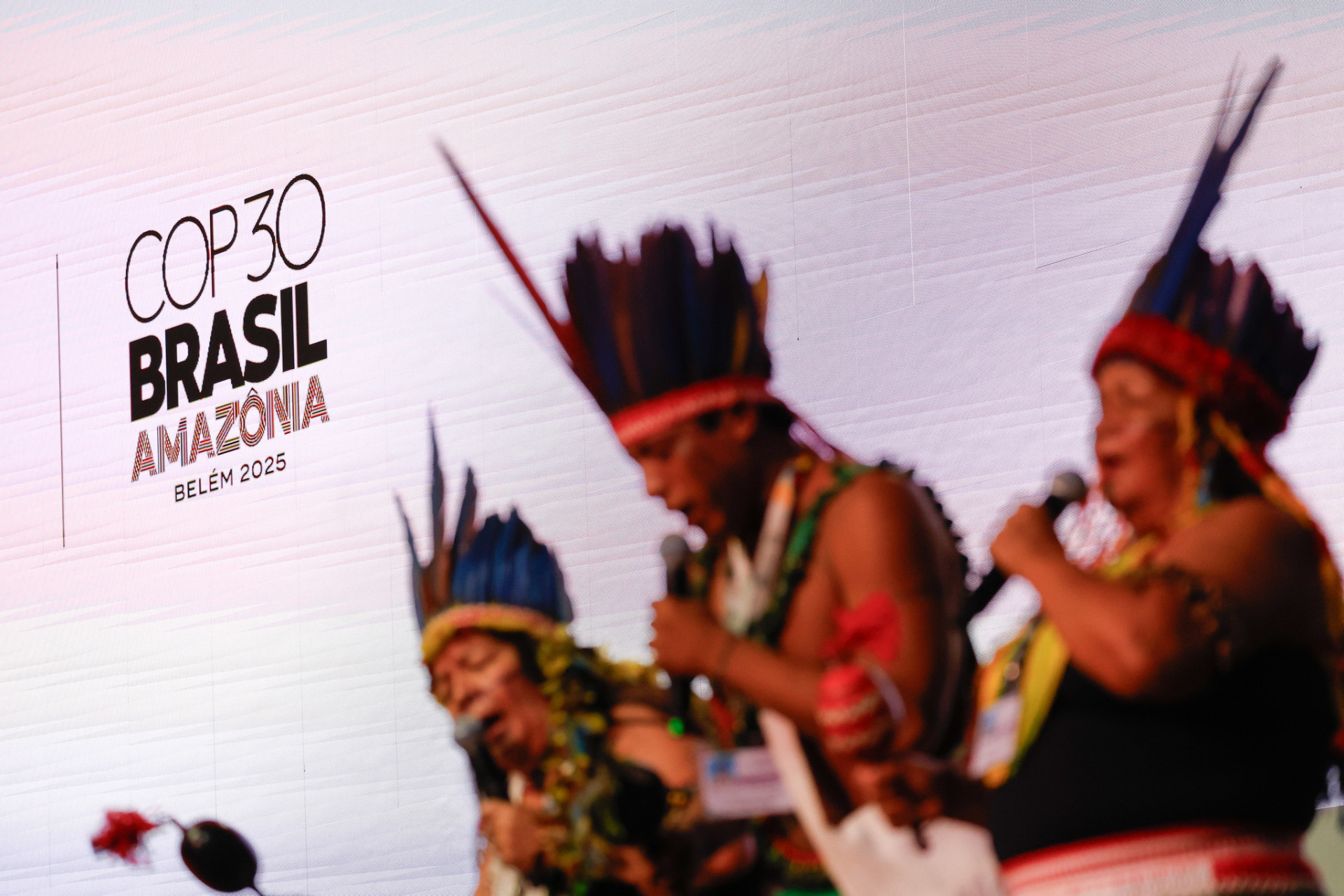


Additional information
ACE Action for Climate Empowerment
AI artificial intelligence
Article 6.4 mechanism mechanism established by Article 6, paragraph 4, of the Paris Agreement
BTR biennial transparency report
CMA Conference of the Parties serving as the meeting of the Parties to the Paris Agreement
COP Conference of the Parties
ETF enhanced transparency framework under the Paris Agreement
GCA global climate action
GCA portal global climate action portal (NAZCA)
GHG greenhouse gas
IPCC Intergovernmental Panel on Climate Change
KCI Katowice Committee of Experts on the Impacts of the Implementation of Response Measures
MRV measurement, reporting and verification
NAP national adaptation plan
NDC nationally determined contribution
PCCB Paris Committee on Capacity-building
RCC regional collaboration centre
REDD+ reducing emissions from deforestation; reducing emissions from forest degradation; conservation of forest carbon stocks; sustainable management of forests; and enhancement of forest carbon stocks (decision 1/CP.16, para. 70)
SB sessions of the subsidiary bodies
SCF Standing Committee on Finance
TEC Technology Executive Committee
TT:CLEAR technology information clearing house


DISCLAIMER

The information contained in this report is provided by the secretariat in fulfilment of its reporting functions. It does not reflect, prejudge, or represent the views, positions, or decisions of Parties under the Convention, the Kyoto Protocol, or the Paris Agreement.

At-a-Glance
Work Programme Area

Scope of Work in 2025

Advanced GGA work; supported NAPs; LCIPP; strengthened regional adaptation support.

Summary of Activities

Work under the UAE-Belém work programme, technical guidance, NAP workshops, NAP Expos, support adaptation- and loss and damage-related constituted bodies and work programmes, enhanced stakeholder engagement, including local communities and Indigenous Peoples, and support to adaptation-related elements of the enhanced transparency framework.

Scope of Work in 2025

PCCB negotiations & mandate implementation

PCCB Network coordination & delivery

Capacity-building programmes (fellowships & youth engagement)

Communications & outreach initiatives.

Summary of Activities

Convening of 9th PCCB meeting and adoption of 2025–2029 workplan, activities aligned with 2025–2026 focus area on holistic investment strategies and bankable projects for NDC and NAP implementation, organization of 14th Durban Forum and Focus Area Day, delivery of 7th Capacity-building Hub at COP 30

Facilitation of five PCCB Network webinars, launch of Energy Cluster, coordination of dedicated capacity-building initiatives, strengthened collaboration among Network members and partners

Implementation of Fellowship Capacity Award Programme (five SIDS and LDC fellows), delivery of Youth4Capacity webinars, youth engagement events at SB 62 and COP 30, launch of Climate Catalysts Mentorship Programme with UNDP Youth4Climate

Launch of Language of Climate Action campaign.

Scope of Work in 2025

Supported the intergovernmental process on climate finance matters

Supported the implementation of the SCF’s mandates

Supported the work related to Article 9.5

Supported the implementation of the Sharm el-Sheikh Dialogue

Supported the CMA 6 and CMA 7 Presidencies in delivering the Baku to Belém Roadmap to 1.3T

Acted as an interim secretariat of the Fund for responding to Loss and Damage;

Supported the work on the Needs-based Finance (NBF) and FINCOAHN.

Summary of Activities

7 agenda items under COP 30, 7 agenda items under CMA7, 1 agenda item under CMP20, 2 agenda items under SBs62, and 2 agenda items under SBs63; Third Biennial High-Level Ministerial Dialogue on Climate Finance under the CMA (Article 9.5 of the Paris Agreement)

SCF meetings; Background papers and  reports of the SCF meetings;  SCF Forum and summary report; draft guidance to the operating entities; Annual report of the SCF to COP and CMA;

Summary report of the second HLMD on climate finance under CMA; Third biennial in-session workshop and its summary report;

Compilation and synthesis of the third biennial communication; Third HLMD on climate finance under the CMA

Workshops and their summary reports;  

Co-Chairs’ annual report to CMA;

Virtual and in-person consultations; Catalogue tool of initiatives, concepts and best practices; and Report on the Baku to Belém Roadmap to 1.3T;

Preparatory work for Board meetings; Report of Board meeting and the annul report of the Board to COP and CMA;

Bridging the Gap: Making Climate Finance Work for the Underserved – Climate finance for LDCs and SIDS facing conflict and severe humanitarian needs (FINCOAHN) — Rome, Italy;

Pan-African Needs-Based Climate Finance Market Place (East, West, and Southern Africa) — Addis Ababa, Ethiopia;

Capacity-building for accessing finance — Addis Ababa, Ethiopia;

Consultation Meetings at SB62 — Bonn, Germany;

Organization of Eastern Caribbean States (OECS) Needs Based Finance Investment Forum — Grenada;

FINCOAHN Inception Meeting — Abu Dhabi, United Arab Emirates.

Scope of Work in 2025

Secretariat overall support on matters related to technology development and transfer and innovation

Supported the work of the Technology Mechanism, particularly the TEC

BTIP support

CTC mandate and hosting

AI for Climate Action

TNA.

Summary of Activities

Support to intergovernmental negotiations on technology (16 negotiations items under SBI/SBSTA 62-63 and COP30/CMA7), communications and outreach efforts, knowledge and information sharing (e.g. via TT:CLEAR), global convening (e.g. Technology Lab at Panama Climate Week), resource mobilization and partnership

Support to Technology Mechanism and TEC rolling workplan implementation, convening TEC and joint sessions with CTCN Advisory Board, inputs to SCF and Financial Mechanism processes, engagement in regional NDE forums, contribution to over 10 UNFCCC and partner events, facilitation of TEC participation in 15+ invited events, policy recommendations on buildings and AI, guidance on TNA for renewable energy with just transition aspects, inter-agency cooperation and partner-supported activities

Supporting intersessional work and negotiations towards the adoption of the Belém Technology Implementation Programme

Extension of Climate Technology Centre mandate to 2041 with revised functions, initiation of CTC hosting process

Inaugural Forum on Artificial Intelligence for Climate Action, global open-source AI contest, TEC policy recommendations on AI

Supporting the implementation of the Global TNA Project, organization of TNA-focused eventsadvancing TNAs for NDC 3.0 implementation at the margin of session, maintaining TNA information on TT:CLEAR.

Scope of Work in 2025

Advanced gender, ACE, children and youth, Indigenous Peoples, and stakeholder engagement, as well as the Sharm el-Sheikh joint work on implementation of climate action on agriculture and food security (SJWA)

Delivered Climate Weeks; and other NPS.Engaged NPS to recognize their climate targets and actions through the NAZCA portal.

Summary of Activities

Delivery of activities related to gender, Action for Climate Empowerment, and children and youth, e.g., events, guidance products, knowledge products, communication and outreach products, in-session and regional workshops and trainings, support to national Gender and Climate Change and ACE national focal points, capacity building and training sessions, information sessions for Party and non-Party stakeholders, networking sessions, elaboration of the annual summary report in implementing activities under the Glasgow work programme on Action for Climate Empowerment, support to the Presidency Youth Climate Champions.

Facilitation of the engagement and participation of observer organizations, including admission of new observer organizations, facilitation of side events and exhibits, and capacity building for observer organizations.

Support to the Climate High-Level Champions and the Marrakech Partnership for Global Climate Action (GCA) in engaging with non-Party stakeholders, delivery of Global Climate Action events and the Yearbook of Global Climate Action, highlighting climate action underway around the world

Provision and communication of timely and relevant information to Parties, non-Party stakeholders and the public, on the UNFCCC process and climate change, in all UN languages for key content, and delivery of media outreach and products including speeches, press releases, editorials, statements, interviews, videos and web briefings, and social media posts.

SJWA activities: Publication of the first annual synthesis report, organization of the first in-session workshop, publication of the workshop report, and operationalization of the Sharm El-Sheikh online portal.

Initiated the redevelopment of the NAZCA portal.

Scope of Work in 2025

GST, JT, synergies, other Support to the intergovernmental process and negotiations on matters related to the global stocktake (GST), including in relation to modalities of the United Arab Emirates (UAE) dialogue on implementing the GST outcomes; reports on the annual GST dialogue; and procedural and logistical elements of the overall GST process.

Summary of Activities

Organization of annual GST NDC Dialogue at SB62.

Support to 2 joint SB items (procedural and logistical elements of the overall GST process, and UAE dialogue) and 1 CMA item (GST NDC Dialogue).

Scope of Work in 2025

Supported the intergovernmental process on the mitigation, including on the mitigation work programme and emissions from fuels used for international transport

Supported the implementation of the Sharm el-Sheikh mitigation ambition and implementation work programme

Provided analytical inputs to the NDC Synthesis Report

Supported the intergovernmental process on Article 6 of the Paris Agreement.

Summary of Activities

Support to 1 joint SB item (MWP, 1 SBSTA item (bunkers) and 1 CMA item (MWP). Organisation of the HLMRT on pre-2030 ambition

Support to the MWP co-chairs; Organization of 2 global dialogues and 2 investment focused events under the MWP; Publication of two summary reports and one annual report under the MWP

Analytical work on domestic mitigation measures and aggregate effect of NDCs

Support to 1 SBSTA item (Art. 6.8) and 3 CMA items (Art. 6.2, 6.4 and 6.8)

Organization of two dialogues on among interested participating Parties and observers to exchange information on and experience in how cooperative approaches in which they participate support ambition

Organization of GCNMA 7 and 8, including an in-session workshop at each meeting, organization of two spin-off groups to support focused exchanges and preparation of two in-session workshop reports

Intersessional capacity-building on Art. 6.8 delivered through webinars, and bilateral and regional support.

Scope of Work in 2025

Facilitate the preparation of first BTRs by supporting developing countries; advanced reporting methodologies; continued BTR technical expert reviews (TERs) and initiated Facilitative Multilateral Consideration of Progress (FMCP); prepared the first-ever BTR synthesis report; developed reporting and review systems and tools.

Summary of Activities

Delivered 47 BTR reviews; completed simplified reviews of GHG national inventory reports by 42 Annex I Parties; held two sessions of FMCP; developed the first BTR synthesis report, including awareness-raising activities to disseminate its key messages; delivered technical support activities - 21 in-person (739 experts from 118 countries) and 18 virtual (2110 experts from 135 countries) - to help developing countries fast-track the preparation of their first BTRs and GHG inventories; certified over 1,300 experts to participate in the TER process; delivered one hands-on training for the Africa region, 3 Q&A sessions and 6 ETF clinic sessions, and additionally produced almost 30 tutorial videos, to support Parties in the use of the ETF reporting tools; delivered 45 events under the #Together4Transparency initiative at SB 62 and COP 30, including 11 mandated events on BTR preparation and ETF implementation; engaged high-level Party representatives and different stakeholder groups (including private sector, civil society, youth, academia, etc,) to participate in the implementation of the ETF and maintain political momentum,; supported countries to carry out REDD+ technical analyses; launched a REDD+ Community of Practice, as a dedicated platform for REDD+ countries, donors, and stakeholders to systematically share experiences and lessons learned; advanced the development of the Climate Data Hub, a centralised platform with global climate data and information submitted by Parties and stakeholders, with AI components; developed needed tools to facilitate TERs of BTRs submitted by Parties, and the FMCP.

Plenary room at the Bonn Climate Meetings
Credit: UN Climate Change | Amira Grotendiek
COP 28 view of flags
Credit: UN Climate Change/Kiara Worth
Outlook
COP30 Stiell Do Lago
Credit: Rafa Neddermeyer/COP30 Brasil


"History will not ask what we intended. It will ask what we achieved."

Off

Outlook for 2026

In 2026, the secretariat will focus on advancing the implementation of activities under the UNFCCC process by strengthening its provision of technical, institutional and procedural support to Parties and enhancing coordination across core thematic and governance areas. Its efforts will aim to facilitate more integrated delivery, improved access to data and digital systems, strengthened transparency and financial processes, and continued support for long-term planning and implementation cycles. It will also work to reinforce regional engagement, accelerate cooperation across UNFCCC workstreams and enhance institutional readiness to meet rising implementation demands.

Looking ahead

The 2025 Climate Weeks established a basis for 2026, confirming the value of a more focused and participatory format linked to real‑economy outcomes. In 2026, the approach will continue with emphasis on connecting international negotiations to national and local implementation. The first Climate Week will take place in Yeosu, Republic of Korea, from 21–25 April, and the second in Baku, Azerbaijan, from 7–11 September. Both events will advance mandated work, strengthen collaboration, and highlight scalable solutions that help ensure climate agreements deliver tangible benefits for people, businesses, and communities. More information will be available on the UNFCCC Climate Weeks page.

In response to decision 1/CMA.7, the secretariat and its RCCs, working together with regional and international support programmes, as well as bilateral and multilateral agencies, will organise peer exchange workshops, including at climate weeks, to facilitate the sharing of knowledge and good practices in relation to the preparation and implementation of NDCs, drawing on the reports on the annual global stocktake dialogue. In collaboration with the NDC Partnership and UNDP’s Climate Promise: Forward initiative and other partners, the secretariat and its RCCs will work to improve cohesiveness and continue to catalyse delivery of technical assistance and support to developing country Parties to facilitate their preparation and implementation of NDCs.

As Parties move into the post‑COP30 implementation phase, advancing delivery on NDCs and Long‑Term Low‑Emissions Development Strategies (LT‑LEDS) becomes essential to translate political signals into sustained mitigation outcomes. Building on the analytical foundations, direct country‑support projects and capacity systems established in 2025, the efforts will focus on ensuring stronger alignment between short‑term NDC commitments and long‑term transformation pathways. This includes deepening support for regulatory coherence, sectoral modelling and investment planning, while strengthening the LT‑LEDS knowledge hub, policy repositories and tracking tools that help countries integrate long‑term trajectories into NDC cycles. Through enhanced UNFCCC RCCs engagement, expanded technical assistance and improved data systems, the engagement will help Parties operationalize NDC–LT‑LEDS linkages as actionable implementation pipelines—turning long‑term vision into near‑term delivery and reinforcing the foundation for credible 2030‑aligned progress.

NDCs: Enhancing coordinated support for preparation and implementation

The secretariat will strengthen support for the preparation and implementation of nationally determined contributions (NDCs). In partnership with regional collaboration centres, bilateral and multilateral agencies, and regional and international support programmes, the secretariat will convene targeted peer‑exchange workshops—including at regional climate weeks—to promote knowledge sharing and good practices informed by the Global Stocktake. Working with the NDC Partnership, the UN Climate Promise Forward initiative, and other partners, it will also enhance coherence and accelerate delivery of technical assistance to developing country Parties for effective NDC preparation and implementation.

As part of the Belém political package, Parties took note of the Roadmap, welcomed the efforts of the Presidencies and decided to urgently advance actions to enable the scaling up of climate finance to developing countries to at least USD 1.3 trillion per year by 2035.

The Belém political package also featured several elements setting up the architecture for Parties to deliberation on how to enhance climate finance delivery out to 2030 and beyond, including:

  • A newly established two-year work programme on climate finance, including on Article 9, paragraph 1, of the Paris Agreement in the context of Article 9 of the Paris Agreement as a whole. In 2026, the secretariat will support the Co-Chairs appointed by the CMA 7 Presidency in launching the work.  
  • The launch of the Veredas Dialogue on the implementation of Article 2, paragraph 1(c), of the Paris Agreement and its complementarity with Article 9 of the Paris Agreement, including the convening by the CMA 7 Presidency of the Xingu Finance Talks as an annual high-level round table facilitating cooperative exchange of views among Parties and non-Party stakeholders. In 2026, the secretariat will support the Presidency and the appointed Co-Chairs in launching the work 

In 2026, the secretariat will support the SCF in producing its flagship products, namely the seventh BA and third report on progress towards achieving the goal of mobilizing jointly USD 100 billion per year to address the needs of developing countries in the context of meaningful mitigation actions and transparency on implementations for consideration at COP 31. The secretariat will also support the SCF in preparing for the SCF Forum on financing climate action and water systems and the ocean, to be held in September, 2026. The secretariat will also support the SCF co-chairs in developing a strategic plan for approaching the preparation of the mandated reports due in 2028, including its eighth BA, the third report on the determination of the needs of developing country Parties related to implementing the Convention and the Paris Agreement, the fourth and final USD 100 billion progress report, the second report on the doubling of adaptation finance in line with paragraph 18 of decision 1/CMA.3 and the first biennial report on the NCQG.

The secretariat will continue to assist developing country Parties, implementing entities and affected communities by facilitating access modalities, improving information flows, supporting reporting arrangements and strengthening coordination with existing Financial Mechanism. This work is central to ensuring that the GCF, GEF and FRLD  deliver timely, needs based support to countries facing the most severe climate impacts.

In 2026, the secretariat will underpin the delivery of the Standing Committee on Finance’s (SCF) key mandated products, including the seventh Biennial Assessment and the third USD 100 billion progress report for COP 31. It will also support the development of a strategic plan guiding the suite of major SCF reports due in 2028 and prepare for the 2026 SCF Forum on financing climate action and water systems and the ocean.

Finance: Supporting SCF deliverables and strategic coherence

In 2026, the secretariat will underpin the delivery of the Standing Committee on Finance’s (SCF) key mandated products, including the seventh Biennial Assessment and the third USD 100 billion progress report for COP 31. It will also support the development of a strategic plan guiding the suite of major SCF reports due in 2028 and prepare for the 2026 SCF Forum on financing climate action and water systems and the ocean.

Parties adopted the Belém Technology Implementation Programme as part of the Belém Political Package. Together with the extended mandate and revised functions of the CTC, this represents a significant step-change in advancing technology implementation under the Convention and the Paris Agreement. The secretariat will continue to play a convening and catalytic role in this new chapter, including by supporting a reinvigorated Technology Mechanism, sustaining and elevating collaborative partnerships aligned with these mandates, and enhancing synergies and complementarities in climate technology efforts.

In 2026, the secretariat helps support the roll-out of the Belém Technology Implementation Programme, including through the provision of support to the TEC and the Technology Mechanism at large. The arrangements for the selection of the new host of the CTC are currently underway and expected to conclude by COP 31. Moreover, in 2026, with support from the secretariat, the report of the third independent review of the CTCN will be completed, and the second periodic assessment of the Technology Mechanism will be initiated.

Technology: Facilitating technology cooperation and support under the Paris Agreement 

In 2026, the secretariat helps support the roll-out of the Belém Technology Implementation Programme, including through the provision of support to the TEC and the Technology Mechanism at large. The arrangements for the selection of the new host of the CTC are currently underway and expected to conclude by COP 31. Moreover, in 2026, with support from the secretariat, the third independent review of the CTCN will be completed, and the second periodic assessment of the Technology Mechanism will be initiated.

With the first PACM methodology adopted, 118 DNAs established, and 155 experts participated in training course of the training programme for technical experts participating in Article 6 TERs in 2025, the system has entered a new phase where readiness must translate into real participation. Beyond COP 30, advancing implementation hinges on resolving the uneven preparedness revealed during the second centralized 6.2 review and expanding bilateral and regional support for host‑party procedures, reporting cycles and carbon‑market governance. The Division will prioritize tailored technical assistance, including through the six UNFCCC RCCs, simplified guidance tools, and enhanced data systems to enable Parties to generate, authorize and transfer high‑integrity mitigation outcomes at scale.

Adaptation will remain a core focus. Guided by the UAE Framework for global climate resilience, the secretariat will help Parties strengthen national planning, improve access to technical support and integrate adaptation considerations into broader implementation efforts. Regional engagement and knowledge sharing will be key to ensuring that adaptation support responds to real world needs, consistent with the Pact for the Future’s call for people centred resilience.

With the assessment of progress in the process to formulate and implement NAPs being concluded at COP 30, the secretariat will continue to support the process.

The ETF is in full implementation mode, with a majority of Parties having submitted their first BTR, 50 BTR reviews in 2024-2025, including 10 voluntary reviews of information related to climate change impacts and adaptation,  and 12 countries that completed their first ETF cycle by undergoing FMCP in 2025.

At COP 30, it was decided for the Consultative Group of Experts (CGE) to continue its term, as well as to continue serving the Paris Agreement, with revised membership and terms of reference. Parties agreed on an initial list of activities to identify and respond to challenges in reporting faced by developing countries, which the secretariat is working to deliver in in collaboration with the CGE and other constituted bodies and relevant partners.

In 2026, an estimated 60 TERs will be organized in in-country and centralized formats (including the first TER for LDCs/SIDS as a group within the Africa region). Moreover, the 3rd and 4th FMCP will be held at the SBI sessions, providing a platform for over 70 Parties to highlight their successes and challenges in implementing the Paris Agreement and providing further insights through the informal FMCP dialogue.

With Parties due to submit their second BTRs by the end of 2026, the secretariat will continue to support Parties to prepare and submit their transparency reports through technical assistance and capacity building, particularly for those who have yet to submit their first BTR, including through supporting Party experts in using the ETF reporting tools through online and in-person hands-on training activities, as well as training and certifying technical expert reviewers.

Furthermore, UN Climate Change will continue its efforts to transform transparency from a reporting exercise into a strategic tool for implementation, enabling countries to refine policies, attract finance, and identify opportunities.

In particular, the secretariat will support Parties to further strengthen their reporting capabilities by enabling the exchange of lessons learned, experiences and good practices – paving the way for the first review of the ETF modalities, procedures and guidelines (MPGs), mandated to take place no later than 2028.

In addition, UN Climate Change will continue to enhance and operationalize the Climate Data Hub, by incorporating new datasets throughout the year, as well as advance the redevelopment of the NAZCA portal to modernize the infrastructure and include new modules such as those requested in the five-year vision of the Global Climate Action agenda and components related to the pilot phase of the Net-zero Recognition Framework, a voluntary process to recognize non-State entities taking robust and credible steps towards reducing their emissions to net-zero, and to encourage transparent, regular progress reporting through the NAZCA portal.

Finally, the secretariat will continue to engage different stakeholders to enhance the implementation of the ETF, with a strategic approach to communication and engagement with Parties and NPS, maintaining political momentum for transparency and enhancing the participation of the private sector, local governments, academia, civil society, media and youth through the #Together4Transparency initiative.

The secretariat will support the COP 30 Presidency in the work on the Presidency’s Roadmap to Halt and Reverse Deforestation and Forest Degradation by 2030. In line with the objective of the roadmap, the secretariat will also continue to support REDD+ implementation efforts by a growing number of developing country Parties in line with Article 5 of the Paris Agreement, including through the coordination of reporting and review processes, organization of expert meetings and webinars, as well as the development of knowledge products and practical guidance materials.

This will require continued and strengthened collaboration of the secretariat with Parties and partners to reinforce the financial sustainability and resilience of its support functions. Resource mobilization efforts will focus on enhancing predictability and flexibility across the overall resource base, including through multi-year funding modalities, diversified partnerships and expanded in-kind collaboration, ensuring that capacities remain aligned with evolving mandates and delivery needs. By fostering a more balanced and forward-looking partnership ecosystem, the secretariat will be better positioned to sustain high-quality support to Parties while maintaining the institutional agility required in an increasingly implementation-focused phase of the Paris Agreement.

Aligned with the Global Initiative for Information Integrity on Climate Change, the secretariat will intensify efforts to ensure factual, consistent information, in particular as a repository of official climate change information provided by Parties and verified under the Transparency arrangements under the Convention and the Partis Agreement, thereby countering mis- and disinformation that undermine climate action, thereby reinforcing credibility and countering mis- and disinformation that undermine global action.

Internally, Human Resources will act as a strategic enabler to ensure the continuity and agility of the organization. This includes strengthening workforce planning, succession strategies, and talent pipelines in priority technical areas (transparency, Article 6, and climate finance). Leadership accountability and data‑driven workforce management will be reinforced to support high‑performance delivery. A culture grounded in the UN values of inclusivity, humanity, integrity, and humility will be further embedded to maintain organizational coherence and resilience as mandates expand. 

ICT priorities will focus on consolidating on recent improvements while accelerating modernization, efficiency and organizational impact as we continue in the implementation phase of the Paris Agreement systems. Key objectives include continual modernization or decommissioning of obsolete platforms, consolidation and modernization of self-service user and access management, and improving data accessibility.  With the rapid expansion of modern and AI powered tools, ICT will continue to support increased adoption in a governed manner, to improve security and productivity across divisions. ICT will continue to strengthen its partnerships with UN system wide ICT service providers to source skills, capacity and seek alignment and efficiencies in the system-wide context. Challenges: Ensuring effective implementation of organization-wide data and ICT governance mechanisms is critical in addressing the issues of  compartmentalization, duplication and inefficiencies.

Contenido