The global stocktake of the Paris Agreement (GST) is a process for taking stock of the implementation of the Paris Agreement with the aim to assess the world’s collective progress towards achieving the purpose of the agreement and its long-term goals (Article 14).
Decision 19/CMA.1 outlines the modalities and sources of input for the GST.
The first Global Stocktake CMA3 (November 2021) - CMA6 (November 2023)
In the Glasgow Climate Pact, the CMA welcomes the start of the global stocktake, and expresses its determination for the process to be comprehensive, inclusive and consistent with Article 14 of the Paris Agreement and decision 19/CMA.1, in the light of the urgency of enhancing ambition and action in relation to mitigation, adaptation and finance in this critical decade to address the gaps in the implementation of the goals of the Paris Agreement.
The figure below illustrates, based on the provisions of decision 19/CMA.1, the timelines of inputs, mandated activities, and the three components of the first GST:
- 1. Information collection and preparation
- 2. Technical assessment
- 3. Consideration of outputs
The SB and SBSTA Chairs are mandated to develop guiding questions for all components of the global stocktake.
Abbreviations: ICP – information collection and preparation; TD – technical dialogue; JCG – joint contact group of the SBSTA and the SBI on the global stocktake; IPCC – Intergovernmental Panel on Climate Change; AR6 – Sixth Assessment Report of the IPCC; SYR – synthesis report; RM - response measures; L&D – loss and damage; GST CFs – the GST’s co-facilitators; WGI, II, and III – the Working Groups I, II and III of the IPCC
Background
The first GST will run from 2021 to 2023 and will be repeated every 5 years thereafter.
The GST facilitates the assessment of global collective progress on three thematic areas:
- Mitigation
- Adaptation and finance flows
- Means of implementation and support
The GST also considers the social and economic consequences of response measures and efforts to address loss and damage. The collective assessment takes inputs on equity into consideration and makes use of the best available science in a cross-cutting manner.
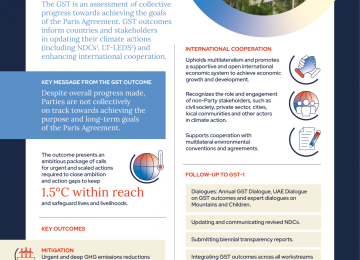
The outcomes of the GST will inform countries on updating and enhancing, in a nationally determined manner, their climate actions and support, as well as on enhancing international cooperation for climate action.
The GST is intended to increase the ambition of actions and support for collectively addressing climate change without focusing on individual countries or groups of countries. GST outputs will consist of key political messages and recommendations, best practices, new opportunities and lessons learned for all thematic areas without being policy-prescriptive.
The GST is designed to complete its work before the beginning of each new cycle of Nationally Determined Contributions (NDCs). This allows Parties to take into consideration the outputs of the collective assessment when formulating and submitting subsequent NDCs.