RCC West and Central Africa
RCC WAC Africa
    Regional Webinar on COP30 Outcomes in NDCs in sub-Saharan Africa RCC EASA flyer
    Regional Webinar on COP30 Outcomes and Status for Nationally Determined Contributions (NDCs) in sub-Saharan Africa

    Background COP30, held in Belém in November 2025, marked a key moment in advancing the implementation of the Paris Agreement, with a strong focus on the next cycle of Nationally Determined Contributions (NDC 3.0), informed by the outcomes of the first Global Stocktake. For countries in sub-Saharan Africa, these developments are particularly relevant as many are in the process of updating or implementing their NDCs, while facing ongoing challenges related to coordination, financing and capacity. In this context, the UN Climate Change Regional Collaboration Centres for East and Southern Africa (RCC EASA) and for West and Central Africa (RCC WACA) are organizing a regional webinar to unpack COP30 outcomes related to NDCs and support countries in advancing their climate commitments. Objectives The webinar aims to unpack the key COP30 outcomes relevant to NDCs and discuss their implications for the development, implementation and financing of NDC 3.0 in sub-Saharan Africa. More specifically, it will: Provide an overview of COP30 decisions relevant to NDCs. Highlight the implications of COP30 outcomes for the NDC 3.0 ambition cycle. Discuss emerging priorities for implementation, financing and institutional coordination. Identify opportunities for regional collaboration and technical support through the RCCs and partners. Promote knowledge exchange among countries in sub-Saharan Africa. Expected outcomes The webinar is expected to contribute to: Improved understanding of COP30 outcomes and their implications for NDCs. Enhanced awareness of emerging priorities for NDC 3.0 development and implementation. Strengthened regional collaboration and knowledge exchange among African countries. Identification of priority areas where the RCCs and partners can provide technical support. Target audience The webinar will bring together stakeholders involved in climate policy and implementation, including national NDC focal points, government ministries and climate coordination units, regional and international organizations, climate finance institutions, technical partners and development agencies, as well as civil society and research institutions.

    West Africa, Ghana
    Validation workshop for UEMOA study

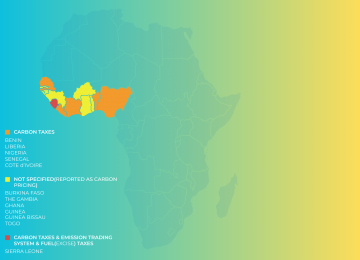
    Version en français ci-dessous Background Carbon pricing is increasingly recognized as an effective tool to reduce greenhouse gas (GHG) emissions by assigning a cost to carbon and encouraging investment in low-emission solutions. Under the Paris Agreement, Parties are exploring a range of instruments, including carbon pricing, to support the implementation of their Nationally Determined Contributions (NDCs) and enhance climate ambition. In West Africa, interest in carbon pricing has been growing. In 2020, the Commission of the West African Economic and Monetary Union (WAEMU) organized a regional consultation and capacity-building workshop, in collaboration with the UN Climate Change Regional Collaboration Centre for West and Central Africa (RCC WACA) and partners. One of the key recommendations was to conduct an exploratory study on the feasibility of carbon pricing in the region. With support from the UNFCCC secretariat through RCC WACA and funding from the CiACA initiative, a feasibility and opportunity study on regional carbon pricing in WAEMU has been carried out. Following data collection and analysis, a draft report has been produced and is now ready for review. This virtual validation workshop is convened to examine the findings of the study and gather feedback from key stakeholders across the region. Objectives Overall objective To review and validate the draft report of the feasibility and opportunity study for regional carbon pricing in WAEMU. Specific objectives Strengthen understanding of carbon pricing concepts and approaches. Examine the regional context for carbon pricing in WAEMU. Review the proposed regional approach, including policy and fiscal instruments. Assess the proposed roadmap for implementation. Identify potential partners and stakeholders for operationalization. Provide feedback and recommendations to finalize the study. Expected outcomes Improved understanding of carbon pricing among participants. Validation of the regional context and analytical findings. Consolidated feedback on the proposed regional carbon pricing approach. Review of the implementation roadmap. Identification of key actors and partners to support implementation. Agreed recommendations for finalizing the study. Target audience The workshop will bring together: UNFCCC national focal points, Article 6 focal points, and members of national climate change committees. Representatives from Ministries of Finance of WAEMU member States. Regional institutions and technical partners, including WAEMU Commission, ECOWAS Commission, BOAD, AGRHYMET, WASCAL, and the West African Carbon Market and Climate Finance Alliance. Representatives from the UNFCCC secretariat and RCC WACA.   VERSION EN FRANÇAIS Contexte La tarification du carbone est de plus en plus reconnue comme un levier efficace pour réduire les émissions de gaz à effet de serre (GES), en attribuant un coût au carbone et en encourageant des investissements dans des solutions plus respectueuses du climat. Dans le cadre de l’Accord de Paris, les Parties explorent différents instruments, y compris la tarification du carbone, pour mettre en œuvre leurs Contributions déterminées au niveau national (CDN) et renforcer leur ambition climatique. En Afrique de l’Ouest, l’intérêt pour la tarification du carbone s’est progressivement renforcé. En 2020, la Commission de l’UEMOA a organisé un atelier régional de consultation et de renforcement des capacités, en collaboration avec le Centre régional de collaboration pour l’Afrique de l’Ouest et du Centre (CRC AOC) de la CCNUCC et ses partenaires. L’une des principales recommandations issues de cet atelier était la réalisation d’une étude exploratoire sur la faisabilité de la tarification du carbone dans la région. Avec l’appui du secrétariat de la CCNUCC à travers le CRC AOC et grâce au financement de l’initiative CiACA, une étude d’opportunité et de faisabilité sur la tarification régionale du carbone dans l’UEMOA a été réalisée. Un rapport provisoire est désormais disponible et doit être examiné. Le présent atelier virtuel de validation est organisé afin d’examiner les résultats de cette étude et de recueillir les contributions des parties prenantes. Objectifs Objectif général Examiner et valider le rapport provisoire de l’étude d’opportunité et de faisabilité pour la tarification régionale du carbone dans l’UEMOA. Objectifs spécifiques Renforcer la compréhension des notions liées à la tarification du carbone. Analyser le contexte régional de la tarification du carbone dans l’espace UEMOA. Examiner la proposition d’une approche régionale et les instruments associés. Évaluer la feuille de route proposée pour la mise en œuvre. Identifier les partenaires et acteurs clés pour l’opérationnalisation. Formuler des observations et recommandations pour finaliser l’étude. Résultats attendus Meilleure compréhension de la tarification du carbone par les participants. Analyse partagée du contexte régional. Retours consolidés sur l’approche régionale proposée. Examen de la feuille de route de mise en œuvre. Identification des acteurs et partenaires clés. Recommandations formulées pour finaliser le rapport. Public cible L’atelier réunira : Les points focaux de la CCNUCC, les points focaux de l’Article 6 et les représentants des comités nationaux sur les changements climatiques. Les représentants des ministères des finances des États membres de l’UEMOA. Les institutions régionales et partenaires techniques (Commission UEMOA, CEDEAO, BOAD, AGRHYMET, WASCAL, Alliance ouest-africaine du marché carbone et de la finance climat). Le secrétariat de la CCNUCC et le CRC AOC.    

    RCC WACA hosts the Regional Workshops on Article 6 and Carbon Pricing for West and Central Africa
    Mobilizing finance from multilateral climate funds for climate adaptation and resilience in West and Central Africa

    Background Climate change is increasingly affecting economic stability, food security, public health, infrastructure, and livelihoods worldwide. In West and Central Africa, these impacts are particularly severe due to high exposure, socio-economic vulnerability, and limited adaptive capacity. The region’s reliance on climate-sensitive sectors—such as rain-fed agriculture, fisheries, and forestry—makes it especially vulnerable to rising temperatures, erratic rainfall, droughts, floods, and land degradation. Adaptation finance remains critically insufficient. Despite estimated needs of USD 215–387 billion annually for developing countries through 2030, a significant gap persists between available resources and actual requirements. Recent global outcomes, including the Global Stocktake and COP30 decisions, have underscored the urgency of accelerating the formulation and implementation of National Adaptation Plans (NAPs), supported by strengthened capacity and scaled-up finance. At the same time, many countries in the region face challenges in translating adaptation priorities into bankable, investment-ready projects, limiting access to key multilateral climate funds such as the Green Climate Fund and the Adaptation Fund. In this context, the UN Climate Change Regional Collaboration Centre for West and Central Africa (RCC WAC Africa) is organizing this webinar to strengthen capacities to mobilize financial resources for adaptation and resilience, while supporting countries in positioning adaptation as a strategic investment for sustainable development. Objectives The webinar aims to: Enhance understanding of practical financing options, particularly multilateral climate funds under the UNFCCC, the Kyoto Protocol, and the Paris Agreement. Support improved access to international climate finance, including the Green Climate Fund, Adaptation Fund, and other relevant mechanisms. Strengthen the capacity of stakeholders to develop investment-ready adaptation projects. Expected Outcomes Increased awareness of available financing opportunities for adaptation and resilience. Improved understanding of requirements and processes to access multilateral climate funds. Strengthened capacity to structure adaptation projects as viable investment opportunities. Enhanced regional dialogue and exchange between countries, institutions, and partners on mobilizing adaptation finance. Target Audience Government representatives and policymakers from West and Central Africa. UN Country Teams. Regional centres and organizations. Civil society organizations and non-governmental organizations. Youth, Indigenous Peoples and local communities. Academic and research institutions.

    Nigerian man standing in the street - Carbon Pricing solutions study
    Validation Workshop on Operationalizing a Pilot Carbon Tax in Nigeria’s Telecommunications Sector

    Background Nigeria is advancing a pilot carbon tax tailored to the telecommunications sector, a high-impact area due to its reliance on diesel-powered infrastructure to ensure network uptime. Building on feasibility work under the Ci-ACA (Collaborative Instruments for Ambitious Climate Action) initiative, stakeholders have identified a carbon tax as a practical, near-term option to drive emissions reductions, complement Nigeria’s NDC targets and long-term low-emission development strategies. This validation workshop, organized by the Regional Collaboration Centre West and Central Africa is a milestone to review and confirm the pilot design elements, align on roles and responsibilities, and strengthen buy-in across government, regulators, telecom operators, and technical partners. Objectives Present the proposed design framework for a pilot carbon tax in the telecom sector (coverage, institutional setup, monitoring, reporting and verification requirements, and policy options). Validate stakeholder inputs gathered through prior consultations to ensure accuracy, representation and inclusivity. Confirm alignment with national climate policy, including the NDCs and LT-LEDS. Assess feasibility and readiness (timelines, roles, inter-agency coordination). Discuss revenue use/fiscal integration and safeguards to ensure equity and development co-benefits. Strengthen stakeholder ownership and agree next steps toward pilot implementation, including potential regulatory/legislative pathways. Reaffirm how carbon pricing can support international cooperation, transparency and climate finance opportunities. Expected outcomes Validation and endorsement of the proposed carbon tax framework for Nigeria’s telecommunications sector, including design elements and MRV requirements. Consensus on implementation pathways, institutional roles, and coordination mechanisms to operationalize the pilot. Strengthened stakeholder ownership and commitment to ensure inclusivity, transparency, and long-term sustainability. Identification of capacity-building needs and support measures to enable effective compliance and adaptive implementation. Target audience Telecommunications industry, government and regulators, Non-Corporate Communication Channels (NCCCs), sector regulators, revenue and standards agencies, competition/consumer protection, customs and statistics offices, policy entities, communications and digital economy, finance, planning, industry and trade, power, works and housing, transport, petroleum, energy and meteorology. Others: UNFCCC National Focal Point, academia, NGOs/CSOs, national experts and training institutes.

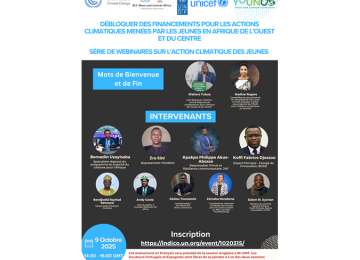
    Flyer Youth Climate Webinar RCC WACA French session
    Jeunes et financement climatique : Débloquer des financements pour l’action climatique menée par les jeunes en Afrique de l’Ouest et du Centre

    Contexte Les jeunes d’Afrique de l’Ouest et du Centre sont au premier plan de l’action climatique. Ils mobilisent leurs communautés, développent des solutions innovantes et défendent des changements de politiques publiques. Malgré ce rôle essentiel et leur engagement, l’accès aux financements climatiques reste un obstacle majeur. Beaucoup d’organisations de jeunes font face à des défis structurels et financiers, comme le manque d’informations accessibles, la complexité des démarches ou encore des conditions d’éligibilité difficiles. Pour répondre à ces défis, cette troisième partie de la série de webinaires organisée par le Centre régional de collaboration d’ONU Climat pour l’Afrique de l’Ouest et du Centre (RCC WACA) se concentre sur le thème “Jeunes et financement climatique”. L’objectif est d’explorer les opportunités et les défis liés au financement, et de mettre en avant des pistes pour renforcer l’accès des jeunes aux mécanismes de financement et d’investissement. Ce webinaire est co-organisé par RCC WACA, le PNUD, UNICEF WCARO,et YOUNGO. Objectifs Renforcer la capacité des jeunes de la région à accéder aux financements climatiques et à influencer les flux financiers. Mettre en évidence les obstacles actuels et proposer des solutions adaptées. Présenter des bonnes pratiques et des projets réussis portés par des jeunes. Faciliter le dialogue avec les gouvernements, fonds climatiques, fondations, secteur privé et partenaires techniques. Résultats attendus Plus grande sensibilisation aux opportunités de financement existantes. Recommandations concrètes pour améliorer l’accès des jeunes aux financements nationaux et internationaux. Identification de modèles réussis et de bonnes pratiques menées par les jeunes. Meilleur partage de ressources et d’expériences entre acteurs de la région. Public cible Organisations et entrepreneurs dirigés par des jeunes. Institutions financières climatiques (FVC, BOAD, BAD, etc.). Ministères de l’Environnement, des Finances et de la Jeunesse. Partenaires du système des Nations Unies, agences de développement et secteur privé. Universitaires et société civile. Important : Les personnes parlant espagnol ou portugais peuvent participer librement à l’une ou l’autre des deux sessions!

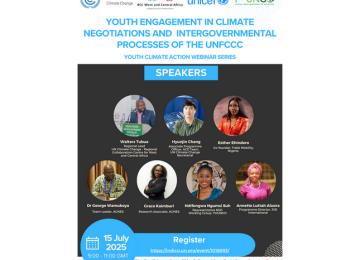
    Flyer Youth Climate Webinar RCC WACA English session
    Youth and Climate Finance: Unlocking Finance for Youth-led Climate Action in West and Central Africa

    Background Young people in West and Central Africa are at the forefront of climate action, mobilizing communities, creating innovative solutions, and advocating for policy change. Yet, access to climate finance remains a major barrier for youth-led initiatives, limiting their ability to scale up and secure resources from national, regional, or international funds. This webinar, co-organized by UN Climate Change’s Regional Collaboration Centre for West and Central Africa (RCC WACA), UNDP, UNICEF WCARO, and YOUNGO, will explore the intersection of youth and climate finance. It will highlight challenges, present successful youth-led models, and open dialogue between youth and key stakeholders to co-design inclusive financial mechanisms. Objectives Strengthen youth capacities to access and influence climate finance flows. Highlight barriers and propose solutions for youth-led organizations. Share good practices and successful case studies. Facilitate dialogue with governments, climate funds, foundations, and the private sector. Expected Outcomes Increased awareness of available climate finance opportunities for youth. Clear recommendations to improve access to national and international funding. Identification of good practices and successful youth-led financing models. Strengthened resource-sharing and knowledge exchange across the region. Target Audience Youth-led organizations and entrepreneurs, government agencies, climate finance institutions, UN partners, development agencies, private sector actors, academia, and civil society.  Important: Spanish and Portuguese speakers are welcome to join either session at their convenience!

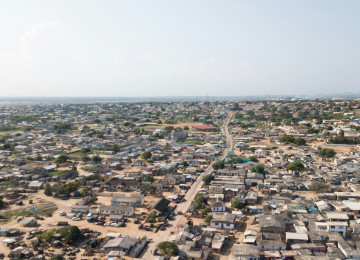
    An aerial view of Prampram, Ghana
    Webinar on Adaptation and Resilience: Forging a Resilient, Sustainable Future for West and Central African Cities

    Background Africa’s urban population is projected to double by 2050, with cities in West and Central Africa such as Lagos and Kinshasa among the fastest-growing globally. This rapid expansion often outpaces infrastructure development and planning, leaving over 60% of urban dwellers in sub-Saharan Africa living in informal settlements. These conditions significantly heighten vulnerability to climate-related disasters like floods, droughts, and extreme heat. West and Central Africa face these challenges acutely, compounded by poverty, conflict, and governance gaps. Addressing them requires urgent, coordinated action. This webinar will serve as a platform for dialogue, knowledge sharing, and partnership-building to advance scalable, context-specific solutions that protect urban lives and livelihoods. With over 400 million people expected to live in the region’s cities by 2050, there is no time to waste in shaping a resilient and sustainable future. This webinar is organized by the West Africa Capitals Coalition Hub (WACCH), a collaborative network dedicated to advancing sustainable development and climate action across West African capitals, convened by the Natural Eco Capital, and in collaboration with the Regional Collaboration Centre for West and Central Africa (RCC WACA). Objectives The objectives of this webinar are the following: Discuss key challenges facing urban development in West and Central Africa, including climate adaptation, infrastructure, and social equity. Highlight successful case studies and best practices in sustainable city planning. Foster collaboration among stakeholders to drive action-oriented solutions. Explore innovative approaches, including smart cities and sustainable financing models. Target Audience Urban planners and city administrators Private sector and development partners Environmental and climate experts Policymakers and government officials Academics and researchers Expected Outcomes Strengthened regional discourse on urban resilience Practical strategies for sustainable urban development Enhanced collaboration among experts, policymakers, and stakeholders

    Yaoundé, Centre, Cameroon general picture
    Workshop to validate the findings of a study on the feasibility of carbon pricing and launch work on the design of a possible carbon pricing instrument suitable to the Cameroon context.

    (Voir la version en français ci-dessous) The UNFCCC Regional Collaboration Centre for West and Central Africa (RCC WAC Africa), in partnership with the Ministry of Environment, Protection of Nature and Sustainable Development (MINEPDED), is organizing a three-day workshop (7-9 July) to validate the findings of a feasibility study on carbon pricing and initiate the collaborative design of a pilot carbon pricing instrument tailored to Cameroon. This three-day workshop will bring together stakeholders from across Cameroon’s climate, energy, and industrial sectors to validate the findings of a feasibility study on carbon pricing instruments and kick off the design phase for a pilot carbon pricing instrument. The event is part of Cameroon’s broader efforts to enhance its Nationally Determined Contributions (NDCs) and promote low-carbon development through economic instruments. Objectives: Present and validate the findings of the national feasibility study on carbon pricing. Strengthen stakeholders’ understanding of carbon pricing instruments or tools. Kickstart the collaborative design of a pilot carbon pricing instrument tailored to Cameroon’s emission profile. Discuss MRV systems, revenue use, and alignment with national climate and development goals. Outline a stakeholder-endorsed roadmap for next steps.   (Français) Le Centre régional de collaboration pour l’Afrique de l’Ouest et l’Afrique centrale de la CCNUCC (RCC WAC Africa), en partenariat avec le Ministère de l’Environnement, de la Protection de la Nature et du Développement Durable (MINEPDED), organise un atelier de trois jours (du 7 au 9 juillet) visant à valider les résultats de l’étude de faisabilité des instruments de la tarification carbone et le lancement de la conception collaborative d’un instrument pilote de tarification carbone adapté au profil d’émissions du Cameroun. Cet atelier de trois jours réunira des parties prenantes des secteurs du climat, de l’énergie et de l’industrie du Cameroun pour valider les résultats de l’étude de faisabilité sur les instruments de tarification carbone et amorcer la phase de conception d’un instrument de tarification carbone. Cet événement s’inscrit dans le cadre des efforts plus larges du Cameroun pour la mise en oeuvre de ses Contributions déterminées au niveau national (CDN) et la promotion d’un développement à faibles émissions grâce à des instruments économiques. Objectifs : Présenter et valider les résultats du rapport d’étude de faisabilité sur la tarification carbone. Renforcer la compréhension des parties prenantes sur les instruments de tarification carbone. Lancer la conception collaborative d’un instrument pilote de tarification carbone adaptée au profil d’émissions du Cameroun. Discuter des systèmes de Mesure, Notification et Vérification (MNV), de l’utilisation des recettes et de l’alignement avec les objectifs climatiques et de développement nationaux. Définir une feuille de route approuvée par les parties prenantes pour les prochaines étapes.

    Photo of Kigali, Rwanda, where the workshop for women negotiators on climate change took place
    Training workshop for legal experts in Central Africa

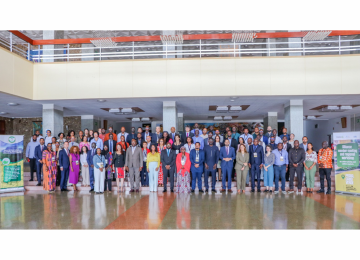
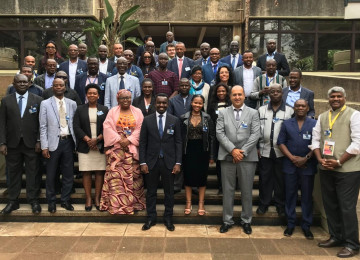
    RCC West and Central Africa and the Regional Climate Action Transparency Hub (ReCATH) for countries in the Economic Community of Central African States (ECCAS) organized a training workshop for environmental lawyers and the Constitutive General Assembly of the Network of Environmental Lawyers Experts of Central Africa (REJEAC). The training workshop aimed to enable lawyers to acquire a basic knowledge of multilateral environmental agreements and their implications at the national level, exchange national experiences, and advance harmonization of member states' legislation. Summary Africa has vast regions rich with natural resources. There is an urgent need to sustainably manage these resources as the continent grows in line with national and global goals. Realizing the vision of a green economy requires legal experts equipped to navigate a complex web of environmental laws and regulations. RCC WAC Africa, the UNFCCC Regional Collaboration Centre for West and Central Africa, co-organized a workshop on multilateral environmental agreements to inform and engage Africa’s legal community.  The workshop engaged the Environmental Lawyers and the Constitutive General Assembly of the Network of Environmental Lawyers Experts of Central Africa (REJEAC) in Kigali, Rwanda, from 30 April to 3 May 2024. Effective implementation of international agreements in Africa requires legal, regulatory and institutional reforms, all of which are tied to legal expertise. The workshop equipped African environmental legal negotiators with in-depth knowledge of multilateral environmental agreements.  Discussions focused on the three Rio Conventions—UNFCCC, CBD, and UNCCDand fostered an exchange of national experiences and a conversation on the urgent need to harmonize legislation across Economic Community of Central African States (ECCAS) members.  RCC WAC Africa held the workshop on-site supported by the secretariat Legal affairs division online. The team facilitated and presented the UNFCCC rules of procedure, the Framework Convention, Kyoto Protocol, and Paris Agreement. Discussions focused on the NDCs and Article 6.   The event culminated with the launch of a network of environmental lawyers in central Africa, which aims to support countries in preparing and participating in UN Climate Change negotiations and implementating the Paris Agreement. The event also established a bureau and drafted a roadmap to guide the network's operations, including a strong capacity-building component. The Government of Rwanda, through the Ministry of Environment, offered to host the Network. This offer and the roadmap were adopted unanimously.   Co-organizers of this meeting included ECCAS – through the Regional Climate Action Transparency Hub for Central African States, Legal Response International and the Africa Group of Negotiators Expert Support.  

    RCC EASA and RCC WACA held a webinar '2025 NDCs: sub-Saharan Africa Partners Stocktaking Meeting'
    2025 NDCs: sub-Saharan Africa Partners Stocktaking Meeting

    RCC EAS Africa and RCC WAC Africa mobilize regional partners for the NDCs 3.0   In late March 2024, RCC East and Southern Africa and RCC West and Central Africa teamed up to bring together more than 10 partners in the region to connect countries with support for the NDCs 3.0. This meeting was convened as part of a global series of partner meetings to develop ambitious NDCs by early 2025. Connecting governments with support for NDC development can increase confidence needed to make bold commitments and accelerate implementation.      Background The 2025 NDCs, or NDCs 3.0, are to be prepared with a timeframe for implementation till 2035. All Parties are required to submit their NDC 3.0, latest by February 2025, in order to allow for sufficient time for the preparation of the compilation and synthesis report in advance of CMA7 (November 2025). NDC 3.0 are expected to be a progression beyond previous NDCs and should reflect the highest possible ambition. The NDCs 3.0 will determine to a large extent whether the world will get back on a global GHG emissions trajectory that is in line with the 1.5C temperature goal of the Paris Agreement and whether countries will build up the resilience for such a scenario. Ideally, the next NDCs should not only be ambitious in terms of numbers on paper. They should also help to accelerate implementation, unlock finance, and be well positioned to credibly move the needle on climate action. Taking the above into account, the UNFCCC secretariat plans to coordinate with key partners to ensure coordinated support for the Parties to deliver the 2025 NDCs. To launch this effort the Executive Secretary of the United Nations Framework Convention on Climate Change secretariat is convening a meeting to bring together key organizations to jointly lay the ground to ensure NDCs 3.0 are fit for purpose, will accelerate implementation of climate action, will unlock finance and will be well positioned to credibly move the needle on climate action.   Meeting Objectives Provide an opportunity for regional development and implementing organizations to discuss approaches for increased cooperation and coordination in providing support towards the developing of ambitious and implementable NDCs by 2025 as a precursor to the webinar that was held with Parties from 12:00 PM to 1:30 PM on the 26 March 2024.    Way forward RCC West and Central Africa and RCC East and Southern Africa together with NDC Partnership will map out the different support areas provided by partners to countries in the Sub-Saharan region, providing insight into where collaborations can be built, and identifying areas where there is a lack of support, both geographically and sectorally.  They will also establish a platform to capture ongoing activities and available support and make this accessible to all. This exercise will hope to ensure that consistent matchmaking support is available to countries in the region. RCC West and Central Africa and RCC East and Southern Africa will look into the integration of various climate action elements such as mitigation, adaptation, gender, loss and damage, etc., aiming to build unified support for the NDCs.

    West Africa carbon pricing workshop
    Carbon Pricing Initiatives in Nigeria

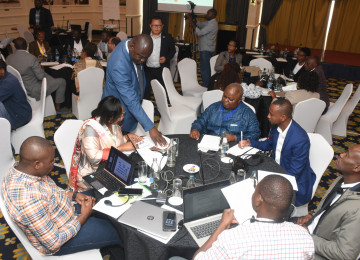
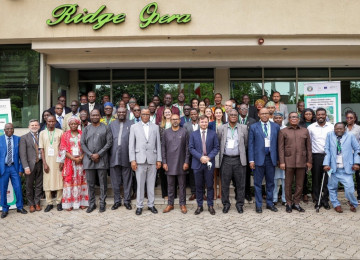
    The Regional Collaboration Center for West and Central Africa (RCC WAC Africa) of the UNFCCC secretariat and the Federal Government of Nigeria organized a workshop on carbon pricing opportunities for Nigeria.   Workshop on Carbon Pricing Initiatives in Nigeria 05 July 2023 | Newton Park Hotel  | Abuja | Nigeria Capacity Building | National Event Click here for the Concept Note and Agenda of the workshop The National Council on Climate Change (NCCC) of Nigeria with support from the UN Climate Change Regional Collaboration Centre for West and Central Africa hosted a workshop on Carbon Pricing Initiatives in Abuja. The workshop discussed the social, economic, regulatory, legal, and institutional implications of different carbon pricing instruments such as carbon tax and Emission Trading Schemes under the Collaborative Instruments for Ambitious Climate Action (Ci-ACA) Initiative.  The workshop brought together 80 stakeholders from various national partner organizations to analyze and discuss the “Assessment of Carbon Pricing Initiatives in Nigeria” study meant to guide national policymakers determine carbon pricing approaches appropriate for Nigeria. The study was commissioned by the Government of Nigeria and RCC WAC Africa.  Moving forward, the NCCC will look at potential next steps and policy options for carbon pricing instruments suitable to Nigeria, including a corresponding national MRV system. RCC WAC Africa will continue to work with the Government of Nigeria and partners in the region to advance carbon pricing and other climate solutions  

    Content