Slow Onset Events

Strategic workstream (a) of the current five-year workplan of the Warsaw International Mechanism Executive Committee (WIM ExCom) focuses on enhancing cooperation and facilitation in relation to slow onset events.

SOEs

The impacts of climate change include slow onset events and extreme weather events, which may both result in loss and damage. Slow onset events, as initially introduced by the Cancun Agreement (COP16), refer to the risks and impacts associated with increasing temperatures, desertification, loss of biodiversity, land and forest degradation, glacial retreat and related impacts, ocean acidification, sea level rise, and salinization.

Work facilitated by the WIM ExCom on this workstream

The WIM ExCom has been conducting a number of activities since 2015, including under strategic workstream (a) of its five-year rolling workplan, to improve the state of knowledge to understand and the capacity to address slow onset events and their impacts.

The Expert Group on Slow Onset Events helps execute the work of the WIM ExCom in guiding the implementation of the Warsaw International Mechanism in an advisory role.


Improving the state of knowledge on loss and damage associated with slow onset events

  • The WIM ExCom published a technical guide on sea level rise in 2025, developed in collaboration with its expert group on slow onset events. The guide discusses the risks and impacts of observed and projected rising sea levels on communities and the environment. It features a range of approaches from case studies, including protective measures such as coastal armouring, flood barriers, and elevating structures, alongside nature-based solutions, accommodation strategies and managed retreat for at-risk communities.

  • The WIM ExCom collaborated with the publisher Elsevier to respond to the growing need to enhance the understanding of the adverse effects of slow onset events on vulnerable populations and relevant approaches for addressing them. The special issue of the journal Current Opinion in Environmental Sustainability on slow onset events related to climate change was published in 2021.

  • A technical paper on slow onset events, drawing on the discussions from regional expert meetings held under the SBI work programme on loss and damage (Nov 2012), provides an overview of the eight types of slow onset events as identified in the Cancun Adaptation Framework and associated approaches to address loss and damage associated with the adverse effects from those events.


Information on organizations working on slow onset events

  • A database of organizations that are working on one or more of the eight types of slow onset events. The database, created in 2014 and updated on a rolling basis, also serves as an information base for ExCom’s work on slow onset events to further strengthen dialogue, coordination, coherence and synergies among stakeholders.

  • See an overview of the scope of work undertaken by those organizations and the mapping details conducted in 2018.

  • The report of the expert meeting, held in 2013, to consider future needs, including capacity needs associated with possible approaches to address slow onset events.
  • A photo campaign on slow onset events and COP 23 side event on “Breaking new ground: Risk financing for slow onset events” to share information on features of financial instruments and innovative ways to engage in collaboration and partnerships for enhancing action and support for addressing the risks of slow onset events. (a summary, presentations)
  • Furthering the link between science and the policy process
    • Letter to the Chair of the SBSTA requesting to consider slow onset events as a possible topic for the research dialogue to be held at SBSTA 44
    • Posters on slow onset events showcased at the 8th Research Dialogue at SBST 44 (poster 1, poster 2)
Expert-Group-on-Slow-Onset-Events

The work of the Expert Group on Slow Onset Events supports strategic workstream (a) of the five-year rolling workplan of the Warsaw International Mechanism Executive Committee (WIM ExCom), which aims to enhance cooperation and facilitation in relation to slow onset events.

The Expert Group currently focuses its technical work on desertification, glacial retreat and sea level rise. Four members of the WIM ExCom facilitate the work of the group.

The COP, at its twentieth session in 2014, decided that the WIM ExCom may establish expert groups, subcommittees, panels, thematic advisory groups or task-focused ad hoc working groups to help execute the work of the ExCom in guiding the implementation of the Warsaw International Mechanism, as appropriate, in an advisory role, and that report to the ExCom (Decision 2/CP.20, para 8). ExCom 12 (2020) adopted the terms of reference for the Expert Group on Slow Onset Events, and the group held its first meeting in 2021.

The WIM ExCom endorsed the second Plan of Action of the Expert Group on Slow Onset Events at ExCom 20 (2024). Recognizing the far-reaching impacts of slow onset events on livelihoods and economies, which can manifest simultaneously in different territories and landscapes, the second plan of action continues the work undertaken during the first rolling plan of action on selected water-related slow onset events: glacial retreat, sea level rise, and desertification. The Plan identifies actions that will contribute to the implementation of strategic workstream (a) of the five-year rolling workplan of the WIM ExCom.

Technical-Guide-on-Sea-Level-Rise

The sections below provide an overview of the range of approaches for responding to loss and damage associated with sea level rise showcased in the technical guide on sea level rise. These approaches are categorized into protective measures, accommodation strategies, and retreat strategies.   

List of the main impacts of, and solutions for, sea level rise
资料来源: Technical guide on sea level rise

Protective measures 

  • Goal: defend vulnerable areas, human activities and assets from the direct impacts of sea level rise and maintain the current land use. ​

  • ​Typically involves the construction of physical barriers and infrastructure. ​ 

  • ​May include natural or hybrid solutions.​ 

  • ​Can be costly and potentially harm ecosystems.  

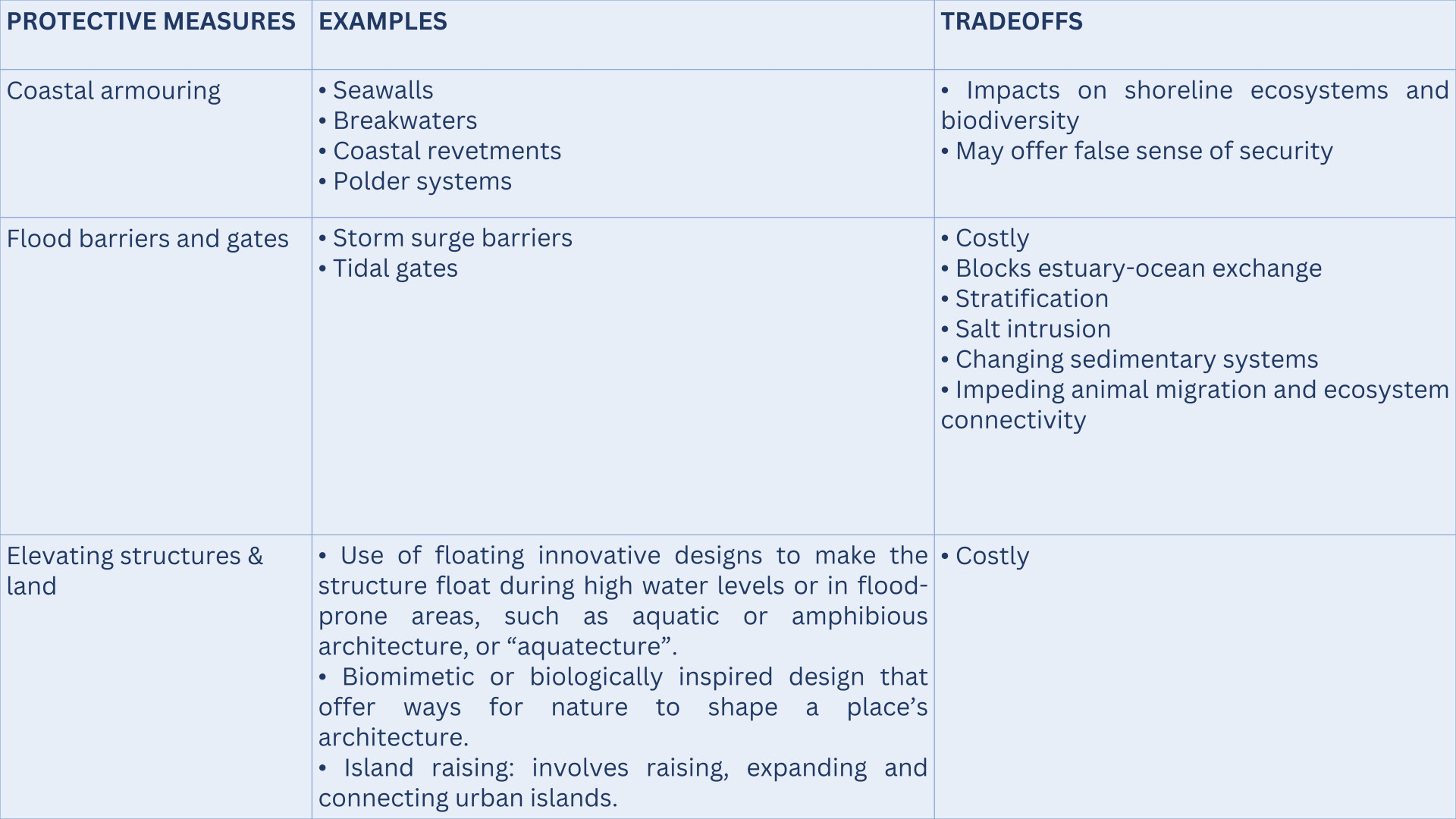
  • Coastal armouring is a hard structure that protects coastal areas from rising tides and storm surges by absorbing and deflecting wave energy.​ 
  • Click here for more information on this approach.
  • Storm surge barriers and tidal gates are constructed in harbours and estuaries to prevent storm surges during high tides and storms, and to minimize flooding.​ 
  • Click here for more information on this approach.
  • This approach involves raising buildings or structures and introducing innovative designs that enable them to float during high water levels.​ 
  • Click here for more information on this approach.
informative table
资料来源: UN Climate Change

Tuvalu Coastal Adaptation Project:

  • This project focuses on capacity building, infrastructure protection, and sustainable financing to enable Tuvalu’s coastal communities to survive a changing climate. It aims to:

    • Strengthen coastal towns against rising sea levels and storm surges using USD 36 million from the Green Climate Fund and USD 2.9 million from the Government of Tuvalu. 

    • Improve Tuvalu’s human resource capacity by training and transferring knowledge to professionals to qualify them to manage and implement climate change adaptation projects. 

  • Building and repairing coastal infrastructure reduces storm surge and erosion susceptibility. 


Coastal protection initiatives implemented by the government of Senegal:

  • With the support from the Adaptation Fund, Senegal constructed a coastal protection dike and an anti-salt dike to protect rice-growing areas from saltwater intrusion, rehabilitated fish processing areas and protected a fishing wharf.
  • In partnership with the World Bank, Senegal has invested over USD 41 million to address coastal erosion and restore the beach at the Saly seaside.
  • The Green Climate Fund financed a EUR 15 million project focusing on national flood risk mapping, detailed urban area mapping, infrastructure design tools, rainfall-runoff models, real-time hazard monitoring, groundwater knowledge improvement, optimized drainage management and enhanced warning systems.

Accommodation strategies

  • Goal: adjusting existing green and grey infrastructure, practices, economic sectors and social systems to live with the changing conditions, reduce vulnerability and increase resilience.​

  • ​Includes adapting buildings, infrastructure and communities to cope with periodic flooding and other sea level rise effects.​

  • ​Encompasses policies and practices that promote sustainable land use and water management.​

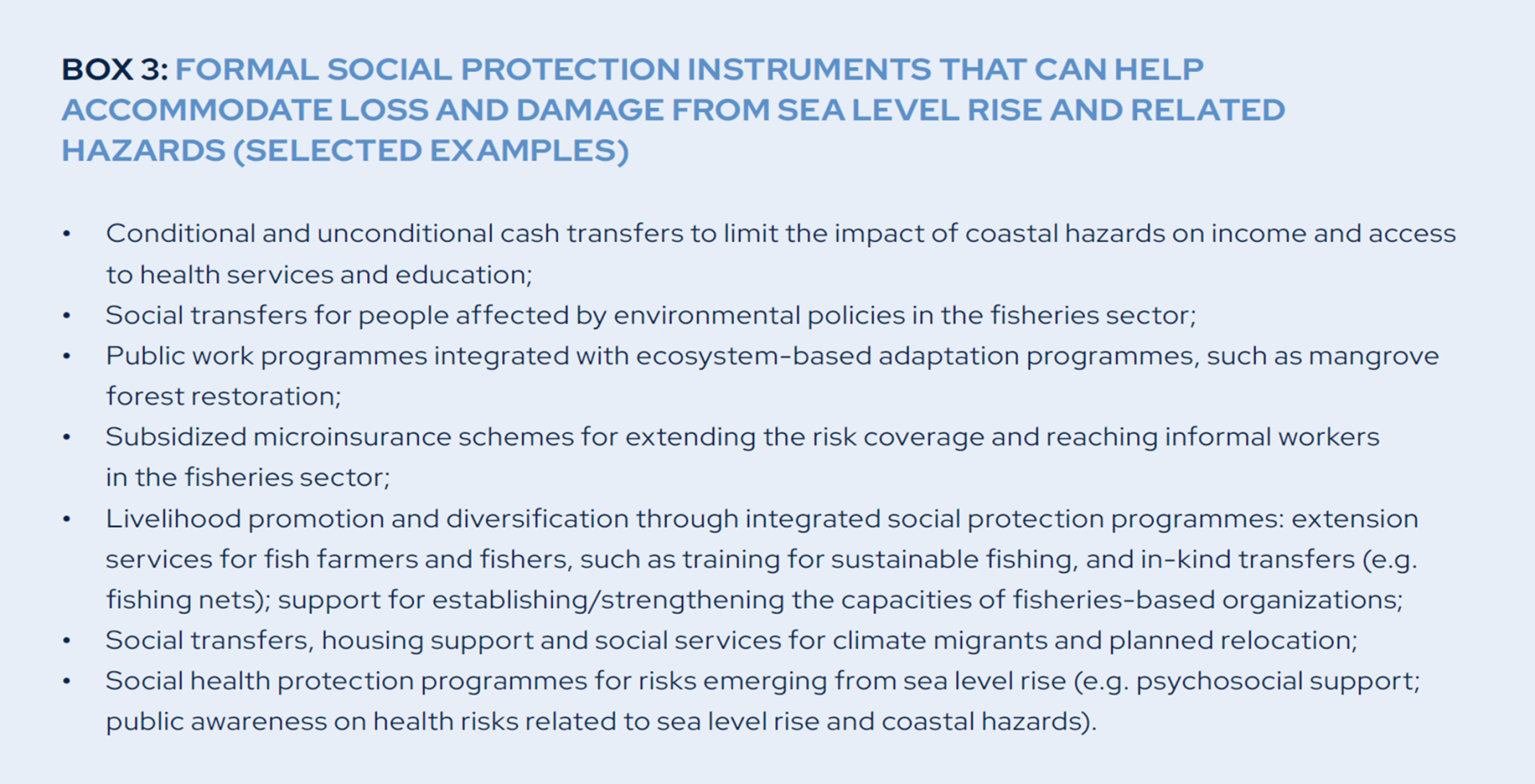
  • ​Include economic and social measures such as transforming food production systems, diversifying economies, adapting health systems and strengthening social protection mechanisms.

  • Ecosystem-based adaptation is the use of natural processes and ecosystem services to mitigate sea level rise and coastal erosion, providing sustainable alternatives to engineered infrastructures.​
  • Restoration of ecosystems such as coastal wetlands, coral and oyster reefs, and sand dunes can be used to dissipate energy waves, reduce flood risks and prevent erosion.
  • Advantages:
    • Cost-effective solutions compared to engineering alternatives.
    • Ecological, social and economic benefits.
  • Click here for more information on this approach.
Informational textbox
资料来源: Technical guide on sea level rise
  • A careful and climate-informed programme and policy design, as well as sustained financial flows, are essential.
  • Click here for more information on this approach.
Comp table
资料来源: UN Climate Change

Coral Reef Restoration in Puerto Rico:

  • The United States Geological Survey and the University of California, Santa Cruz, initiated a project to restore damaged coral reefs by transplanting coral fragments onto degraded reefs and constructing artificial reef structures to facilitate coral growth and habitat restoration, accelerating the recovery of coral ecosystems and enhancing their resilience.
  • Innovative techniques employed, such as coral nurseries, and artificial reef structures made from eco-friendly materials.
  • Promising results, with increased coral cover and biodiversity at restoration sites, improving coastal protection by reducing wave energy and preventing shoreline erosion.
  • Funding from government agencies, non-profit organizations and private sector partners, ensuring the availability of necessary resources for successful implementation and monitoring.
  • Example of how targeted restoration efforts can enhance coastal resilience and protect vulnerable communities from climate change impacts.


Social protection interventions supported by the Green Climate Fund:

  • The FP184 Vanuatu community-based climate resilience project seeks to support community-based adaptation through the development of locally defined shock-responsive social protection mechanisms.
  • The multi-country project FP215 Community Resilience Partnership Program aims to strengthen the resilience of communities in target countries through the provision of finance for climate-risk-informed social protection. Planned activities include capacity-building and exploring options for designing innovative social protection schemes or expanding existing programmes in the future.

Retreat strategies

  • Goals: relocate people, infrastructure, and economic activities to reduce exposure to climate and environmental hazards.

  • Refers to spontaneous relocations and coordinated movements by governments and organizations.

  • Often considered a last resort when other protection or accommodation measures are not viable.

Informational table
资料来源: Technical guide on sea level rise
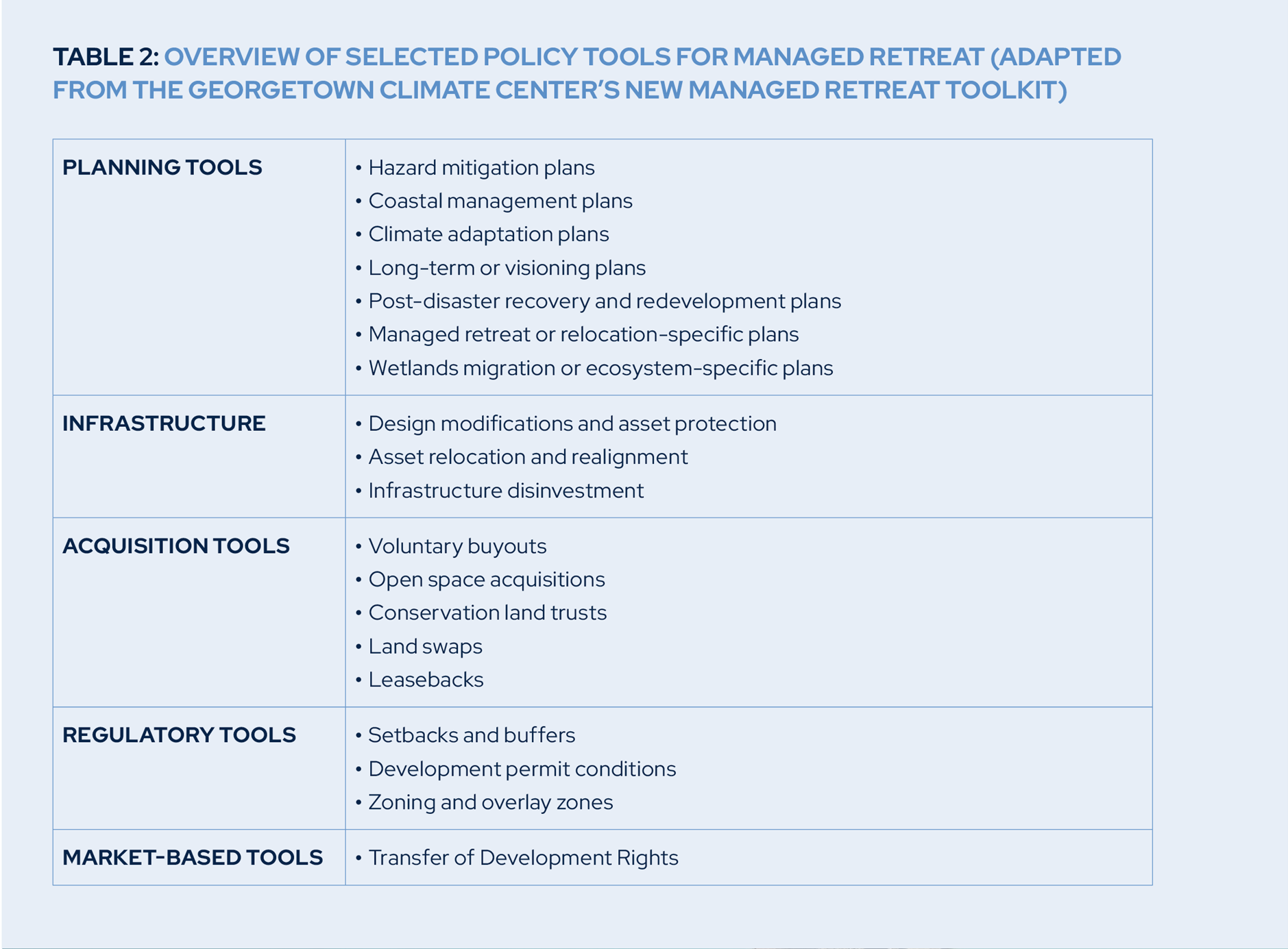
  • Planned relocation is a form of human mobility response in the face of sea level rise, that is initiated, supervised and implemented from national to local levels, involving small communities and individual assets. May also involve large populations.
  • Click here for more information on this approach.
  • informational table
    资料来源: UN Climate Change

Planned relocation in Fiji:

  • Comprehensive national relocation policy package developed to address climate change-induced relocation and guide national responses to planned relocation, including the 2018 Planned Relocation Guidelines and the 2023 Standard Operating Procedures.
  • The 2021 Climate Change Act supports these policy documents by establishing principles and procedures for the relocation of communities that are at risk, and by establishing the Climate Relocation of Communities Trust Fund, the world’s first national trust fund dedicated to community-driven planned relocation.
  • Programme financed by domestic funding mechanisms like the Environment and Climate Adaptation Levy and international contributions.

The technical guide on sea level rise was developed by the expert group on slow onset events and published in February 2025. Beyond presenting the range of approaches for responding to loss and damage associated with sea level rise, the guide also discusses the risks and impacts of observed and projected rising sea levels on communities and the environment.