The First Global Stocktake

Learn about the first global stocktake process and outcome. 

The First Global Stocktake (2021-2023)


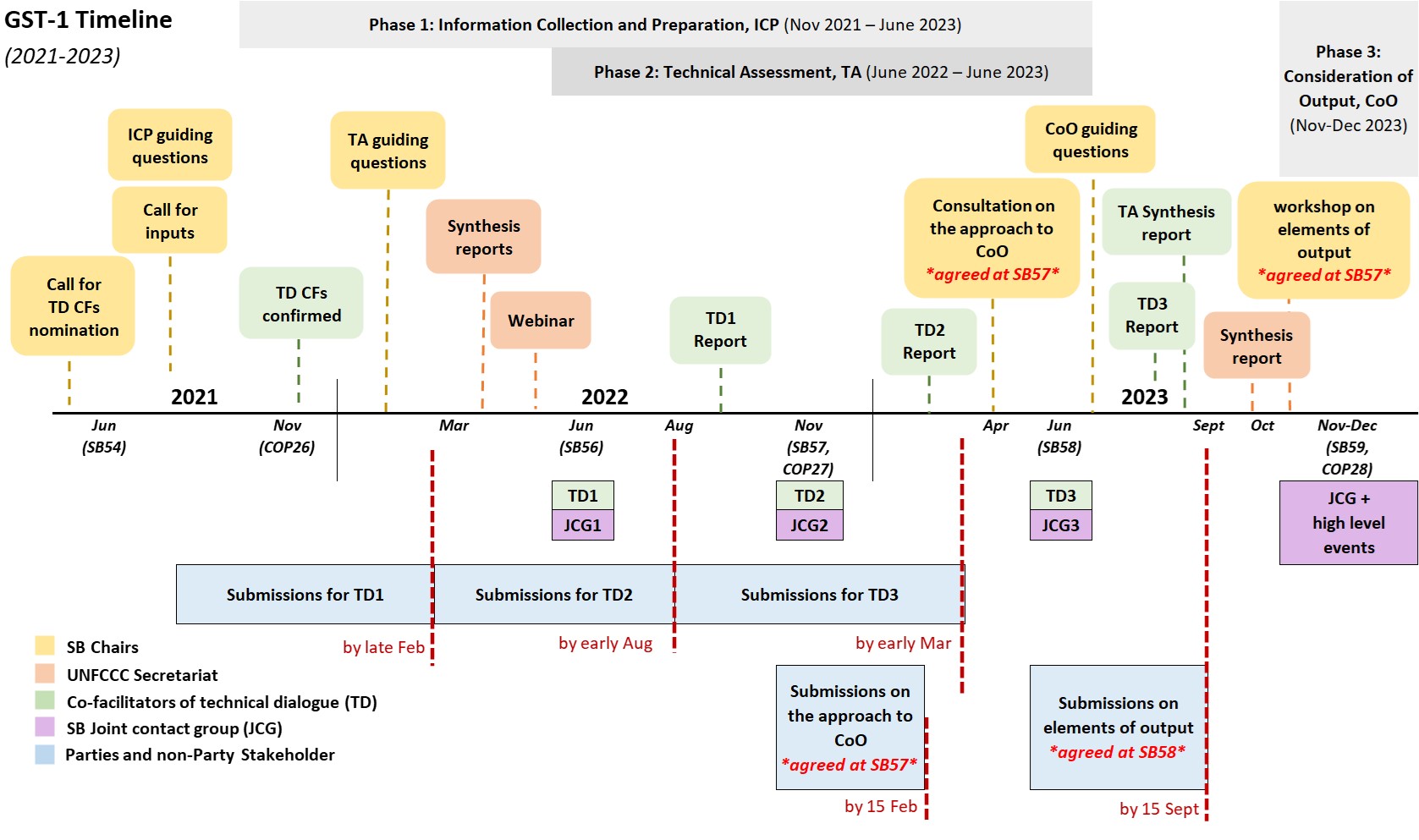
What is the timeline of the first Global Stocktake?

The first Global Stocktake (GST) was launched at COP26 in Glasgow and concluded at COP28 in the United Arab Emirates.

the GST1 timeline
资料来源: UNFCCC secretariat


What are the main components of the GST process?

In accordance with the modalities of global stocktake (decision 19/CMA.1), the GST1 comprised the following three components:

  1. Information collection and preparation, focusing on gathering, compiling, and synthesizing information and preparing for conducting the technical assessment;
  2. Technical assessment, focusing on taking stock of the implementation of the Paris Agreement to assess the collective progress towards achieving the purpose and long-term goals of the Paris Agreement, as well as opportunities for enhanced action and support to achieve its purpose and goals;
  3. Consideration of outputs, focusing on discussing the implications of the findings of the technical assessment, with a view to achieving the outcome of the global stocktake of informing Parties in updating and enhancing, in a nationally determined manner, their actions and support, in accordance with relevant provisions of the Paris Agreement, as well as in enhancing international cooperation for climate action.


What governance structures and arrangements guide the GST?

  • The CMA has the overall responsibility to conduct the GST.
  • The SBSTA and SBI are mandated to assist the CMA in conducting the global stocktake, especially with regards to the technical assessment component through the technical dialogue (TD) and the Joint Contact Group (JCG).
  • The technical dialogue (TD), which will be focused, transparent and facilitative in nature and will allow Parties to engage and discuss with constituted bodies and forums and other institutional arrangements under or serving the Paris Agreement and/or the Convention and experts to consider inputs and assess collective efforts. The TDs will be facilitated by two co-facilitators selected by Parties, each from a developing and developed country, and will be guided by questions to be developed by the SBSTA and SBI Chairs on each thematic area and cross-cutting.
  • A High-Level Committee consisting of the CMA Presidencies and the Chairs of the SBSTA and SBI will chair the high level events of the consideration of output.


What is the outcome of the first GST? 

The first GST concluded at COP28 in December 2023, with the adoption of decision 1/CMA.5, which provides a comprehensive assessment of collective progress under the Paris Agreement and guidance for climate action.

Information-Collection-and-Preparation

Information Collection and Preparation

CMA3 (November 2021) - SB 58 (June 2023)


The Information Collection and Preparation is intended to gather, compile and synthesize information in preparation for the Technical Assessment component. The choice of information gathered, compiled and synthesized is determined by Article 14 and decision 19/CMA.1, including the guiding questions developed by the SB Chairs. The SBSTA and SBI Chairs held informal consultations in June and November 2021 to identify sources of information to the ICP.

Sources of input are provided in the non-exhaustive lists in decision 19/CMA.1

  • Paragraph 36 lists information types
  • Paragraph 37 lists information sources
  • At SB52-55, Parties agreed that these lists will serve as a basis for the sources and types of information for the first GST. In addition, further sources and types of information pursuant to paragraphs 2 and 6(b) of decision 19/CMA.1 will also serve as a basis for the sources and types of information for the first GST with a view to informing the technical assessment component thereof.

All inputs to the first GST are provided on the GST Information Portal (decision 19/CMA.1 paragraph 21).

UNFCCC and Constituted Bodies synthesis reports

As part of the inputs to the first GST, the secretariat worked under the guidance of the co-facilitators of technical dialogue and prepared four assessment reports on: 1) the state of GHG emissions; 2) the state of adaptation efforts; 3) the overall effect of NDCs; and 4) on finance flows, means of implementation and support and mobilization and provision of support (decision 19/CMA.1 paragraph 23).

The relevant Constituted Bodies and forums and other institutional arrangements under or serving the Paris Agreement and/or Convention prepared synthesis reports for the technical assessment of the first GST, with the assistance of the secretariat (decision 19/CMA.1 paragraph 24).

The secretariat also held a virtual webinar to clarify the methodologies and assumptions used to aggregate the inputs for the synthesis reports in May 2021, as mandated by paragraph 21 of decision 19/CMA.1. More information of the webinar can be found here.

Technical-Assessment

GST1 Technical Assessment

SB56 (June 2022) - SB58 (June 2023)


The technical assessment focuses on taking stock of the implementation of the Paris Agreement to assess collective progress towards achieving the purpose and long-term goals of the Agreement, as well as opportunities for enhanced action and support, including international cooperation for climate action. 

The technical assessment overlaps with the Information Collection and Preparation component to allow interaction between the two components as needed, for example, to allow further information collection and preparation to respond to requests for additional information by the SBSTA-SBI Joint Contact Group under the technical assessment.

In addition to the Joint Contact Group, the technical assessment includes technical dialogues(TDs) to hold balanced, holistic and comprehensive discussions on the themes, taking into account equity considerations and the best available science. The TDs are open, inclusive, transparent and facilitative, allowing engagement of and between constituted bodies, forums, and other institutional arrangements under or serving the Paris Agreement and/or Convention, as well as experts.

During the first GST, three TDs were conducted at SB 56, SB 57 and SB 58 sessions respectively: June 2022 (TD1.1), November 2022 (TD1.2), and June 2023 (TD1.3). The TDs were facilitated by a pair of co-facilitators selected by Parties, Harald Winkler (South Africa) and Farhan Akhtar (USA), who prepared TD summary reports, as well as an overarching synthesis report of the technical assessment. 


Dedicated webpage:  Information of the first technical dialogue of the global stocktake (TD1.1) can be found here

Information notes by co-facilitators: Information note on the first meeting of the technical dialogue of the first global stocktake under the Paris Agreement

Summary reports by co-facilitators: The summary report for TD1.1 is available here

More information on  Non-Party Stakeholder participation in the first meeting of the Technical Dialogue of the first Global Stocktake


Dedicated webpage: Information on the second technical dialogue of the global stocktake (TD1.2) can be found here

Information notes by co-facilitatorsInformation note on the second meeting of the technical dialogue of the first global stocktake under the Paris Agreement

Summary reports by co-facilitators: The summary report for TD1.2 is available here

More information on Non-Party Stakeholder participation in the second meeting of the Technical Dialogue of the first Global Stocktake

Dedicated webpage: Information on the third technical dialogue of the global stocktake (TD1.3) can be found here.

Information notes by co-facilitatorsInformation note on the third meeting of the technical dialogue of the first global stocktake under the Paris Agreement

Summary reports by co-facilitators: The summary report for TD1.3 is available here

More information on Non-Party Stakeholder participation in the third meeting of the Technical Dialogue of the first Global Stocktake

Consideration-of-Outputs

Consideration of outputs

CMA5 (November 2023)


The consideration of outputs component (or "political phase") of GST focuses on discussing the implications of the findings of the technical assessment to inform Parties in updating and enhancing, in a nationally determined manner, their actions and support in accordance with relevant provisions of the Paris Agreement, as well as in enhancing international cooperation for climate action. It will summarize key political messages, including recommendations for strengthening action and enhancing support. Outputs of this component will be referenced in a decision for consideration and adoption by the CMA and/or a declaration. 

The consideration of outputs also consists of high level events where the findings and implications of findings are presented and discussed by Parties. The events are chaired by a high-level committee made up of the CMA Presidencies and the Chairs of the SBSTA and SBI (decision 19/CMA.1 para 33).

Consultations

In support of the consideration of the outputs component of the first GST at CMA 5, the SB Chairs were mandated at SB 57 to convene two intersessional activities in 2023, with the support of the Secretariat, including a hybrid consultation in April and an in-person workshop in October.

A synthesis report for the views on the elements for the consideration of outputs component of the first GST was prepared by the secretariat, under the guidance of the SB Chairs. It provided an analysis of submissions by Parties and non Party stakeholders in response to an invitation from SB 58 (of ).

At COP28 (CMA5), as communicated in his letter to Parties, the COP28 President Dr. Sultan Al Jaber requested the support of Her Excellency Barbara Creecy, Minister of Environment, Forestry and Fisheries of South Africa and His Excellency Dan Jørgensen, Minister for Development Cooperation and Global Climate Policy of Denmark, to conduct consultations and engage at the political level, with Parties, Groups and constituencies, on critical elements regarding the outcome of the first GST at COP28. 

High-Level Events

This consideration of output component also consisted of high-level events where the findings of the technical assessment were presented and their implications discussed and considered by Parties.

Three High-Level events (on Adaptation, Means of Implementation and Mitigation respectively) were held on the 1st and 2nd December 2023. The events were chaired by the first GST High-Level Committee,  consisting of the COP 27 Presidency, COP 28 Presidency and the Chairs of the SBSTA and the SBI. 

Please find the First Global Stocktake High-level Committee Summary of High-level events at COP 28
Outcome

 What does the first global stocktake tell us? 


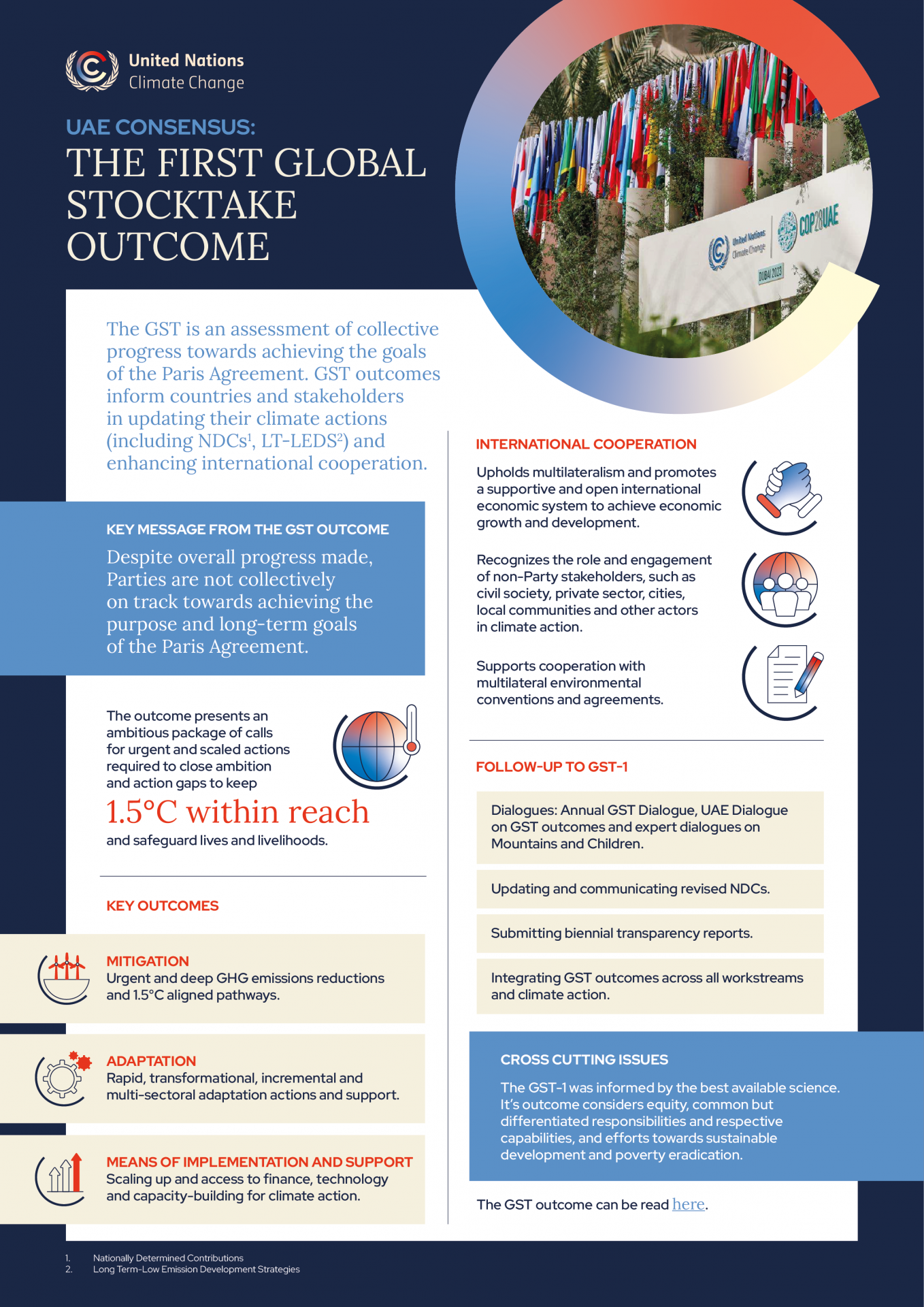
The first global stocktake outcome recognized that progress has been made towards the Paris Agreement goals, reaching near-universal climate action. The outcome also tells us that these efforts are, however, insufficient and that the world is not on track to meet the long-term goals of the Paris Agreement. The world has a narrowing window of opportunity to get back on track.

GST outcome overview
资料来源: UN Climate Change
GST-1 outcome overview
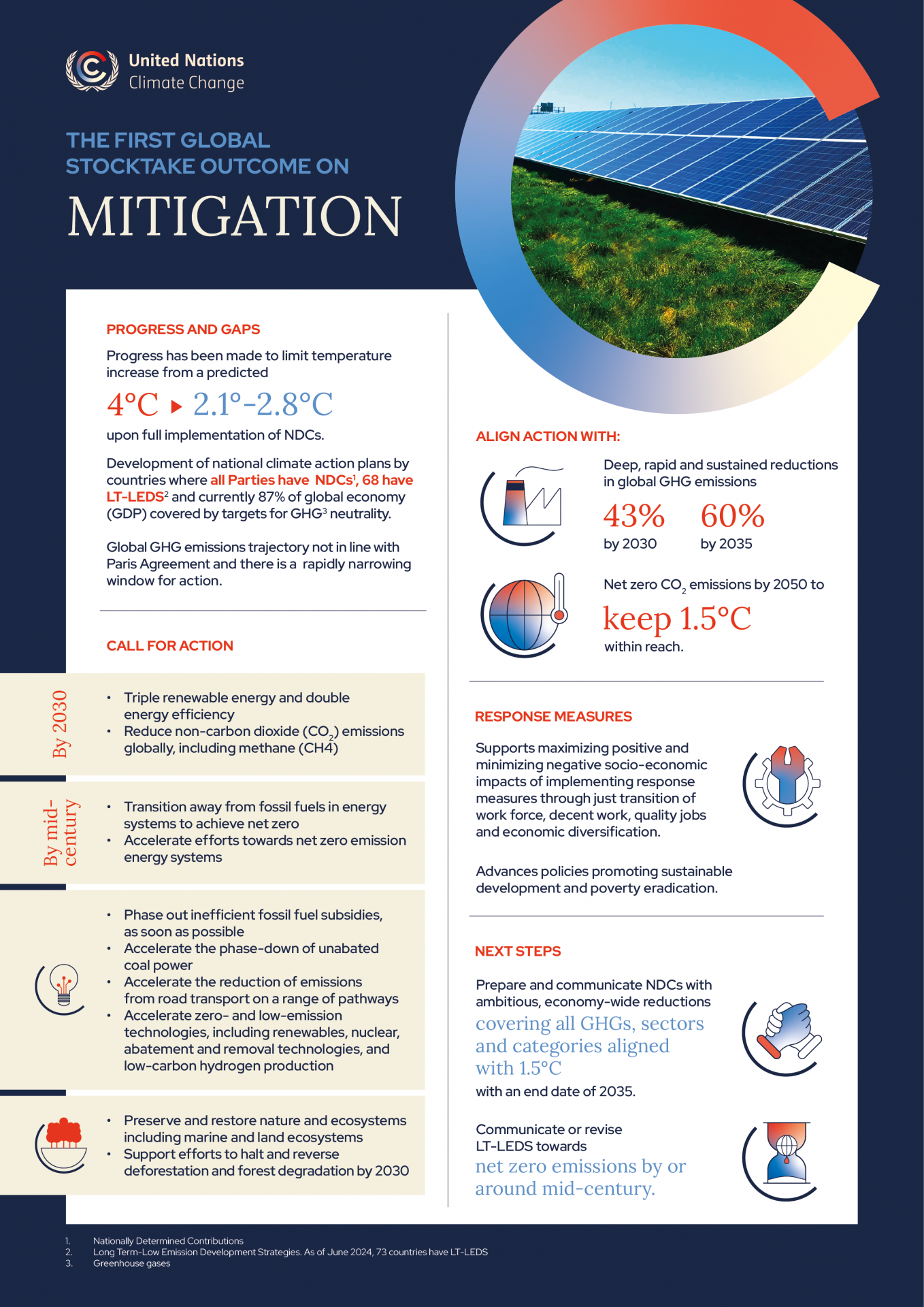
GST outcome mitigation
资料来源: UN Climate Change
GST-1 outcome on mitigation
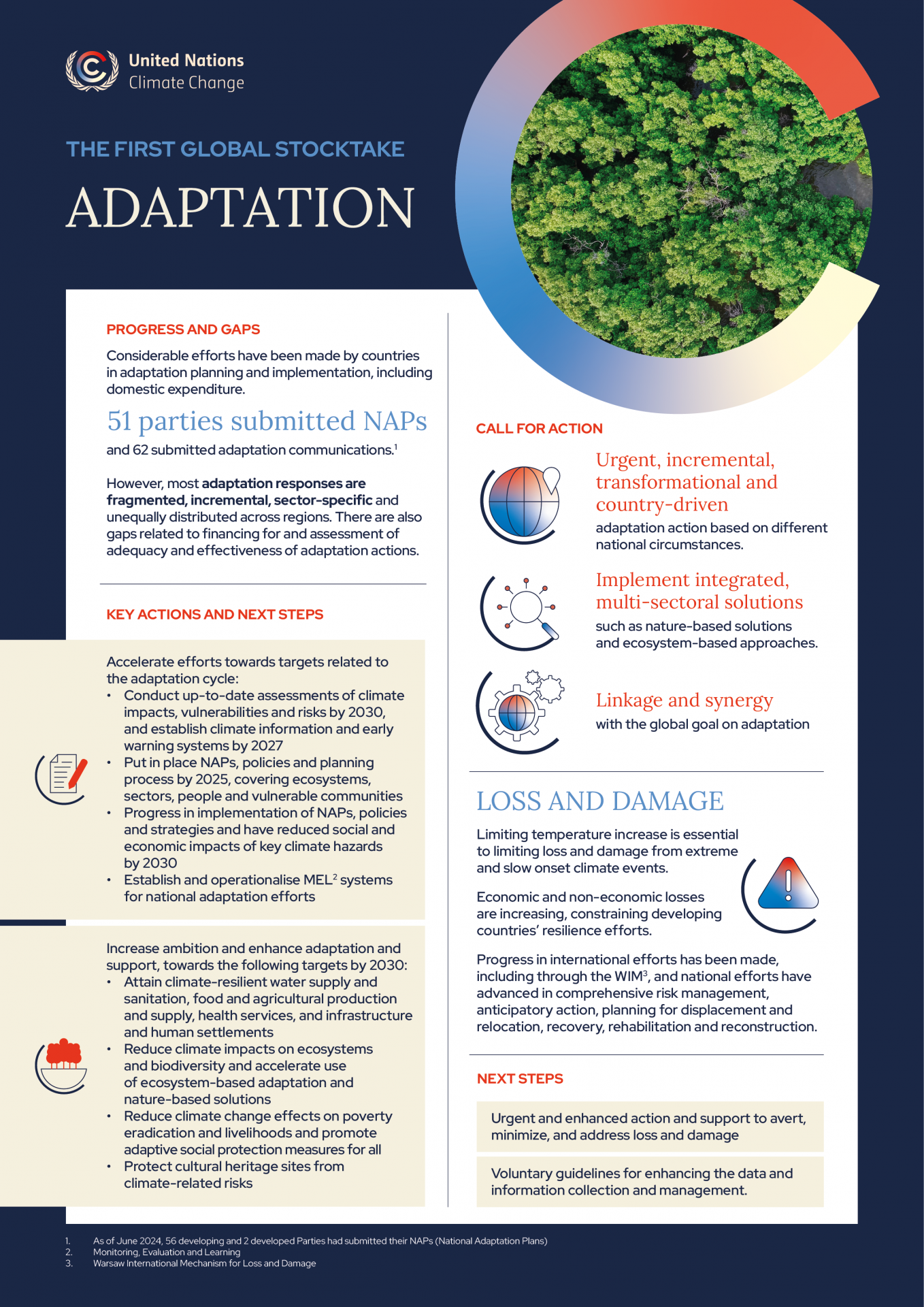
GST outcome adaptation
资料来源: UN Climate Change
GST-1 outcome on adaptation
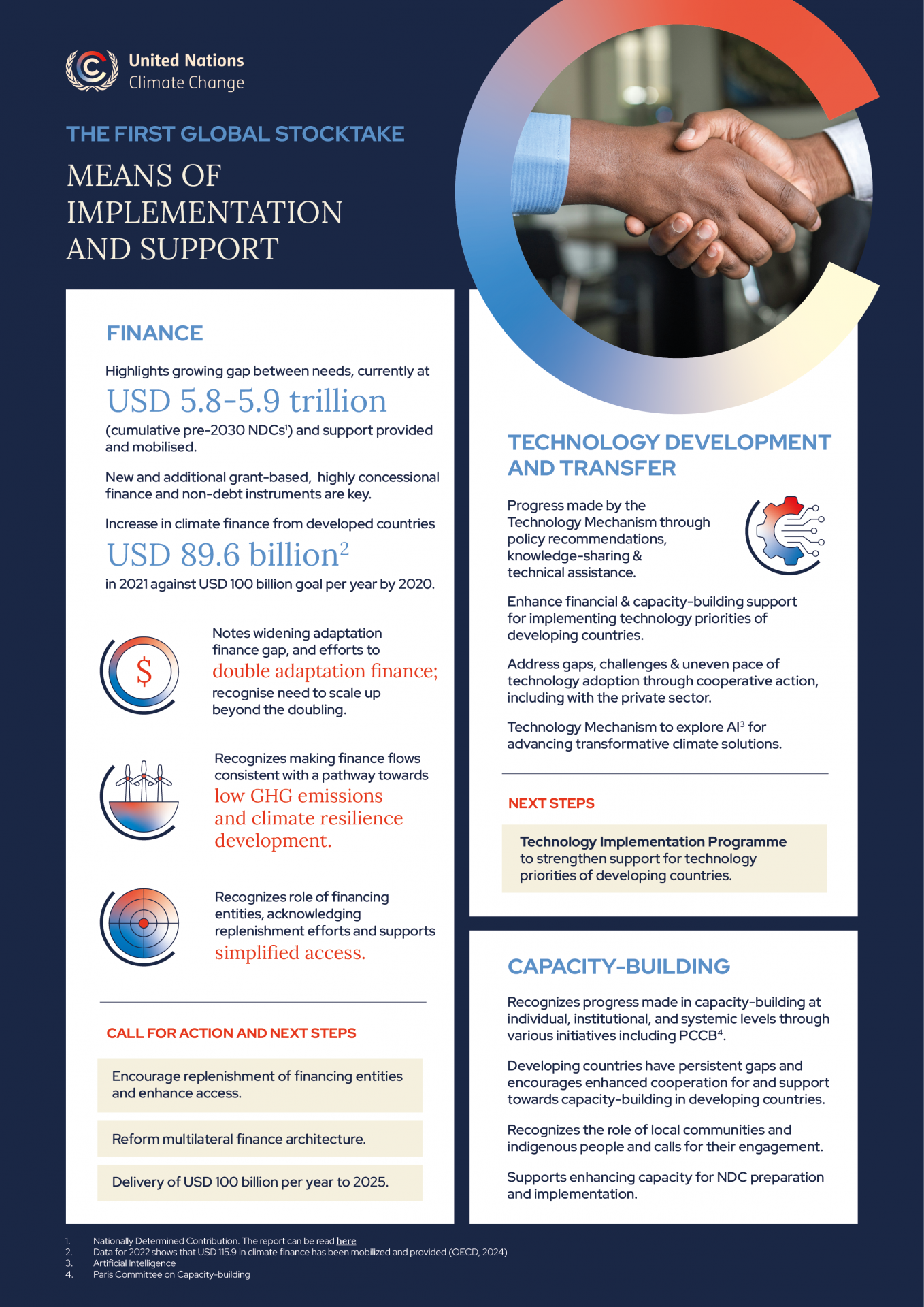
GST outcome MOI
资料来源: UN Climate Change
GST-1 outcome on means of implementation and support


Content