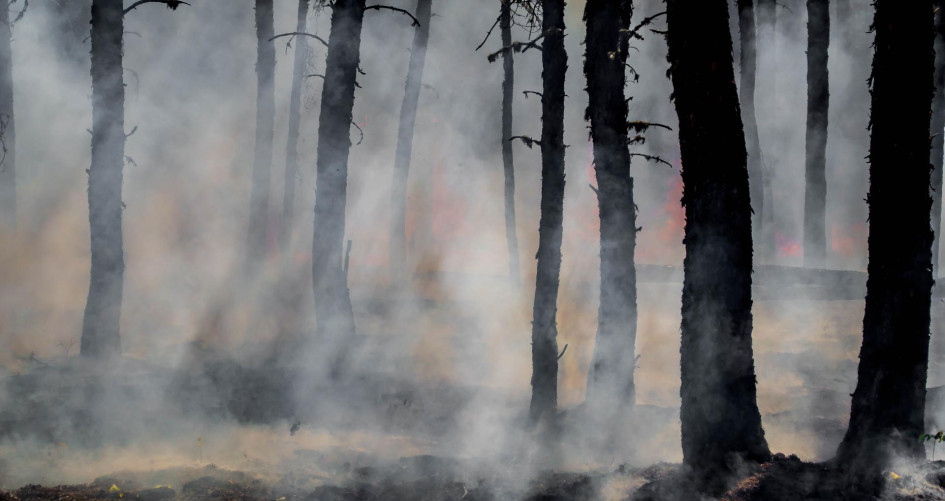
This summer, in a depressingly familiar scenario, the world has had to deal with devastating wildfires, a very visible, and very damaging illustration of the climate crisis.
In the United States, multiple states are battling wildfires, including in Alaska, where more than three million acres of land had been destroyed by fire by mid-July. In California, just one fire close to the Sierra Nevada mountain range has burned through more than 15,000 acres and forced 3,000 people out of their homes. According to the Guardian, more than 5.5 million acres of land have already burned in the US this year, roughly 70 per cent more than the 10-year average.
In Russia, more than 6,000 wildfires had started by the end of June, covering more than two million acres of land, most of it in the country’s far east and Siberia.
Wildfires have also raged across Europe, most notably in France, Portugal, Spain and Greece, which have all experienced record temperatures and long periods of drought. Tens of thousands have been evacuated while hundreds of thousands of acres have been destroyed across the continent.
Spain’s Prime Minister, Pedro Sanchez, speaking at a visit to Extremadura, a south-western region of the country that has been hit hard by wildfires, said: “Climate change kills: it kills people; it also kills our ecosystem, our biodiversity, and it also destroys the things we as a society hold dear – our houses, our businesses, our livestock.”
Yet while the wildfires in Europe have generated many headlines, wildfires are far more common – and devastating – in the Developing World, where authorities often lack suitable fire-fighting equipment.
Wildfires start due to a number of factors, including high temperatures, humidity and a lack of moisture in trees, shrubs and grasses. Add longer, warmer, drier summers and it is no surprise that we are seeing more frequent, and longer-lasting wildfires across the world.
And wildfires look set to become even more frequent. A report from UNEP released earlier this year predicted that extreme fires are set to rise by up to 14 per cent by 2030, 30 per cent by the end of 2050 and 50 per cent by the end of the century.
And while wildfires destroy property, land and lives, they also release a CO2, further exacerbating the climate crisis.
“According to the IPCC, wildfires generate up to one-third of global ecosystem carbon emissions, a feedback that exacerbates climate change,” says Robert Stefanski, Chief, Agricultural Meteorology Division at World Meteorological Organization. Yet, there are multiple other factors that contribute to forest fires, he says. “Deforestation, peat draining, agricultural expansion or abandonment, fire suppression, and inter-decadal cycles such as the El Niño-Southern Oscillation, can exert a stronger influence than climate change on increasing or decreasing wildfire.”
The Copernicus Atmosphere Monitoring Service (CAMS) revealed that last July, a record 1,258.8 megatonnes of CO2 was released, with more than half of the carbon dioxide attributed to fires in North America and Siberia.
Dr Mark Parrington, a Senior Scientist at CAMS, says that while there have been fewer fires in the past two decades on a global scale, in some regions, such as the western United States and Siberia, there have been many more wildfires recorded. The intensity of the fires has also increased. “One thing that the data is showing is that some of these fires are now burning at high intensity with longer duration in recent years,” Parrington says. “Where extreme wildfires were more isolated and burned for a handful of days previously, recent years has shown them to burn for multiple weeks.”
The key factor in the intensity of wildfires is surface temperature. “Human-caused climate change increases wildfire by intensifying its principal driving factor – heat,” says Stefanski. “The heat of climate change dries out vegetation and accelerates burning. Non-climate factors also cause wildfires,” he adds.
“Agricultural companies, small farmers, and livestock herders in many tropical areas cut down forests and intentionally set fires to clear fields and pastures. Cities, towns, and roads increase the number of fires that people ignite. Governments in many countries suppress fires, even natural ones, producing unnatural accumulations of fuel in the form of coarse woody debris and dense stands of small trees. The fuel accumulations cause particularly severe fires that burn into tree crowns.”
So, what can be done to prevent wildfires?
“Adaptation for natural forests includes conservation, protection and restoration measures,” Stefanski says. “In managed forests, adaptation options include sustainable forest management, diversifying and adjusting tree species compositions to build resilience, and managing increased risks from pests and diseases and wildfires. Restoring natural forests and drained peatlands and improving sustainability of managed forests, generally enhances the resilience of carbon stocks and sinks,” he adds.
Indigenous people have their own techniques to prevent wildfires, including controlled burning, where small fires are set to the rid the forest of highly flammable dead foliage. “Cooperation, and inclusive decision making, with local communities and Indigenous Peoples, as well as recognition of inherent rights of Indigenous Peoples, is integral to successful forest adaptation in many areas,” Stefanski says.
Ultimately, the only way there will be a decrease in wildfires is if climate change is tackled in a comprehensive manner. This means countries submitting much stronger National Defined Contributions under the Paris Agreement – only by cutting emissions can global temperature rises be reversed.
Educating the public is also important – just one ember from a BBQ or a cigarette can have devastating consequences, while the heat from a car exhaust is enough to set dry leaves alight. And with wildfires predicted to increase in frequency and intensity, governments will need to invest more in fire-fighting equipment and personnel, as well as ensuring homes in high-risk areas have high fire safety standards.