Organizer
Background
WECF International is a civil society, not-for-profit, feminist organization based in the Netherlands, Germany, and France, with network partners in over 50 countries particularly from the Global South, working to advance the rights and leadership of women and girls in all their diversity. We co-facilitate the engagement of feminist organizations through the “Women’s Major Group” in the United Nations 2030 Agenda for Sustainable Development and the Women and Gender Constituency at the United Nations Framework Convention on Climate Change (UNFCCC) as well as for the regional Beijing+25 process for the UNECE region. Through this advocacy work, we can support capacity-building coordination under and outside of the UNFCCC, maximizing synergies with other networks. WECF has previously contributed to awareness-raising events for the PCCB’s capacity-building hub at the COPs, showcasing good practices for Parties and non-Party stakeholders.
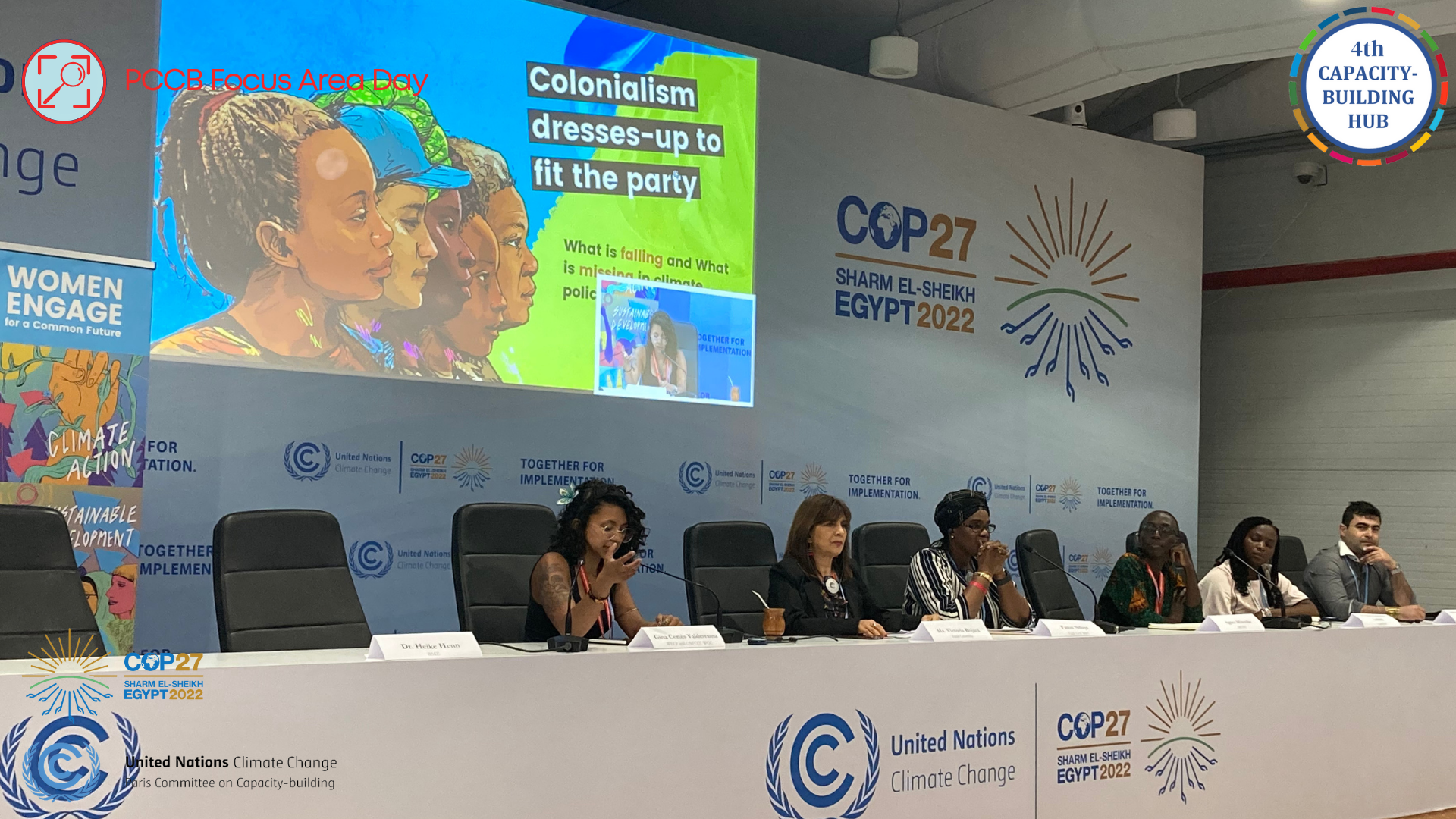
In November 2022, WECF with the support of the German Federal Ministry for Economic Cooperation and Development (BMZ) launched a new publication: "Transformative pathways: climate and gender-just alternatives to intersecting crises". It analyses the 2030 Agenda and Paris Agreement to propose gender-specific targets for each of the Sustainable Development Goals (SDGs) drawn on the key principles of climate and gender justice, care economy, and degrowth. The publication was disseminated during the PCCB Hub event and through our different online platforms and networks. This event opened learning space for the leaders of these gender-just climate solutions to talk more broadly about their experiences and lessons learned over the years in their community work for mitigation with a gender focus.
Objectives
-
Promoted and disseminated gender-just targets to assess the multiple benefits of local climate mitigation solutions across the Sustainable Development Goals to advance on the Paris Agreement.
-
Underlined the need to strengthen capacity-building and investment for gender-sensitive climate initiatives that actively contribute to changing power dynamics and ensuring women's rights while engaging in mitigation or adaptation efforts.
-
Build bridges and open new spaces for exchanging experiences and views among local practitioners, researchers, and policymakers around the cross-cutting benefits of locally owned and gender-responsive climate mitigation and adaptation actions.
-
Contributed to building the capacity of Parties delegates to mainstream gender in the national climate policies.
Structure
|
Time (14.30-15.30)
|
Segments |
| 5 min |
Welcome to the audience and presentation of the event objectives
|
| 5 min |
Introductory words from BMZ Representative
|
| 7 min |
Setting the context - “Transformative Pathways: climate and gender-just alternatives to intersecting crises”
|
| 7 min |
An alternative to development from a solidarity economy model:
In Latin America, Buen Vivir is an alternative model to development that focuses on a common interest. How can this model be brought to reality under current conditions and how does it contribute to a sustainable present and future?
|
| 7 min |
A gender-just transition is possible through a shift to a care economy:
To tackle climate change a just transition is key. However, a just transition goes beyond a model of moving the labour force from one sector to another. From a feminist perspective, how can we advance towards a real just transition, following principles from a care economy and redistribution of power?
|
| 7 min |
Ancestral knowledge driving decentralized and community-owned energy technologies:
Mitigation funding and national development plans tend to focus on large-scale investments. However, such projects fall short of benefiting the entire population, especially those on the frontline of climate change. How do energy cooperatives models and ancestral knowledge contribute to national strategies, and which are the additional benefits of it?
|
| 7 min |
Agroecology as a pathway to conflict resolution and social cohesion:
CAMGEW has an ecosystem-based approach that is a far cry from the popular and unproven technofixes. How does this approach work and how has it served to not only fight hunger in Cameroon but also promote women's agency and conflict resolution?
|
| 7 min |
Gender and climate change focal point:
What is missing from your perspective and experience in the political and legal landscape to promote gender-sensitive mitigation solutions and how to involve these local solutions in the process of formulating and updating NDCs and national climate change policies?
|
| 8 min |
Discussion and closing remarks
|
Speakers
- Dr. Heike Henn, Director for Climate, Energy and Environment, German Federal Ministry for Cooperation and Development – BMZ
- Maria Victoria Bojacá, General director , ENDA Colombia, Colombia
- Agnes Mirembe, Executive director , Action for Rural Women’s Empowerment (ARUWE) , Uganda
- Fatou Ndoye, Enda Graf Sahel, Senegal
- Sevidzem Ernestine Leikeki, Founder and director, Cameroon Gender and Environment Watch (CAMGEW)
- Ambrosio Yobánolo del Real, Chair Technology, Executive Committee UNFCCC
Moderator
Key Outcomes
- This session focused on gender mainstreaming in capacity-building for climate action.
- Key outcomes of the session include the need for capacity-building and investment for gender-sensitive climate initiatives that actively contribute to changing power dynamics and ensuring women's rights is crucial for mitigation or adaptation efforts. Likewise, women need to be integrated into the political decision-making process to enable and accelerate climate-just solutions.
- Lastly, conflict resolution and social cohesion needs to be addressed in pathways for capacity-building in climate action. Speakers from Latin America's Buen Vivir presented their alternative model to development that focuses on a common interest. Likewise, the ecosystem-based approach has been developed in Cameroon not only fights hunger, but promotes women's engagement and conflict resolution.