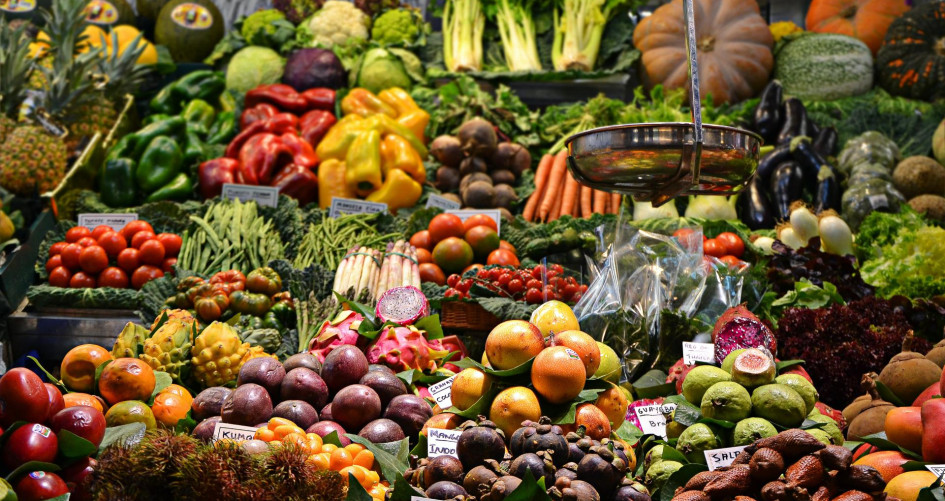
The figures are shocking: More than two billion people globally suffer from food insecurity, and global food waste is responsible for a staggering 8 per cent of greenhouse gas emissions. According to the UN’s Food and Agriculture Organisation, an estimated one third of all the food produced in the world ends up as rubbish before it even gets to the dinner table – a terrible indictment of a broken food system. Indeed, responsible consumption and production patterns is a Sustainable Development Goal, underlining its importance.
One man attempting to fix this is Matt Homewood, a Londoner living in Copenhagen, who set up his An Urban Harvester account on Instagram a few weeks after graduating from Copenhagen University, where he studied climate change science.
He posts near daily dumpster diving (where someone goes through a supermarket’s bins to find edible food) hauls on his feed, illustrating the huge scale of food (and packaging) waste in Denmark. His goal? To make food waste illegal in Denmark.

Speaking at his event at the Climate Action Hub at COP26, Homewood underlined the scale of the problem, and its complexity. “Consumers expect full shelves in supermarkets, even at the end of the day, and supermarkets need to start communicating to customers that this is not normal; you should not expect fresh bread at 10pm at night,” he says. Indeed, we have got used to a consumer society, where we can get anything at any time of the day or night, something that is having a profound effect on the environment. “Food waste doesn’t just happen in supermarkets, it happens at home as well, and we have maybe lost the value of food, and we have lost touch with how it gets made, it is something that just emerges on the shelf,” Matt says. This is reflected in the falling cost of food over the past few decades. “We spend too little relatively on food today – in the UK we only spend 8 per cent of our income on food.” This relates to something called Engel’s Law, which illustrates that when our income rises, we spend proportionally less on food, as we can only eat so much.
Homewood illustrates our complex relationship with food through the disturbing photos and videos he posts on his Instagram feed: Wasted hunks of meat that have come from Uruguay, blueberries, pitta bread, bananas from Dominican Republic, baguettes and dried chickpeas and cans of tuna, entire boxes of food which have not even been opened. Homewood brings what he can back to his flat to photograph them: 45 pizzas, 180 bags of coffee, 157 packets of bacon. While we may be vaguely aware that food gets wasted, seeing the food literally laid out on the floor brings home the scale of the problem in a visceral manner.
“What the photos cannot get across is the stench and the blood,” Homewood says. “My girlfriend is vegetarian and she nearly kicked me out of the apartment, as I was bringing so much food home!”
As Homewood’s follower count grew (he now has more than 20,000), he started getting photographs of food waste sent from around the world. “My followers send in photos of huge amounts of food being wasted around the world, from Sydney and Belgium, Estonia and Sweden.” While all countries have their share of food waste, is seems to be more of a phenomenon in the West, and the effect on the climate is devastating.
A recent report from WWF and Tesco revealed that 1 billion tonnes more food is being wasted than was previously thought, contributing 10 per cent of all GHG emissions. Producing food uses a huge amount of land, water and energy, which is why wasted food produces the equivalent of twice the annual emissions of all the cars driven in Europe and the United States.
“This is even more shocking,” says Homewood, “as 690 million people still go hungry every year, and three billion cannot afford a healthy diet. Yet despite this only 6 per cent of Paris Agreement signatories have food waste goals.”
So, what should happen? Are we doomed to a never-ending toxic relationship with food, or can we escape this vicious cycle?
“There is a lot that needs to happen,” Homewood says. “At the moment, the cost of wasting food is not high enough (between 1-5 per cent of the store's turnover), so a food waste tax would change that. There also needs to be better food labelling, so there is no confusion about when something is still fine to eat. There also needs to be better legislation, and mandatory reporting of food waste, with legally binding reduction targets.”
Yet it’s not just the supermarkets who need to change – we do too. We need to place more value on the food we buy, and make the link between the throwing out perfectly good food and the climate crisis. Homewood’s Instagram account is effective as it helps us make that link, visualising the problem in a stark way – no one of us really thinks about how much bacon is wasted from an average supermarket, but it’s impossible not to when you see 157 packets of bacon laid out on Homewood’s floor.
So, what can you to reduce your food waste? Luckily, the Food and Agricultural Organisation has come up with 15 tips to reduce food waste, which include:
Understand Food Labelling
There’s a big difference between “best before” and “use-by” dates. Sometimes food is still safe to eat after the “best before” date, whereas it’s the “use-by” date that tells you when it is no longer safe to eat. Check food labels for unhealthy ingredients such as trans fats and preservatives and avoid foods with added sugar or salt.
Love Your Leftovers
If you don’t eat everything you make, freeze it for later or use the leftovers as an ingredient in another meal. Of course, if you consistently have leftovers, it might be time to cook a little less food!
Support Local Producers
By buying local produce, you support family farmers and small businesses in your community. You also help fight pollution by reducing delivery distances for trucks and other vehicles.
Use Less Water
Water is an integral part of the food production process. And while it is important that farmers use less water when growing food, reducing food waste also saves the water resources that went into producing the food in the first place. You can reduce your water usage in other ways too, from fixing leaks to turning off the tap when you are brushing your teeth.
Donate Food
Donate food that would otherwise be wasted. For example, there are lots of apps that connect neighbours with each other and with local businesses so surplus food can be shared and not thrown away. Type “food sharing apps” into Google to find apps that service your local area.