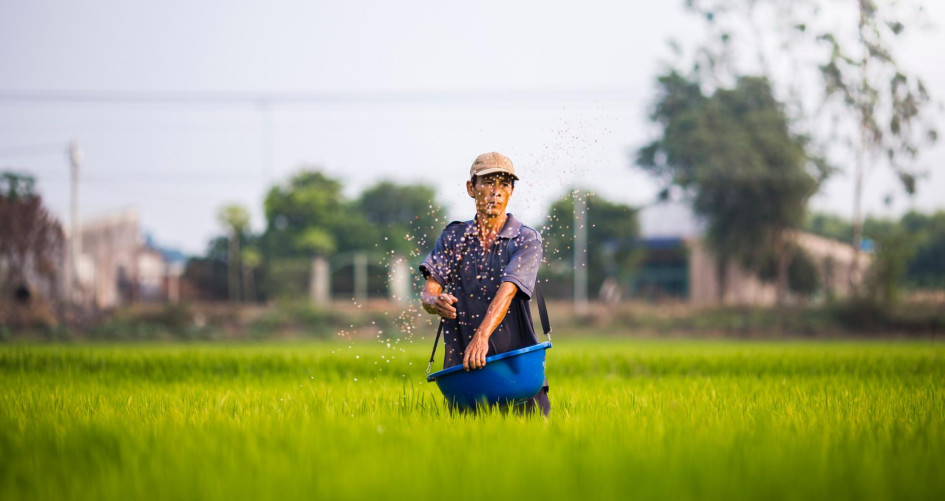
Food, and how we produce it, is unsurprisingly, central to tackling the climate crisis. Food systems – everything from crop production to transportation, processing and retailing – is both a contributor to, and a victim of, climate change. “Agriculture, Forestry and Other Land Use systems are currently responsible for an estimated 23 per cent of global GHG emissions, with food systems as a whole responsible for between 21 to 37 per cent,” says Julia Wolf, an agricultural economist who works for the UN Food and Agriculture Organization (FAO).
Yet despite the importance of our food systems, there is a clear adaptation gap between what is needed on the ground and what is happening. “The adaptation gap in food systems is the difference between the level of adaptation planning, finance and implementation required to achieve the Paris Agreement’s global goal on adaptation,” Wolf says, “and the current levels of adaptation planning, finance and implementation within the food system..” Wolf highlighted that these levels are largely inadequate to meeting the sustainable development global goal on Zero Hunger.”
Speaking at Stepping up adaptation action in food systems: Actioning findings from IPCC Working Group II, a side-event at the current Bonn Climate Conference, food security expert, Bruce Campbell, highlighted some of the takeaways from the most recent IPCC report.
“This is the first time the IPCC has said that some [regions] will not be able to produce food as they won’t be climatically suitable by 2050,” he said. “The report also said that increased, potentially concurrent climate extremes will periodically increase simultaneous crop losses in major food producing regions. So, we could see South East Asia food production capability and Australia’s food production capability collapsing at the same time which would have major implications.”
Wolf points out that there are ways to intensify the use of current farmland, without using peatlands or forests. “There are multiple pathways towards more climate-resilient and sustainable forms of producing food for a growing population within our planetary boundaries,” she says. “These include agroecological intensification, organic farming, climate-smart agriculture, nutrition-sensitive agriculture and nature-based solutions.”
Campbell makes the point that the IPCC report says that small-scale changes by individual farmers won’t be good enough. “Implemented adaptation in crop production will be insufficient to offset the negative effects of climate change, if we go beyond 1.5 degrees and especially if we go beyond 2 degrees. The IPCC also says that while there is a lot of options out there, there is a lack of information on the economic or institutional feasibility of these options, and the limits to adaptation.”
Everyone agrees that all solutions need to be locally driven and context specific. “Agriculture is super context-specific,” says Campbell. “What a farmer in southern Zimbabwe can do is different to what a farmer in central Zimbabwe can do. Irrigation in one place might be great, but irrigation done in a certain way in another place is terrible,” he adds. This is echoed by Wolf: “The role of international organizations is not necessarily to encourage certain solutions over others, but rather to create a suitable enabling environment in which solutions tailored to country contexts may be co-created by everyone considered a stakeholder in the food system.”
In 2014, the IPCC defined maladaptation as “actions that may lead to increased risk of adverse climate-related outcomes, increased vulnerability to climate change, or diminished welfare, now or in the future.” Essentially, these are adaptation techniques that backfire, and actually make things worse, which is why local on-the-ground input is so vital.
Campbell also makes the point that building public and political awareness around the benefits of food systems adaptation is important. “That includes everything from building business cases for adaptation and mainstreaming adaptation into institutional budget cycles to building social movements,” he says.
Despite the somewhat gloomy outlook, Wolf is optimistic about the future. “We are seeing an increase in momentum for climate action in the agri-food systems through an increase in levels of political commitment across all levels of government,” she says. “Government actors are doing much to raise public awareness, ensure accountability and transparency mechanisms, mainstreaming adaptation into institutional budget and policy planning cycles, enhance monitoring and evaluation of adaptation progress, and foster local and indigenous knowledge on impacts and solutions. There is also increasing involvement of key stakeholders such as the private sector, whose ability to provide large upfront investments of human, financial and technological resources are critical now more than ever.”