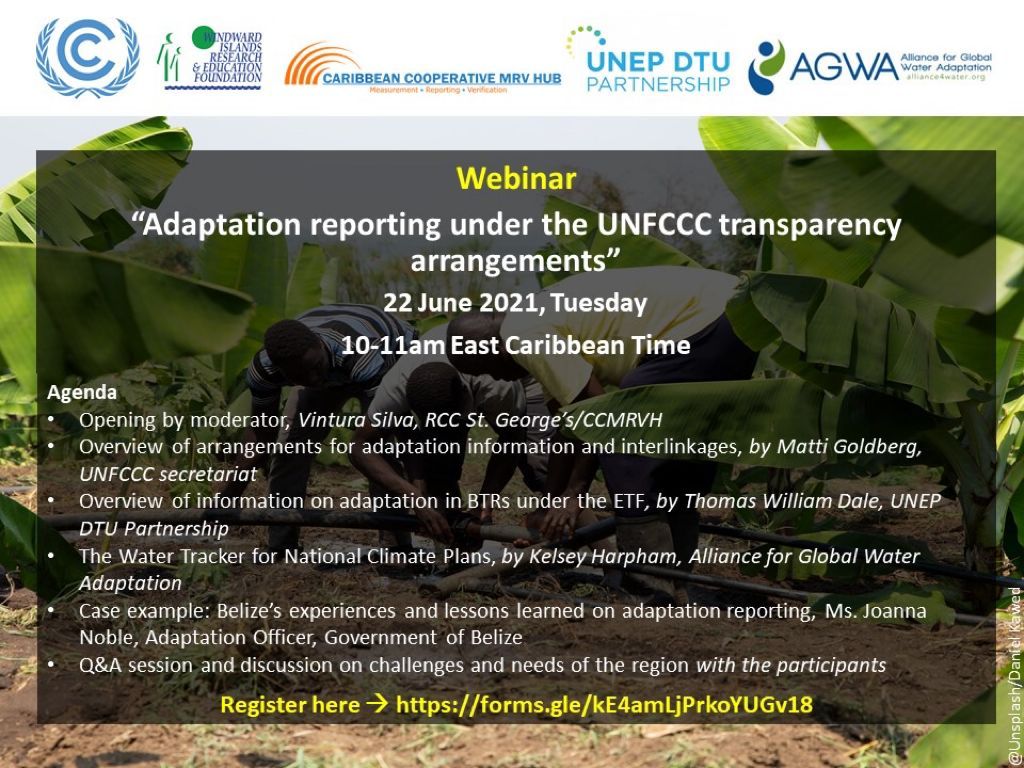
On 22 June 2021, the RCC St. George’s in collaboration with the UNFCCC Secretariat, the Caribbean Cooperative MRV Hub, UNEP DTU Partnership, and the Alliance for Global Water Adaption hosted a webinar on adaptation reporting under the UNFCCC transparency arrangements. The webinar was attended by over 50 participants bringing together national experts from the region who are actively involved in the preparation of National Adaptation Plans (NAPs), National Communications (NCs), Biennial Update Reports (BURs) and national GHG inventories and will be involved in the preparation of BTRs.
The webinar aimed to support the countries in the ETF implementation, specifically to:
- Support participants in acquiring knowledge on the arrangements for adaptation information under the Convention and the Paris Agreement, as well as the interlinkages and complementarities between those arrangements;
- Enhance their understanding on the information that Parties should report on adaptation in the BRTs;
- Build understanding on the evolving role of metrics or indicators in monitoring and evaluation of adaptation actions under the ETF.
In his opening remarks, Vintura Silva, Regional Lead of the RCC St. George’s, highlighted the importance of the modalities, procedures and guidelines of the ETF. This was followed by a presentation by Matti Goldberg from the UNFCCC Secretariat who gave an overview of the UNFCCC arrangements for adaptation information, their overlaps, similarities and differences, as well as possibilities for using them in coherent, efficient and non-duplicative ways.
The presentation by Thomas William Dale from UNEP DTU Partnership provided an overview of the guidelines for reporting on adaptation though the BTRs under the ETF, in particular the types of information that the adaptation sections of the BTRs should include under the guidelines in decision 18/CMA.1. Additionally, a presentation on the water tracker, a new tool that is being developed under the adaptation action coalition to enhance recording water-related information, was given by Kelsey Harpham, Alliance for Global Water Adaptation.
Participants also listened to a case example by Joanna Noble, Adaptation Officer from Government of Belize which focused on their experiences and lessons learned on adaptation reporting in their fourth NC and first BUP project.
The webinar ended with a Q&A session and further discussions with the participants on challenges and needs of the region. In his closing remarks, Vintura, provided information on the next events of the webinar series which aims to build knowledge around the ETF to facilitate the countries preparation for the implementation of the ETF. The next webinar will focus on support and will cover capacity building, climate finance and technology transfer for reporting purposes under the ETF.