Climate Weeks
2025
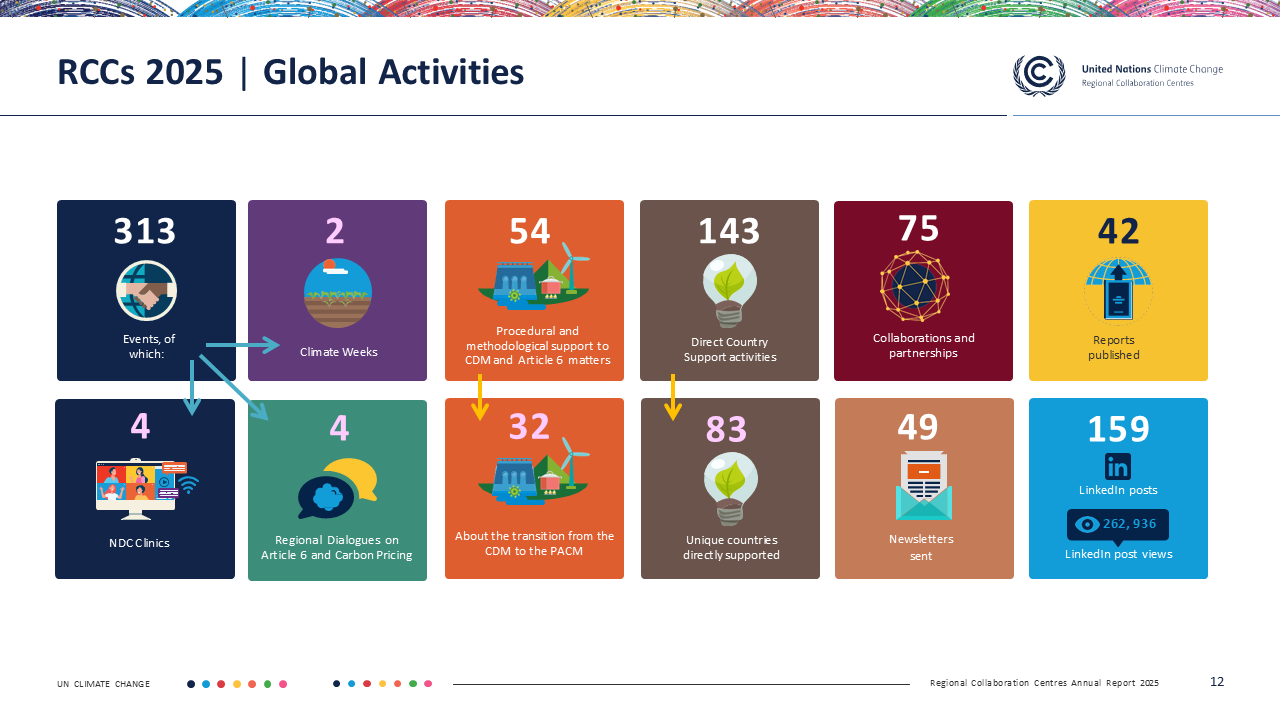
In 2025, our UN Climate Weeks took on a new format, focused on supporting governments and other Paris Agreement stakeholders to drive forward implementation of pledges. One of the ways our new Climate Weeks do this is by providing a practical space to advance priorities on finance, technology cooperation, and carbon markets. The UNFCCC Regional Collaboration Centres (RCCs) played a central role in this in 2025.
Through extensive regional outreach towards, targeted mobilization of stakeholders including multilateral development banks and regional organizations, and operational and technical support to event coordinators at CWs, the RCCs helped to ensure the Climate Weeks advanced progress on NDC implementation, NAP-related support, and Article 6 readiness.
A key feature of the new format for Climate Weeks is also providing spaces to connect negotiators attending mandated events with implementers from across governments, the private sector and financiers, international bodies, and civil society, including young people
The first Climate Week in the new format (CW1), hosted by the Government of Panama (19–23 May), brought together Party delegates and a wide spectrum of non‑Party stakeholders— including multilateral development banks, investors, businesses, civil society and local communities and Indigenous Peoples. A key milestone of the Week was the inaugural Implementation Forum, designed to help translate commitments from the intergovernmental COP process into practical implementation pathways. RCCs contributed directly by supporting stakeholder engagement and by helping to deliver initiatives such as the Implementation Labs.
Another top priority of the new format is finding efficiencies and cost savings for Parties and other Climate Week participants, by clustering mandated meetings.CW1 also hosted several key mandated sessions supported by the RCCs — such as the fifth global dialogue and investment-focused event under the Sharm el‑Sheikh Mitigation Ambition and Implementation Work Programme, the third dialogue under the UAE Just Transition Work Programme, and the Global DNA Forum on Article 6 implementation. In addition, the first in‑person NDC Clinic of the year, provided hands‑on, country‑tailored support for NDC implementation.
The second Climate Week (CW2), held in Addis Ababa, Ethiopia, in September, had a strong emphasis on adaptation and unlocking finance for implementation. The Week leveraged the Implementation Forum formats — including Implementation Labs and targeted technical exchanges — to help identify solutions that can be scaled up or replicated in other geographies.
2026
Building on the foundation laid in 2025, Climate Weeks continue to strengthen as practical platforms with a clear emphasis on connecting negotiated outcomes to delivery in communities and real‑economy systems. Climate Week 3 (CW3) took place in Yeosu, Republic of Korea (21–25 April), followed by Climate Week 4 in Baku, Azerbaijan (7–11 September). The focus will again be on real-world solutions that can help Parties and other Paris Agreement stakeholder to drive forward faster and more inclusive implementation, while also advancing mandated work and connecting it more closely to real economy implementation.
The RCCs are expected to remain key delivery partners in the Climate Weeks into the future. RCC's contributions will span programme design and consultation, expanded regional stakeholder engagement, and onsite operational and technical delivery, alongside the Climate Week core team. Through this role, the RCCs will help to translate COP outcomes and issues into more implementation and real-world outcomes that reflect realities on the ground, while providing continuity to follow-up support through RCC work programmes and partnerships.
In this way, Climate Weeks in 2026 will continue to serve as a practical bridge between mandates and measurable progress on the ground, helping translate global commitments into regional action, strengthened capacities, and tangible outcomes for Parties and stakeholders that deliver concrete benefits for millions more people at community and national levels, as well as economic benefits, as the global transition to clean energy and climate resilience gathers pace and scale.