Background
The UNFCCC secretariat plays a central role in collecting, managing, analysing and sharing climate data and information to support the implementation of the Convention, the Kyoto Protocol and the Paris Agreement. As climate action accelerates and reporting requirements expand, the volume, diversity and complexity of climate data have grown significantly.
Today, the secretariat and the wider climate community face several systemic challenges: rapidly increasing data volumes; inconsistent formats and deviations from agreed data models; fragmented and largely manual processes; siloed tools and datasets; limited data visualisation and sharing; and the underutilisation of advanced analytics and artificial intelligence. Together, these challenges constrain the ability to generate timely insights and to support coordinated global climate action.
Why a Climate Data Hub?
As climate-related risks become more frequent and severe, fragmented data systems are no longer just inefficient—they limit the collective capacity to respond effectively. Reliable, accessible and well-integrated climate data are essential for transparency, accountability and informed decision-making at all levels. The UNFCCC Climate Data Hub is the secretariat’s response to this need.
Vision
The vision of the UNFCCC Climate Data Hub is to demonstrate—through data—a credible pathway to closing the gap to 1.5°C, bridging global commitments with evidence-based insights that can inform action, policy and ambition.
About the UNFCCC Climate Data Hub
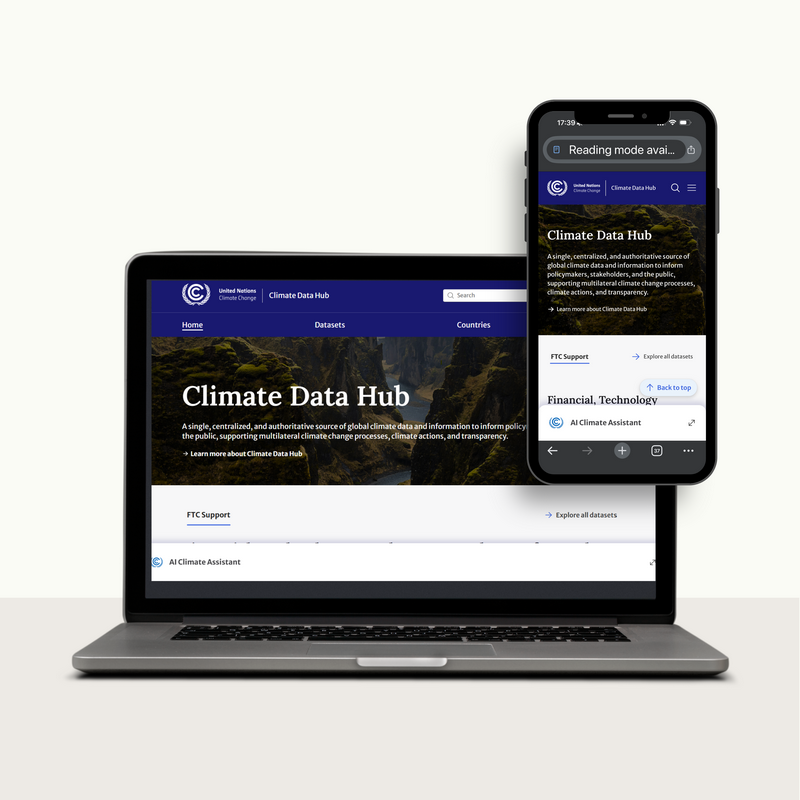
The UNFCCC Climate Data Hub is being developed as a single, centralised and authoritative platform for global climate data and information. It is designed to support the secretariat, policymakers, Parties, stakeholders and the public by strengthening multilateral climate processes, climate action and transparency.
The Hub leverages data and information submitted by Parties and other stakeholders and transforms them into actionable insights and analysis. It serves as a core repository—a single source of truth—for climate data submitted under key UNFCCC processes, including the Enhanced Transparency Framework (ETF) and non-Party stakeholders. By integrating these diverse data streams, the Climate Data Hub plays a transformative role in advancing global climate transparency and supporting informed decision-making across the UNFCCC process.
In its initial phase, development has focused on supporting the Enhanced Transparency Framework, particularly the management, analysis and review of information submitted through Biennial Transparency Reports (BTRs).
An Integrated Ecosystem
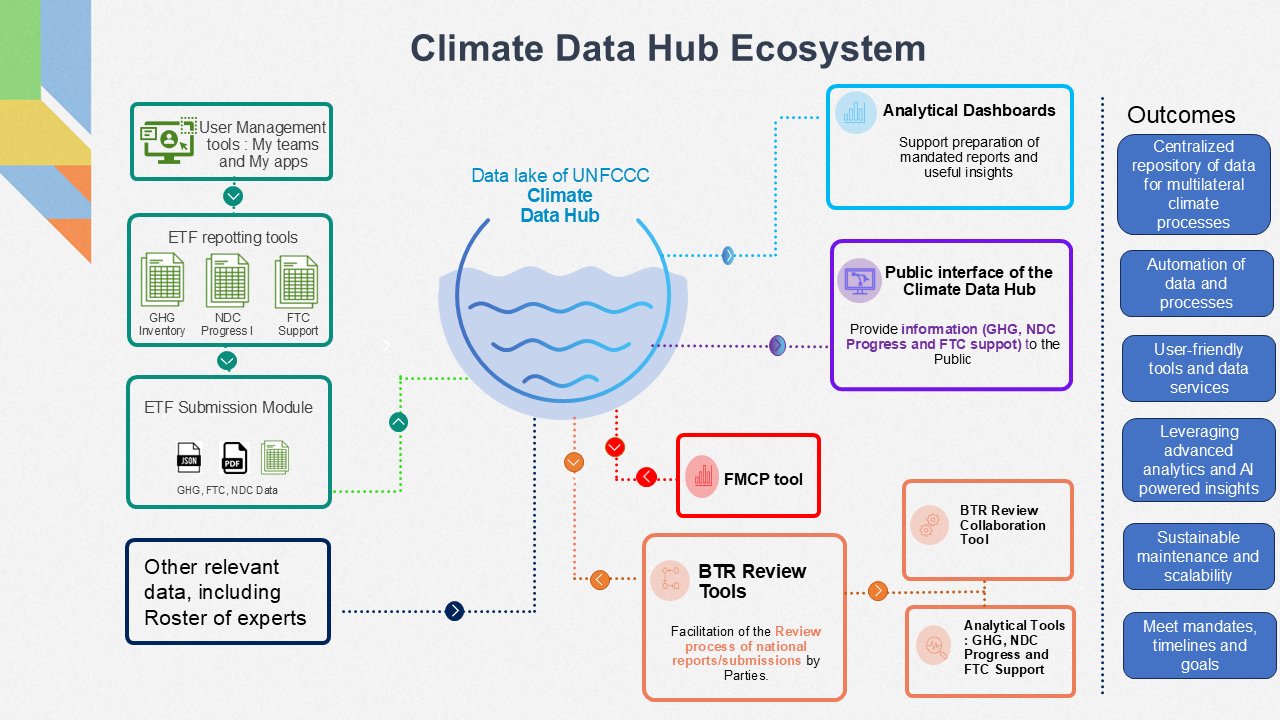
The Climate Data Hub is not a single tool, but an interconnected ecosystem that brings together:
- Reporting tools under the Enhanced Transparency Framework that enable Parties to submit data and information
- Other relevant data sources and tools, such as the roster of experts
- A central data lake for storing, managing and analysing climate data
- Review tools that support and streamline the technical review of national reports, including BTRs
- Analytics and visualisation services to support mandated reports and generate insights
- A public interface to share datasets and insights with stakeholders and the wider public
The modular and scalable design allows the Hub to evolve over time, integrate new data sources and processes, and remain compatible with emerging data formats and technologies.
Intelligence-Driven by Design
The Climate Data Hub is being built with a strong focus on data engineering and advanced analytics. Over time, it will incorporate AI-powered capabilities to unify data sources, enhance analytical depth and improve data presentation. These capabilities will support strategic planning, policy support, negotiations and outreach, while also enabling Parties and the public to derive insights that can inform climate action and ambition.
Current Status
Key components of the Climate Data Hub are already operational:
- A scalable data lake foundation that receives, manages and analyses BTR narrative and tabular data, including information on greenhouse gas emissions, NDC progress and financial, technology and capacity-building (FTC) support
- Automated integration between ETF reporting tools and the data lake
- Analytical tools and dashboards to support the BTR review process
- A collaborative review tool to facilitate technical expert reviews of BTRs
- An AI-powered public interface, currently focusing on FTC support information
These foundations provide a robust platform for future expansion across additional UNFCCC processes.
Key Benefits
The UNFCCC Climate Data Hub delivers clear and tangible benefits:
- Enhanced data management through a centralised repository that improves data consistency, quality and efficiency
- Improved collaboration via integrated tools and shared data environments
- Advanced visualisation and analytics that transform complex datasets into meaningful insights
- Scalability and future readiness through a modular, extensible architecture
- AI-enabled insights that strengthen analysis, planning and policy support
- Stronger support for climate action and transparency across the ETF and other UNFCCC processes
- Greater public engagement, enabling wider access to climate data and insights
Through these benefits, the Climate Data Hub contributes to a more transparent, efficient and effective global climate governance system—supporting collective efforts to address climate change.