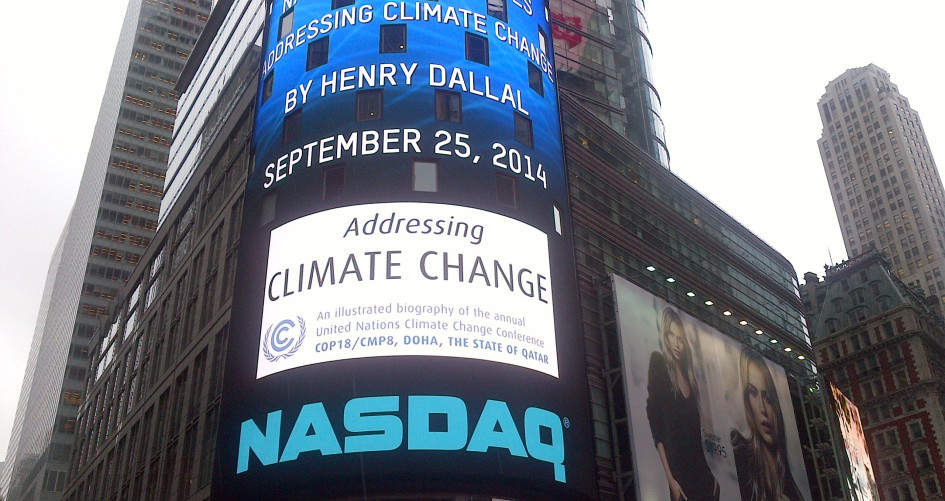
Hard on the heels of a major set of global business sector commitments to address climate change at the UN Climate Summit, US stock exchange NASDAQ hosted a special opening bell on September 25 with top UN climate change official Christiana Figueres, who said:
Today, the NASDAQ opening bell rang out loud and clear for the capital markets to drive the transformation to a low-carbon world, which is now so urgent.
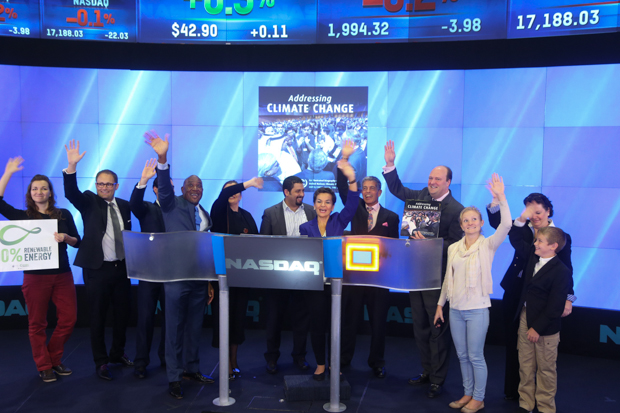 The sounding bell may have been symbolic but the swell of commitments and calls by the financial and corporate sector to take faster, firmer climate action and get on track to a truly sustainable economic future is becoming a very real wave of change.
Time and again at the summit, major companies and financial institutions along with mayors of the world’s cities and leaders of states and regions announced big-ticket initiatives to create clean and resilient societies and economies.
But they also repeatedly underlined that, in order to move ahead further and faster, they need governments at national and international level to launch more ambitious climate policies and incentives which put a proper economic price on carbon and other pollutants and lay the foundation for a new, effective global climate change agreement in Paris, at the end of 2015.
Speaking at the NASDAQ, which fielded the logo of the UN Framework Convention on Climate Change (UNFCCC) prominently on its Times Square display, UNFCCC Executive Secretary Figueres said:
Governments are being given both the license and the finance to act in the interests of the world's people. It is time to act on this.
Swelling Wave of Investor Climate Action to Reduce Risk and and Secure Sustainable Returns
 In a sign of the breadth and depth of the financial sector response just days before the UN summit, nearly 350 global institutional investors representing over $24 trillion in assets called on government leaders to put a “stable, reliable and economically meaningful” price that polluters have to pay for their carbon emissions to help scale up investment towards clean power and energy efficiency.
A major new report, the New Climate Economy, was also released just ahead of the summit. Backed by a group of current and former global leaders from 19 countries, mayors of two of the world’s biggest cities and the heads of four of the largest corporations, it said:
"Low-carbon and climate resilient growth is possible. The capital for the necessary investments is available, and the potential for innovation is vast. What is needed is strong political leadership and credible, consistent policies."
Business Action in Spotlight at UN Climate Summit
Summarizing the results of the climate summit, UN Secretary General Ban Ki-moon said that moving markets across a wide range of sectors is essential for transforming economies at scale and mobilizing sufficient public and private funds for low carbon, climate resilient growth is essential to keep the world on a pathway below an average global temperatures rise of 2 degrees Celsius.
Key results from the business sector at the summit included:
- A new coalition of governments, business, finance, multilateral development banks and civil society leaders announced their intent to mobilise over $200 billion for financing low-carbon and climate-resilient development.
- Countries strongly reaffirmed their support for mobilising public and private finance to meet the $100 billion dollar goal per annum by 2020.
- Leaders expressed strong support for the Green Climate Fund and many called for the Fund's initial capitalization at an amount no less than $10 billion. There was a total of $2.3 billion in pledges to the Fund's initial capitalization from six countries. Six others committed to allocate contributions by November 2014.
- The European Union committed $3 billion for mitigation efforts in developing countries between 2014 and 2020.
- The International Development Finance Club (IDFC) announced that it is on track to increase direct green/climate financing to $100 billion a year for new climate finance activities by the end of 2015.
- Significant new announcements were made on support for South-South cooperation on climate change.
- Leaders from private finance called for the creation of an enabling environment to undertake the required investments in low-carbon climate resilient growth. They announced the following commitments:
- Leading commercial banks announced their plans to issue $30 billion of Green Bonds by 2015, and announced their intention to increase the amount placed in climate-smart development to 10 times the current amount by 2020.
- A coalition of institutional investors, committed to decarbonizing $100 billion by December 2015 and to measure and disclose the carbon footprint of at least $500 billion in investments.
- The insurance industry committed to double its green investments to $84 billion by the end of 2015.
- Three major pension funds from North America and Europe announced plans to accelerate their investments in low-carbon investments across asset classes up to more than $31 billion by 2020.
Summit Gives Powerful Boost to Price Carbon Properly
Much stronger policy that puts a real economic price on carbon will also provide markets with the signals needed to invest in climate solutions. At the summit:
- Seventy-three national Governments, 11 regional governments and more than 1,000 businesses and investors signalled their support for pricing carbon. Together these leaders represent 52 per cent of global GDP, 54 per cent of global greenhouse gas emissions and almost half of the world’s population.
- Some leaders agreed to join a new Carbon Pricing Leadership Coalition to drive action aimed at strengthening carbon pricing policies and redirecting investment
- More than 30 leading companies announced their alignment with Caring for Climate Business Leadership Criteria on Carbon Pricing.