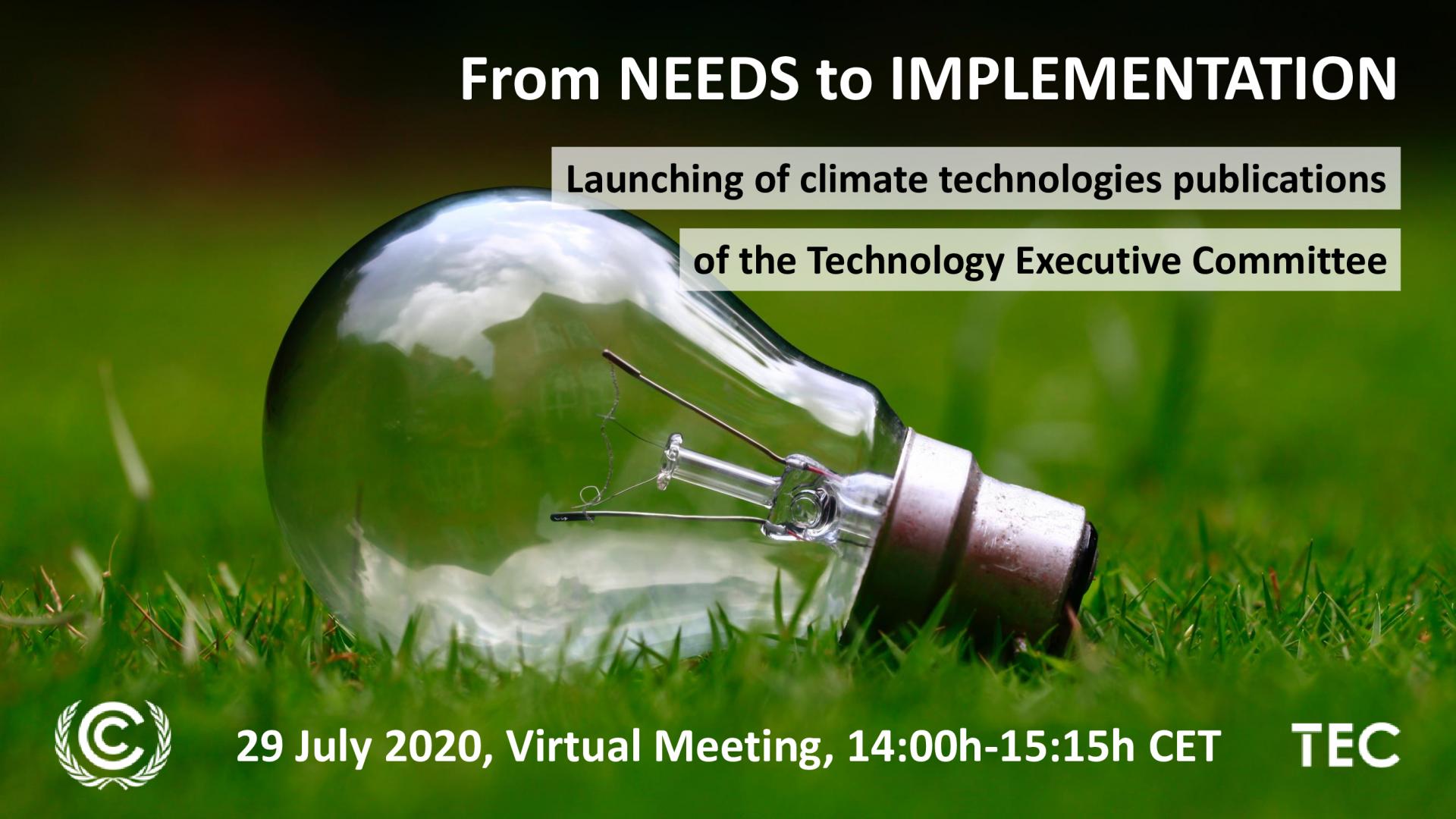
Launching of climate technologies publications of the Technology Executive Committee
Short info: The topics of the publications are well interlinked. TEC Brief #13 explores the starting point of the climate technology journey, that is the identification and prioritization of the best suited climate technologies for countries. The implementation of the identified technologies for climate change mitigation and adaptation is the next step. How to accelerate and scale up the implementation of such technologies through innovative approaches is elaborated in the second publication of the TEC. The third publication takes a sector specific perspective and showcases country examples of implemented adaptation climate technologies in coastal zones.
Short info: In 2019, conditions forced a climate change reality check on the world. We have seen the grief and anguish of communities that have been subject to climate-related disasters. We have seen a wealth of new evidence highlighting the speed and severity of the climate crisis come to light, as well as the power and influence of millions of young people striking in our streets, compelling world leaders to listen and act. On Sunday, 15 December, COP25 finally ended after numerous delays. This major climate conference was the last opportunity for governments to finalise the rules that will guide the implementation of the Paris Agreement, before they have to submit emission reduction plans that match their promises to limit the temperature increase to 1.5°C.
Providing bodies: Least Developed Countries Expert Group
Short info: GCF regularly holds Structured Dialogues in different regions of the world to share knowledge about how to use public investment to address climate change and stimulate private finance.
Short info: The platform aims to bring visibility to potential investments and identify opportunities for action and investment; mobilize multiple sources of finance and combine them most effectively to maximize deployment and impact; identify barriers to scaled up investment and develop solutions and political support to address them; facilitate the identification and allocation of risk to those who can best bear and manage them and hence facilitate appropriate financial structuring to crowd in additional funding.
Short info: A series of capacity-building related events at the COPs that provides all stakeholders involved in capacity-building with the opportunity to exchange experiences, knowledge, success stories and lessons learned on how best to support capacity-building in developing countries.
At COP 24, four gender-related events were held at the Capacity-building Hub.
Short info: An annual platform that gathers together a wide range of stakeholders with diverse perspectives, including students, entrepreneurs and policymakers, to identify climate challenges, including gender-related issues, and together come up with solutions at the city level.
Short info: One of the greatest obstacles in eradicating poverty and hunger worldwide and achieving the United Nations Sustainable Development Goals (SDGs) is the availability of and access to natural resources. Our natural environment works in cycles and, to be effective and sustainable, so should resource management.
These challenges will be the focus of the third Dresden Nexus Conference on 3–5 June 2020, under the theme “Circular Economy in a Sustainable Society”. The programme will explore research and practical examples of sustainable resource management in communities around the world, and how these management strategies support the achievement of the SDGs. Focus will be placed on how the Nexus Approach to the management of environmental resources, such as water, soil, and waste, contributes to the realisation and implementation of circular economy principles.