Early Warning Systems
TEC Rolling Workplan 2023-2027
Advancing community-based early warning systems
Multi-hazard early warning systems are an essential public good for climate adaptation, disaster risk reduction and resilience. Through the Early Warnings for All (EW4All) initiative, governments and partners have committed to ensuring that every person is protected by life-saving early warning systems by 2027. While investments in risk knowledge, monitoring and forecasting have expanded, progress remains uneven. In many contexts, warnings are produced but do not reach all people at risk, are not communicated in an accessible or trusted form, or cannot be translated into timely protective action.
This brief builds on Realizing Early Warnings for All: Innovation and Technology in Support of Risk-Informed Climate Resilience Policy and Action, a policy brief prepared by the UNFCCC’s Technology Executive Committee and the Group on Earth Observations. It focuses on the operational dimensions of people-centred early warning systems, with particular relevance to EW4All Pillar 3 on warning dissemination and communication and Pillar 4 on preparedness to respond.
Advancing community-based early warning systemsThe brief highlights that:
The brief also recommends the importance of:
| |

Realising Early Warnings for All: Innovation and Technology In Support of Risk-Informed Climate Resilience Policy and Action
Positioned as one of the flagship reports of the UN Secretary General’s Early Warnings for All (EW4All) initiative, the joint Technology Executive Committee (TEC) and the Group on Earth Observations (GEO) policy brief highlights the essential role of climate technology policies and scalable fit-for-purpose technology solutions in improving climate information and disaster risk knowledge, enhancing the effectiveness of multi-hazard early warning systems (MHEWS).
- At COP 29, TEC and GEO launched the policy brief at the Earth Information Day 2024.
- Policy brief has informed the Global status of multi-hazard early warning systems 2024 and its section 3.2.5. which focuses on Technology and innovation for risk knowledge.
- News Article: UN Climate Change’s Technology Executive Committee and Group on Earth Observations Launch Policy Brief to Bolster Climate Resilience with Early Warning Technologies
Additional language versions of the Key Messages & Recommendations: | Realising EW4All: Innovation and Technology in Support of Risk-Informed Climate Resilience Policy and ActionThe joint policy brief:
|
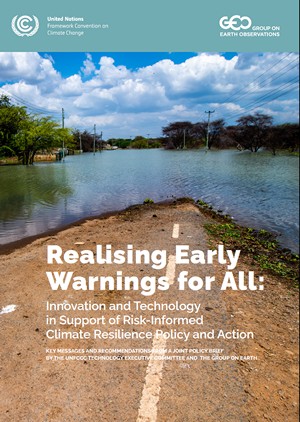
Key Messages and Recommendations
The brief’s executive summary, which also serves as TEC’s key messages and recommendations for consideration at COP29 and CMA6 (*) is available in Arabic, Chinese, English, French, Russian, and Spanish. It offers a high-level summary of the key findings and recommendations for Parties, international organisations and all stakeholders to scale up innovation and MHEWS technology solutions with six action points:
- Consider MHEWS technologies when preparing and updating NDCs, NAPs, TNAs and other documents;
- Invest in multisectoral technology solutions;
- Leverage international initiatives and public-private partnerships;
- Support the integration of technologies into projects to promote local stakeholder engagement;
- Build the technical capacity of stakeholders in developing countries;
- Leverage the global community of scientific experts and innovators
(*) See the Joint annual report of the TEC and the CTCN for 2024 (p.25-26)