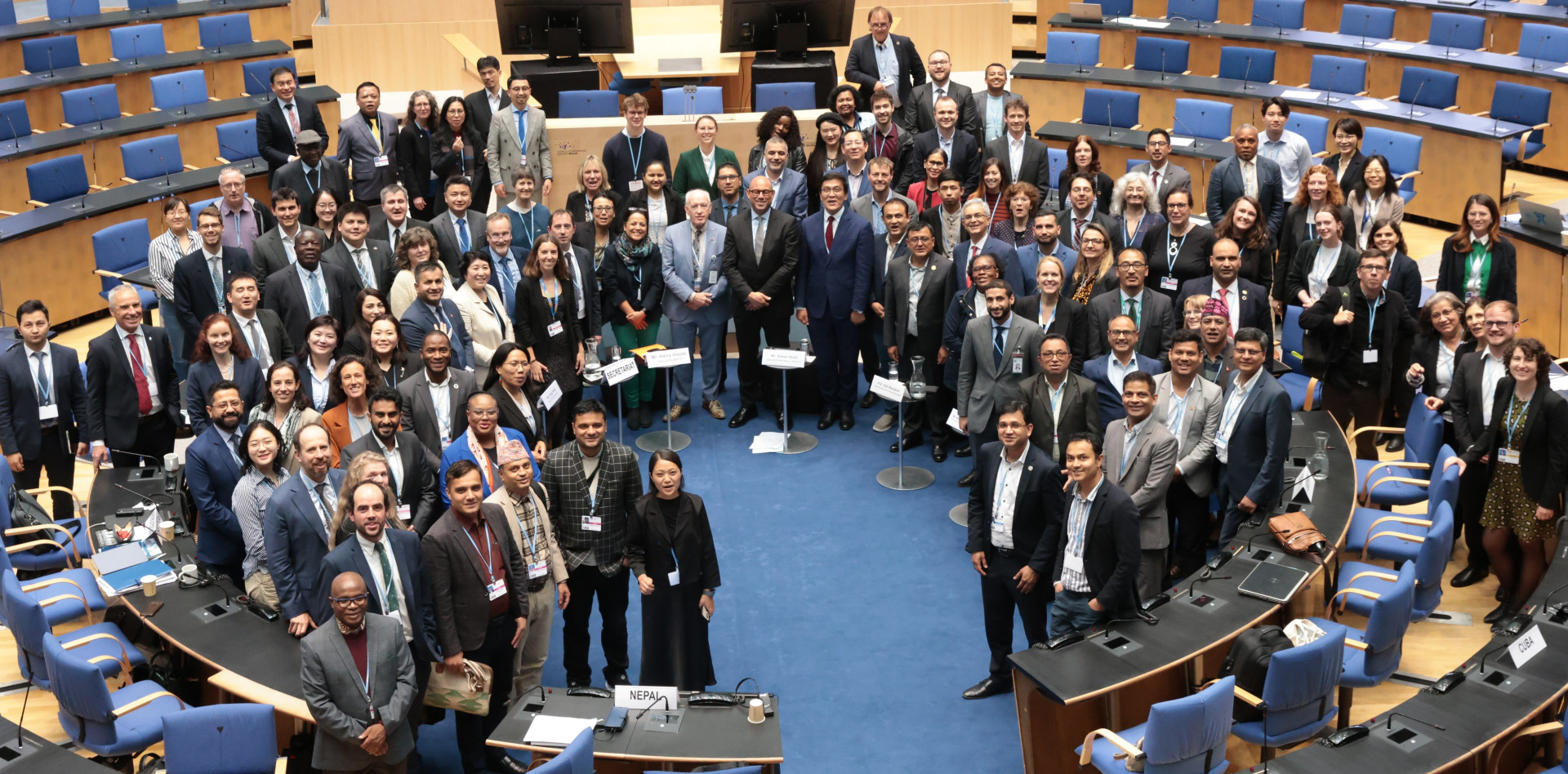
Harry Vreuls, Chair of the Subsidiary Body for Scientific and Technological Advice (SBSTA), convened the expert dialogue on mountains and climate change on June 5, 2024, during the UN climate conference (SB 60) in Bonn, Germany. The dialogue brought together experts, policymakers, frontline communities and stakeholders to discuss the impacts of climate change on mountainous ecosystems and explore solutions to enhance their resilience. The overarching objective of the dialogue was to enhance understanding of climate impacts on mountains, showcase resilience solutions, and discuss ways to accelerate climate action at all levels.
Key messages: Building a collective vision for resilience in mountainous ecosystems
“Climate change risks and impacts in mountainous ecosystems are transboundary in nature and impact downstream communities and countries. There is a value in building synergy and efforts at transboundary and regional level.”
Mr. Harry Vreuls, Chair of the SBSTA
The key take-away messages from the dialogue include:
- There is compelling evidence from science that the choices and actions implemented in this decade will have impacts now and for thousands of years. In this regard, accelerated collective and transformative climate action to build the resilience of mountain ecosystems is of paramount importance;
- Recognizing that mountain systems are complex, fragmented, and globally distributed, the solutions necessary to address climate change must be tailored for mountains and the resources need to match the scale of action required;
- Engaging communities and indigenous peoples is vital. Local practices that consider entire systems’ health and functionality need to be part of the solutions in strengthening the resilience of mountainous ecosystems;
- Recognizing the context specificity of climate change solutions in all regions, it is key to encourage the interregional exchange of experiences, data, and lessons learned to encourage innovation and learning between regions;
- There is a need to continue the political momentum, strengthen efforts, and create enabling environments to build resilience of mountainous ecosystems, both under and outside the UNFCCC process.
Mountainous ecosystems play pivotal roles in building climate resilience, through their socio-economic, ecological, and agricultural functions. Mountains store clean water for downstream communities, provide livelihoods for inhabitants, support climate-resilient biodiversity, and allow for high-altitude adapted crop production.
Understanding science, risks, and impacts on mountains due to climate change
Experts emphasized the importance of mountain regions and ecosystems as these represent about a quarter (23.5%) of the global land surface, with more than 1 billion people residing within these lands and billions more downstream dependent on mountain resources, particularly water.
However, mountains are significantly vulnerable to climate change, and 1.5 degrees warming is too hot for mountainous ecosystems to be preserved in the long term (see ICIMOD presentation).
The Intergovernmental Panel on Climate Change (IPCC) highlighted the cascading effects of climate hazards in mountains and their impacts on mountain residents and downstream communities. Warming temperatures, melting glaciers and ice, permafrost thaw, and extreme weather events put communities at significant risks, including harm to people, damage to infrastructure from floodings and landslides, adverse impacts to livelihoods and risks to economic sectors, changes in water availability and management, and changes to mountainous ecosystems and risk of mountain species extinction (see IPCC presentation).
Solutions contributing to the resilience of mountainous ecosystems
“The mountains are not only our home, but they are also our guardians or protectors. Only through collaboration and recognition of our ancestral wisdom can we ensure a sustainable future for humanity.”
Maria Eugenia Choque Quispe, Network on Biodiversity of Indigenous Women from Latin America and the Caribbean
Experts presented diverse and innovative solutions to increase the resilience of mountain ecosystems. Examples include:
- The Scaling up Climate Ambition on Land Use and Agriculture through Nationally Determined Contributions and National Adaptation Plans (SCALA) programme, led by the United Nations Food and Agriculture Organization (FAO), has been pivotal in building resilience in Colombia's mountainous ecosystems. SCALA supports rural producers with community-led planning and through climate action labs and agrifood system observatories with national universities;
- The United Nations Environment Programme (UNEP)-led Adaptation at Altitude initiative seeks to increase the resilience and adaptive capacity of mountain communities and ecosystems to climate change. The initiative has been rolled out in the Andes, East Africa, Hindu Kush Himalaya, and the South Caucasus in collaboration with partners such as CONDESAN and ICIMOD. The initiative's Adaptation Knowledge Solution Portal provides access to established climate change adaptation measures for mountain regions;
- As the first international treaty covering an entire cross-national mountain range, the Alpine Convention built the Alpine Climate Target System 2050 to achieve climate-neutral and climate-resilient Alps. The cross-sectoral Climate Action Plan 2.0 involves adaptation and resilience measures in areas such as agriculture, soils, water, and forests;
- The International Union for Conservation of Nature (IUCN) has implemented ecosystem-based adaptation projects in mountainous areas in countries such as Peru, Nepal, Uganda, and Kenya. Projects include the protection of water source springs to ensure a clean and safe water supply for Indigenous communities in Kenya and riverbank restoration in Uganda.
Accelerating climate action in mountains
In breakout groups by region, participants discussed solutions and ways to accelerate climate action in mountains. Several issues were highlighted as key to building climate resilience of mountains in many regions:
- Integrating traditional and Indigenous practices and engaging mountain communities in resilience building;
- Placing local communities at the center of initiatives and ensuring their participation in decision-making processes;
- Scaling up actions focusing on ecosystem restoration, biodiversity conservation, and sustainable agriculture;
- Adopting multi-sectoral approaches and engaging diverse stakeholders in climate action;
- Strengthening transboundary and regional governance, cooperation, and knowledge sharing;
- Strengthening scientific assessment coverage and scope of impacts, risks, monitoring, and evaluation;
- Increasing global awareness and consideration of mountains in international policy discussion, including under the UNFCCC process.
Regional discussions highlighted funding as a critical need to accelerate action in mountainous ecosystems, showing distinct region-specific priorities, such as adequate and sustainable funding for research in the Asia-Pacific region, and promoting institutional stability for regional and national decision-making platforms in Latin America and the Caribbean.
“We must allow regional mountain communities to talk to each other and learn from each other like it is happening for communities in coastal areas and cities.”
Luis Daniel Llambí, Coordinator in the Andes Adaptation at Altitude Program (CONDESAN)
For more information on the expert dialogue, visit: https://unfccc.int/event/expert-dialogue-on-mountains-and-climate-change
<< BACK TO NEWSLIST