Credit: UN Climate Change
|
|
Abstract
This Technical Guide provides practical guidance to support Parties and stakeholders in accessing financial resources to avert, minimize and address displacement and other forms of human mobility associated with the adverse effects of climate change, within the broader context of loss and damage. It complements the first human mobility-focused technical guide published by the Executive Committee of the Warsaw International Mechanism for Loss and Damage, which outlined steps to integrate human mobility considerations into national climate planning and National Adaptation Plans.
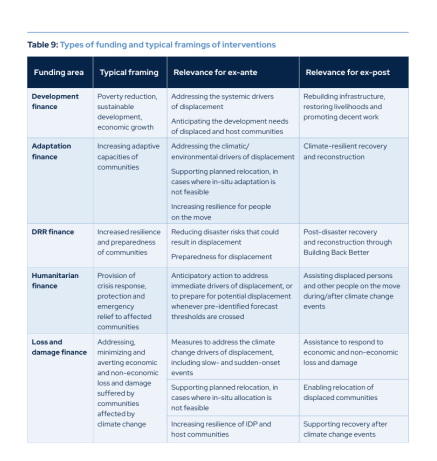
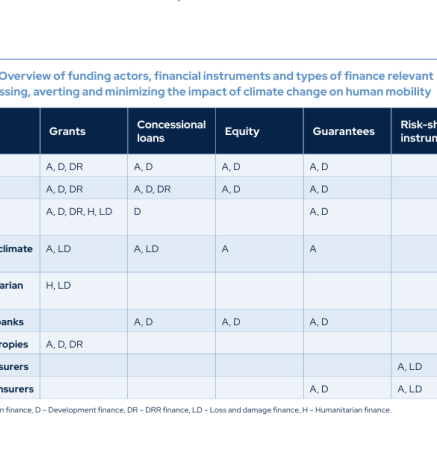
The Guide offers a structured framework for identifying human mobility-related needs and risks, prioritizing operational responses, and matching them with funding instruments, actors, and access modalities. It maps programming domains across the risk management cycle—from adaptation and preparedness to response, recovery, and durable solutions—and clarifies how interventions can align with development, adaptation, disaster risk reduction, humanitarian, and loss and damage finance. Recognizing diverse national contexts, it provides adaptable entry points, analytical tools, and illustrative matrices to support country-led, context-specific approaches.
It also reviews the evolving finance landscape and its limitations, and outlines operational approaches such as anticipatory actions, planned relocation and durable solutions. Annexes include typologies of funding, terminology, example needs matrices, and curated resources to translate fragmented information into actionable policy and financing insights.
The Guide concludes with a four-step process: (1) needs assessments; (2) governance and coordination; (3) appraisal methods; and (4) matching programming needs with finance sources. Prepared under the third plan of action of the Task Force on Displacement, the technical work was led by Task Force members, the Platform on Disaster Displacement and the International Organization for Migration.
|