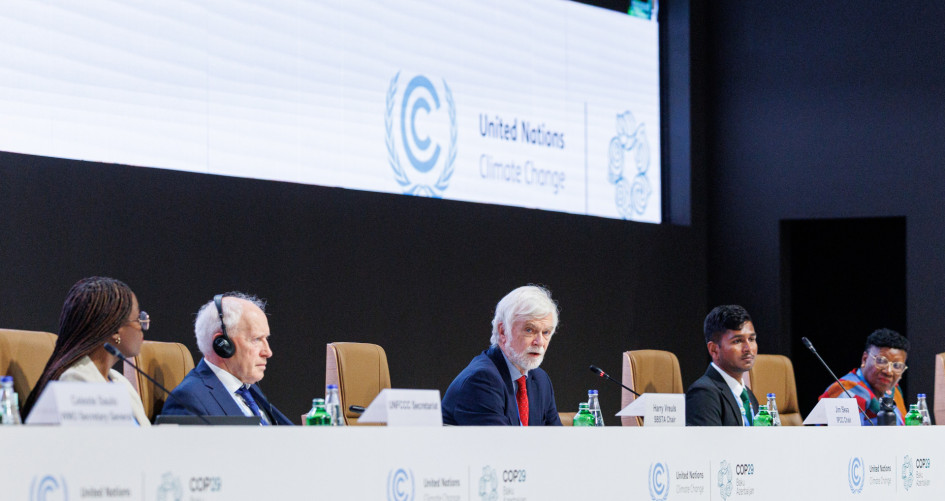
Science: The basis for action
Climate change is one of the three issues of the devastating poly-crisis we are experiencing, the other two being biodiversity loss and land degradation. Three conventions, one for each of the issues, were born at the 1992 Earth Summit in Rio de Janeiro to be the reference point for our response to the three critical environmental issues, and it is science that underpins this response.
Our collective response under the United Nations Framework Convention for Climate Change consists of scientists, researchers, and affected peoples around the world investigating, measuring and reporting the beyond-natural changes in temperatures on land and in the ocean. This is essential for learning about, mitigating, and adapting to the abnormal trends in the timing of seasons, rainfall patterns, and in many other systems – all of which affect livelihoods globally.
The evidence for climate change is clear: these abnormal changes result from global warming due to an increased greenhouse effect, caused by the vast amounts of greenhouse gases (GHGs) added to the atmosphere through human activities.
This is why the response to the urgent threat of climate change needs to be effective and progressive and based on the best available scientific knowledge, as recognized in the Paris Agreement preamble (also see Articles 4, 7 and 14). As the symbol of international unity and collective climate action to limit global warming to below 1.5°C to 2°C, the Agreement identifies the need to support this by strengthening systematic observation, climate services and knowledge sharing (Article 7), highlighting systematic observation and early warning systems as areas of cooperation and facilitation for better understanding, action and support (Article 8).
Deepening the science, together
In response to this, an international climate regime was developed to underpin the collective response to climate change: governments, intergovernmental organizations, non-governmental organizations, businesses, research bodies, civil society and more are working together to build and deepen the science and knowledge that help us to tackle the causes and threats of climate change. The key underlying facts are the following:
|
Since the Industrial Revolution, the atmospheric GHG concentration has been rising steadily as a result of human activity – primarily the burning of fossil fuels and changes in land use – leading to increased global temperatures.
|
The average global temperature on Earth is directly linked to the GHG concentration in the atmosphere. Even small rises in temperature produce major impacts on weather and climate systems, detrimentally affecting life for society globally.
|
Urgent action is required to mitigate the effects of additional emissions, reduce the atmospheric GHG concentration, and to adapt to the existing and future impacts of climate change.
|
To support the international climate regime, science at the UNFCCC is approached trilaterally: