UN Climate Change News, 27 January 2026 – Transparent climate action and support is a cornerstone of climate cooperation. It equips countries with an evidence base to better identify needs and prioritize actions, track progress towards national climate plans (NDCs), and refine climate policies over time, preparing and implementing increasingly ambitious NDCs. By demonstrating progress in implementing the Paris Agreement, transparency builds mutual trust among Parties.
Transparency also offers donors and support providers greater clarity on where action and support are needed. Continued support remains essential for developing countries to engage effectively in the Paris Agreement’s Enhanced Transparency Framework (ETF).
The timely submission of the first biennial transparency reports (BTRs) under the ETF – particularly by developing countries – has been made possible largely through sustained financial, technical and capacity-building assistance from the international community.
As developing countries continue to prepare their first and second BTRs, collaboration among supporting agencies has become increasingly critical to ensure that support is well-aligned, effective, and responsive to country-specific needs.
Joining forces for transparency
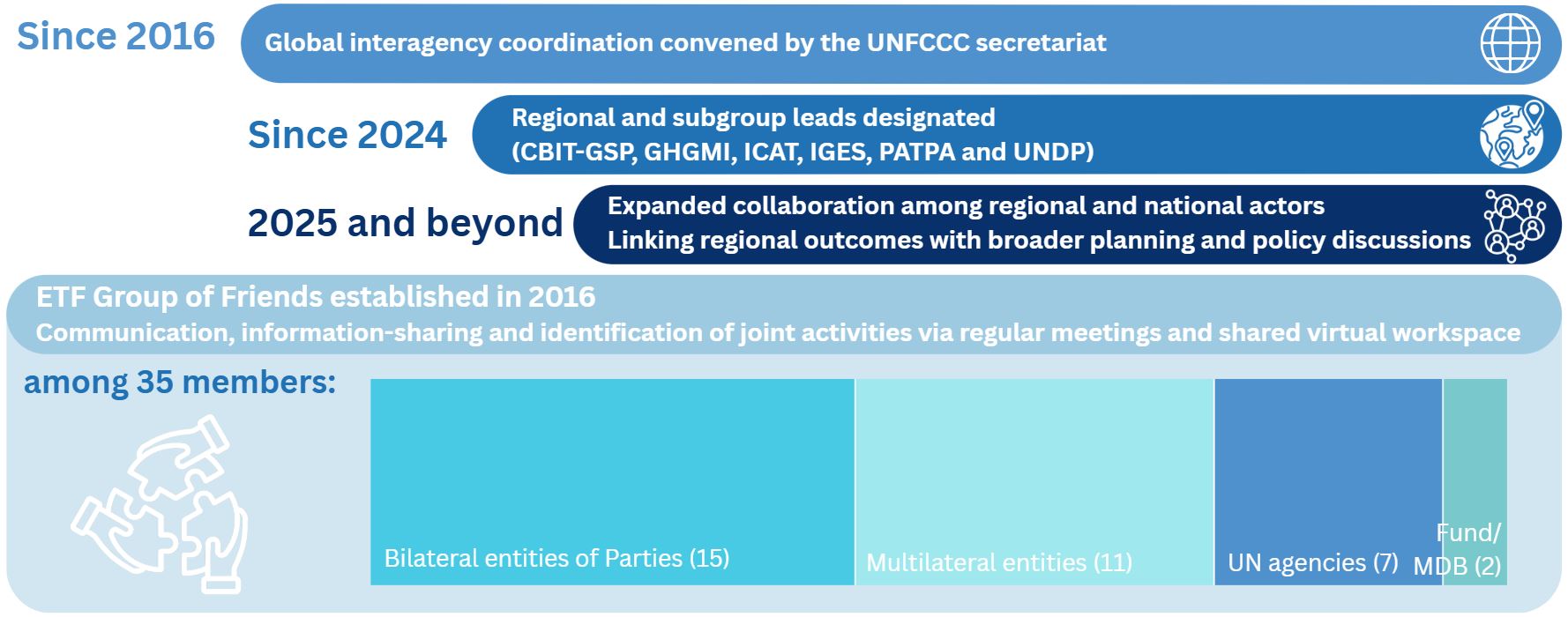
In recent years, coordination among international actors supporting transparency in developing countries has deepened significantly, resulting in more coherent approaches and delivery. This progress has been driven by the ETF Group of Friends – an informal network of around 35 organizations that serves as a central hub for communication, information-sharing, and joint activities.
“No single organization can meet all transparency needs alone,” noted a UN Climate Change representative. By promoting inter-agency collaboration, the Group seeks to deliver support more coherently and achieve greater collective impact.
Coordination that delivers results
Since its establishment in 2016, the ETF Group of Friends has convened more than 45 coordination meetings at global, regional, and national levels – 24 of these were organized by UN Climate Change.
At the same time, regional and subgroup leads have become increasingly active. These include the Capacity-building Initiative for Transparency-Global Support Programme (CBIT-GSP), the Greenhouse Gas Management Institute (GHGMI), the Initiative for Climate Action Transparency (ICAT), the Institute for Global Environmental Strategies (IGES), the Partnership on Transparency in the Paris Agreement (PATPA), and the United Nations Development Programme (UNDP). Over the past 18 months alone, these partners have hosted 21 regional coordination meetings.
Growing regional engagement has shifted coordination from simple information exchange towards concrete joint planning and in-country collaboration. Regular exchanges enable network members to map ongoing activities, identify synergies, and avoid duplication – helping to promote coherent and complementary support at the national level.
The network also contributed to six mandated ETF support and first BTR workshops in 2024 and 2025. These workshops brought together developing countries, the Global Environment Facility (GEF), implementing agencies, and other partners to share experiences and discuss available support for preparing the first BTRs – an updated compilation of transparency support provides developing countries with an overview of assistance and guidance on how to access it.
Looking Ahead
Regional and subgroup leads are expanding engagement with regional and national actors to ensure meaningful follow-up after coordination calls, and to translate dialogue conclusions into tangible outcomes. Efforts are focused on identifying areas of overlap, promoting complementary initiatives, and strengthening collective impact at regional and country levels.
At the global level, UN Climate Change will continue to enable information-sharing, link regional outcomes with broader policy discussions, and promote coordinated planning.
By connecting support providers and responding to countries’ needs, the ETF Group of Friends promotes a coherent global approach to transparency support, strengthening collective efforts to track progress and implement the ETF under the Paris Agreement.