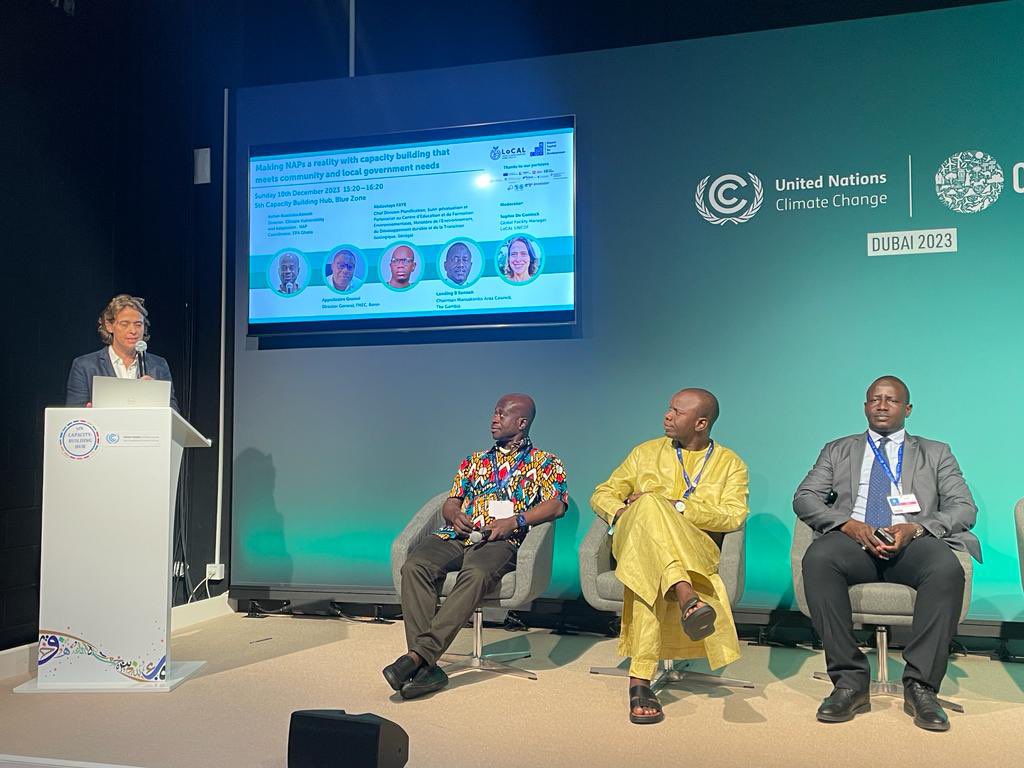
Credit: UNCDF
Recording
Organizers
This session was hosted by UN Capital Development Fund Local Climate Adaptive Living Facility (LoCAL), Governments of Benin and Ghana
Background
As countries develop and implement their National Adaptation Plans (NAPs), and their Nationally Determined Contributions (NDCs), cornerstones for any climate action at both national and sector levels, discussions around the inclusion and integration of the subnational level into these processes have gained momentum.
Local communities and stakeholders, e.g. local governments, have indeed a key role to play in delivering adaptation action and results because 1) they are uniquely positioned to know their vulnerabilities and needs, 2) have a stake in the outcome of any adaptation intervention, and, 3) if appropriately empowered, have strong incentives to ensure that interventions are efficient, effective and impactful.
Yet, they frequently lack the resources, both technical and financial, to live up to such an endeavor. According to the UNFCCC’s 5th Biennial Assessment and Overview of Climate Finance Flows, figures from 2019/2020, adaptation finance has grown by US$ 20bn but this growth is not keeping pace with the growing needs of vulnerable and developing countries. According to a report prepared by UNEP The Adaptation Gap 2023 the adaptation finance shortfall is 50% bigger than previously estimated and requires urgent action to prevent mucher high loss and damage costs. “We really need ambitious adaptation action this decade, and if not, we will increase loss and damage,” said report co-author Georgia Savvidou.
In this context, it is paramount to devise mechanisms and processes that enhance the effectiveness of the scarce adaptation finance, including strengthening transparency, accountability and responsiveness of donor funding, increase ownership and participation of local communities, build the capacity of local stakeholders and of local financial structures to better manage finance and deliver adaptation results, while addressing asymmetries, in particular the gender dimension, and that ultimately empower local governments in contributing towards NAP implementation.
This session discussed and shared experiences and lessons learned on best practices for how local governments can be engaged in delivering adaptation results in support of NAP implementation, focusing on three pillars: capacity building for climate change mainstreaming into local public planning and budgeting systems, innovative financial mechanisms and implementation of local climate action in the context of the NAP process.
Objectives
-
Shared the potential for increased adaptation action and achievements in building capacity at the local level, drawing from LoCAL experience in Benin and Ghana.
-
Drilled down on the findings: what are the solutions, as experience via LoCAL implementation and support to NAPs, to meeting capacity gaps especially at the local and local government level?
-
Illustrated that capacity building at the local and local government level delivers scalable results and impact, beyond adaptation, taking local governments and communities to 'can do' partners in development.
-
Underscored the importance of capacity and awareness-raising when it comes to adaptation, including NAP formulation and implementation.
Speakers
|
Name
|
Affiliation/Organization
|
|
Antwi-Boasiako Amoah
|
Ghana
Messages:
LoCAL and support to NAPs, why so important
Empowering local governments
|
|
Appolinaire Gnanvi
|
FNEC, Benin
Messages:
- Experience with GCF affiliation and LoCAL implementation
- Access to finance
|
|
Abdoulaye FAYE
|
Senegal
Messages:
L’adaptation va appeler des transformations qui ne peuvent se produire qu’à partir de l’éducation et le renforcement des capacités.
|
|
Landing B Sanneh
|
Local government, The Gambia
Messages:
- why local action supports youth and vulnerable groups, experience in implementation in Gambia
- how LoCAL builds capacity of local government
|
Moderator
Sophie De Coninck, UNCDF LoCAL
Key outcomes
- Local government can be instrumental in making the link with communities that are on the frontline of the climate crisis, yet they like the finance needed to fulfill their potential in delivering on adaptation. The event focused on how capacity building can help local governments to access finance to plan, execute and deliver on adaptation drawing on concrete examples from Ghana, The Gambia and Senegal.
- Ghana: capacity-building is essential at all levels for delivering on adaptation and the NAP process. LoCAL uses government systems to build community level resilience to climate change but provides additional resources, in the form of grants, which comes with capacity building and training on assessments of existing adaptation needs and monitoring results and impact. Reporting often lets down the process – we found that local governments often do well on the adaptation project implementation but do not have the skills they need to report and monitor on their results and impact.
- In Senegal, the public policy institutional framework – Le Plan Senegal Emergent (PSE) – focuses on harnessing building human capital for national development. The government is looking across all sectors – economic and social - to see how climate change is impacting the country and identify what capacities need to be built to address these needs.
- The Gambia, communities are engaged with LoCAL at not only the ward level but right down to the village level. Projects require procurement, monitoring and reporting and to do this, we have engaged in capacity building at the local government but also at the village level as the communities are directly involved in developing and managing their adaptation projects.
Resources
LoCAL final report on second period of global expansion 2019–2022
ACCAF: A UNCDF LoCAL Framework for Climate Change Adaptation Monitoring and Evaluation
LoCAL Brochure 2023 (November Update)
LoCAL ISO Flyer 2023 (November Update)