Background
The Asia-Pacific region faces rapidly intensifying climate risks, including floods, droughts, heat extremes, sea-level rise, and compound hazards. Recent assessments under the United Nations Framework Convention on Climate Change (UNFCCC) and the IPCC Sixth Assessment Report indicate that adaptation gaps in the region are increasingly driven by implementation constraints, rather than the absence of plans or policy commitments. These constraints include weak integration of climate risk information into sectoral decision-making, limited deployment of scalable adaptation solutions, insufficient monitoring and evaluation systems, and persistent challenges in mobiliszng adaptation finance. Within the UNFCCC architecture, the National Adaptation Plan (NAP) process remains the principal mechanism for translating climate risk assessments into coordinated, multi-sectoral adaptation action. Recent UNFCCC technical guidance—including the updated NAP Technical Guidelines, the outcomes of the first Global Stocktake, and synthesis work on the Global Goal on Adaptation (GGA)—places stronger emphasis on moving NAPs from planning toward implementation, progress assessment, and learning. These developments, reinforced through COP30-related decisions, signal heightened expectations for countries to demonstrate measurable adaptation progress supported by robust monitoring frameworks and finance-ready pipelines.
The Early Warnings for All (EW4All) initiative, launched by UN Secretary-General António Guterres in 2022, is a global effort to ensure that everyone on Earth is protected by life-saving multi-hazard early warning systems by the end of 2027. It is co-led by the World Meteorological Organization (WMO) and the United Nations Office for Disaster Risk Reduction (UNDRR), with the International Telecommunication Union (ITU) and the International Federation of Red Cross and Red Crescent Societies (IFRC) leading the operational pillars of warning communication and preparedness and supported by a wide range of UN agencies and partners working across risk knowledge, forecasting, dissemination and response.
Within this evolving framework, Early Warning Systems (EWS) and Nature-based Solutions (NbS) are increasingly recognized as priority adaptation pathways in UNFCCC technical work. The UNFCCC Adaptation Committee highlights EWS as a foundational system for reducing climate-related losses by enabling anticipatory action across disaster risk reduction, health, food systems, water management, and urban services. Similarly, UNFCCC technical papers and guidance hosted on NAP Central identify NbS as cost-effective, multi-benefit adaptation options that reduce vulnerability while delivering ecosystem, livelihood, and resilience co-benefits.
Despite this recognition, recent UNFCCC and regional assessments show that financing for NbS-based adaptation remains limited and fragmented, particularly in Least Developed Countries and climate-vulnerable economies. The UNFCCC Standing Committee on Finance (SCF) notes that adaptation finance flows remain insufficient relative to identified needs, with NbS interventions often referenced in NAPs and NDCs but weakly linked to financing strategies, investment criteria, and monitoring systems.
Evidence from the Asia-Pacific Climate Report 2025 further demonstrates that many NbS initiatives remain at pilot scale due to limited investor readiness, unclear revenue models, and weak alignment between adaptation planning and finance mechanisms. UNFCCC guidance increasingly stresses that scaling adaptation finance requires clear adaptation objectives, credible monitoring, evaluation, and learning (MEL) systems, and stronger alignment between NAP priorities, climate finance proposals, and national budget frameworks. Tools such as JAMES, alongside emerging GGA indicators, are intended to support this shift by linking adaptation actions to measurable outcomes and informing financing decisions. Against this backdrop, this regional capacity-building workshop is designed to strengthen multi-sectoral capacity to operationalize NAPs through integrated NbS, EWS, MEL, and financing approaches, fully aligned with UNFCCC technical guidance and COP30 outcomes. The workshop responds directly to UNFCCC calls for enhanced implementation support, peer learning, and capacity building to enable countries to move from adaptation commitments toward measurable, finance-ready, and scalable adaptation action.
Objectives
This regional capacity-building workshop aimed to support governments of Asia-Pacific countries in advancing their National Adaptation Plans (NAPs) by strengthening technical capacities and providing practical, internationally tested approaches, tools, and models to:
- Improve understanding of the NAP process and its role in operationalising adaptation commitments under the UNFCCC;
- Strengthen national capacities to formulate, implement, and monitor NAPs using system-based, multi-sectoral approaches;
- Enhance familiarity with relevant UNFCCC technical guidance, support platforms (including NAP Central), and linkages with NDCs and other national planning processes; and
- Provide practical guidance on how to:
- Establish and strengthen institutional arrangements for NAP formulation and implementation;
- Integrate Nature-based Solutions (NbS) and Early Warning Systems (EWS) as implementation pathways for NAPs;
- Ensure gender-responsive, inclusive, and equity-oriented adaptation planning;
- Design and apply monitoring, evaluation, and learning (MEL) frameworks aligned with emerging Global Goal on Adaptation indicators; and
- Access and mobilise climate finance for adaptation planning and implementation, including through GCF and other relevant financing mechanisms.
Audience
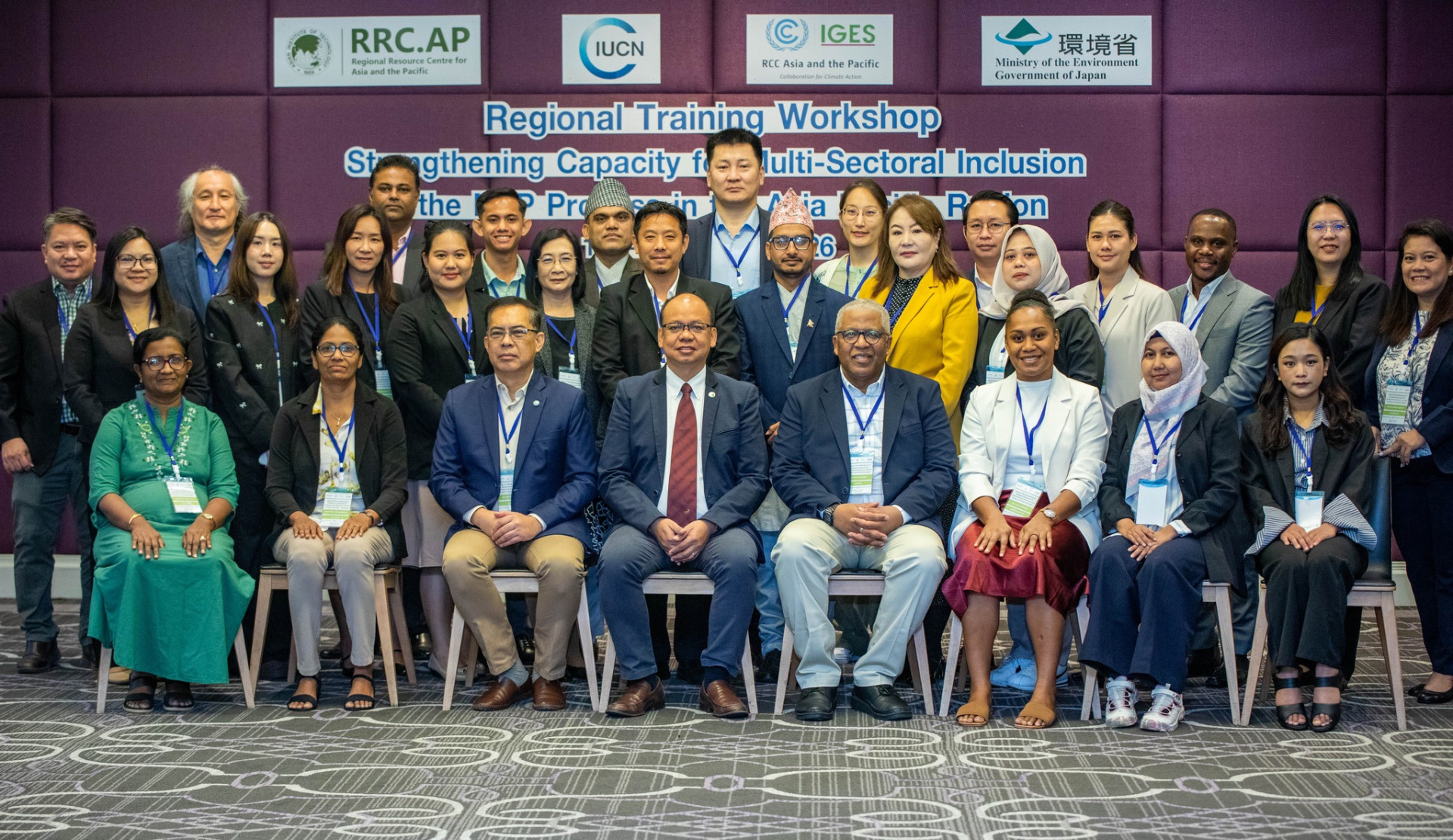
Priority was given to countries that have formally submitted a National Adaptation Plan (NAP) or were at an advanced stage of NAP finalisation, where the focus had shifted from planning to implementation, monitoring, and financing. These participants are best positioned to apply training content on sectoral integration, Nature-based Solutions (NbS), Early Warning Systems (EWS), adaptation MEL (including JAMES), and finance readiness. The participant mix included:
- NAP focal points and senior technical officers from environment, planning, or climate change agencies in countries with recently submitted or updated NAPs.
- Sectoral experts and planners (e.g. water, urban development, disaster risk management) actively integrating NbS and EWS into national or sub-national adaptation processes.
- A limited number of participants from countries without a formally submitted NAP, selected only where there is clear readiness, such as a near-final NAP draft, active readiness support, or ongoing NbS or EWS investments requiring national integration.
Credit: UN Climate Change