The UNFCCC secretariat announced the pilot phase of the Net-zero Recognition Framework (NZRF) at COP 30. The pilot phase aims to better understand participation processes and test the technical feasibility of showcasing participants' net-zero journeys on the Non-State Actor Zone for Climate Action (NAZCA) portal.
Since COP 20, Parties have regularly invited the UNFCCC secretariat to showcase and track voluntary commitments from non-Party stakeholders and to strengthen transparency of initiatives through the NAZCA portal. Following the mandate from COP 27, the secretariat initiated a process to develop a draft net-zero tracking concept. This initial concept underwent an independent consultation to support the formulation of a net-zero framework. Following further consultations with Parties and non-Party stakeholders, the NZRF’s pilot phase officially began in February 2026.
Approach
The NAZCA portal will publicly recognize the Eligible Net-zero Initiatives (ENZIs) and their signatory entities that have voluntarily opted into the NZRF. ENZIs showcased on the portal will provide:
A brief statement on their voluntary participation in the NZRF pilot;
Their science-based criteria, reviewed by an independent third party, and optionally other membership-based criteria, such as disclosure frequency requirements and applicable standards;
Individual entities – including businesses, financial institutions, cities and regions – must be signatories of an ENZI to participate in the NZRF. Enhanced transparency of participating entities aims to showcase progress on transition planning and recognize leadership in achieving interim targets towards net-zero commitments. The NZRF is also intended to promote peer-to-peer learning, encourage wider implementation across the economy, and thereby accelerate global climate action.
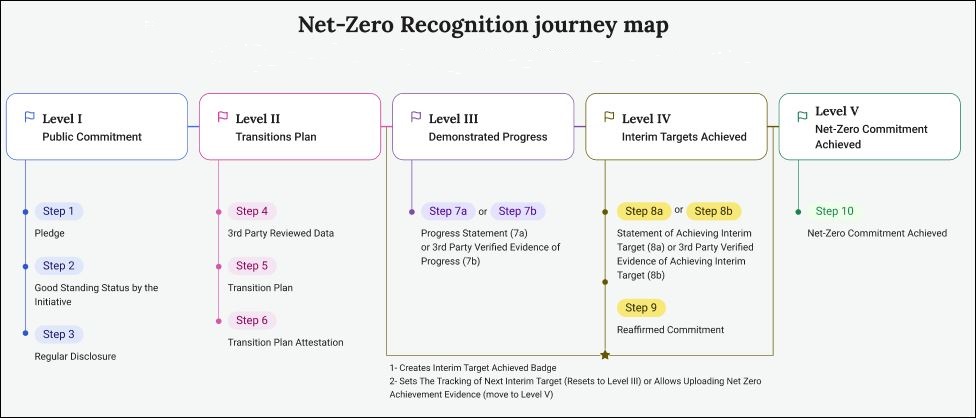
The journey of non-State entities from net-zero commitments to achievement will be recognized and tracked through defined levels and steps, ranging from public commitments and transition plans to demonstrated progress, achievement of interim targets, and fulfillment of net-zero commitments. Entities will be recognized across these levels and steps upon submission and disclosure of relevant information and data. While the UNFCCC secretariat will collect only the required supplemental information, participants are encouraged to disclose greenhouse gas emissions data to a data provider or to follow jurisdictional approaches, where applicable. Information received from data providers may then be showcased through the NAZCA portal.
Pilot Phase and beyond
The UNFCCC secretariat initiated the NZRF pilot phase in February 2026 and will operate it throughout the year. Initial findings from the pilot phase, as well as the way forward, will be presented at COP 31
Through the voluntary Net-zero Recognition Framework (NZRF) pilot, the UNFCCC secretariat is enhancing transparency of non-State actors’ progress
towards achieving their net-zero greenhouse gas emissions commitments. The secretariat announced the NZRF pilot phase at COP 30 and opened the
first opt-in period for Eligible Net-zero Initiatives (ENZIs) from February to May 2026. Signatories of ENZIs can opt in to the NZRF until 9 October 2026
ENZI
Eligible Net Zero Initiatives
During the pilot phase, partner initiatives of the former Race to Zero (RtZ) Campaign were invited to opt in as ENZIs between February and May 2026. The RtZ Campaign, led by the Climate High-Level Champions, mobilized over 15,000 non-Party stakeholders to strengthen ambition and action towards net-zero emissions. Throughout the campaign, the net-zero criteria of RtZ
partner initiatives were assessed by an independent Expert Peer Review Group (EPRG).
A key requirement for participation in the NZRF as an ENZI is to have the initiative criteria reviewed by an independent third party. It is envisaged that, following the pilot phase, additional net-zero initiatives beyond those previously part of the RtZ Campaign may express interest in joining the NZRF.
To opt-in, invited initiatives must be registered as a Cooperative Climate Initiative on the NAZCA portal and submit documentation on their participation for public disclosure. Initiatives are required to:
Submit a statement confirming participation in the NZRF process;
Provide their third-party reviewed net-zero criteria and any additional membership criteria applicable to signatory entities; and
Submit a statement on the degree of alignment with each of the ten recommendations of the High-Level Expert Group on the Net-Zero Emissions Commitments by Non-State Entities.
ENZIs are also requested to confirm that any signatories opting into the NZRF remain in good standing with the initiative.
Signatory entities of opted-in ENZIs listed below are invited to opt into the NZRF pilot until 9 October 2026 by contacting their respective initiative for further details.
The Fashion Charter initiative demonstrates strong alignment with ENZI eligibility criteria through a comprehensive, 1.5°C-aligned framework combining science-based targets, value chain action, and accountability mechanisms. Signatories must adopt either SBTi-approved targets or achieve at least a 50% absolute reduction across Scope 1–3 emissions by 2030 (from a ≥2019 baseline), alongside a commitment to net zero by 2050. The Charter mandates annual public GHG disclosure, requires transition plans and regular updates, and enables oversight and removal of non-compliant members. It further drives real-economy emissions reductions through renewable energy adoption, coal phase-out, low-impact materials sourcing, and supplier engagement across the value chain. The Initiative overall meets ENZI expectations for credible targets, transparency, and implementation.
International Wineries for Climate Action (IWCA) considers itself aligned with the UNFCCC Net Zero Recognition Framework as a collaborative, sector-led initiative dedicated to decarbonising the global wine industry in line with a 1.5°C pathway. IWCA requires all members to set and deliver science-based targets consistent with the Science Based Targets initiative (SBTi), covering Scopes 1, 2, and relevant Scope 3 emissions, and to achieve net zero by 2050 or sooner. Through its charter, IWCA mandates annual GHG measurement, transparent reporting, and independent third-party verification. Members must demonstrate continuous emissions reductions and remain in good standing through regular review. IWCA combines rigorous accountability with practical guidance and peer collaboration, enabling measurable climate action across the wine sector in support of the Paris Agreement.
The Planet Mark Net Zero Certification Programme empowers over 700 businesses on their journey to net zero, providing tools to focus decarbonisation efforts and deliver measurable results for their business, employees and their customers.
Planet Mark has partnered with the Race to Zero Campaign since COP27, supporting more than 50 Member organisations to align their net zero transitions with its framework, free of charge. In January 2025, the Planet Mark Net Zero Certification Programme was launched and officially registered as a Climate Change Initiative (CCI) on the UNFCCC Global Climate Action Portal (GCAP).
Our measurement methodology is aligned to the GHG Protocol, our definition of corporate net zero is aligned to the principles of the SBTi Corporate Net-Zero Standard and our Net Zero Transition Plans are aligned with the TPT Disclosure Framework.
As a result, our programme meets ENZI requirements and HLEC recommendations. The proposed NZRF tiers closely align with our certification levels, enabling a streamlined application.
Pledge to Net Zero aligns with the Race to Zero criteria by committing organisations to robust, science-based targets, transparent reporting, and credible decarbonisation pathways. Our framework requires signatories to set near-term and long-term emissions reduction targets consistent with limiting warming to 1.5°C, publish annual progress, and prioritise real emissions cuts over offsets. We provide clear guidance, independent scrutiny, and sector-relevant tools to ensure integrity and accountability. Through this, Pledge to Net Zero meets the Race to Zero’s requirements for ambition, action, transparency, and verification.
The SME Climate Hub is strongly aligned with the NZRF. We ask our SME signatories to set public climate targets aligned with a 1.5°C pathway and report on their progress annually. These commitments include achieving net zero by 2050 and setting near-term emissions reduction targets.
However, we offer flexibility in how these commitments are implemented, recognising the unique circumstances SMEs face compared to larger organisations. Many SMEs have limited time, resources, and technical expertise, so flexibility is important to ensure climate commitments remain achievable and do not become a barrier to participation. This participation is crucial, as SMEs make up 90% of businesses globally.
The Sports for Climate Action Framework aligns strongly with the Net Zero Recognition Framework by committing signatories to a 1.5°C-aligned pathway under the Paris Agreement, with defined interim 2030 and long-term 2040 targets, comprehensive coverage of Scope 1, 2 and 3 emissions, and clear requirements for measurement, reporting, and annual disclosure of progress. It embeds the use of recognised GHG accounting standards and promotes transparency, accountability, and continuous improvement through reporting and oversight. The Framework also addresses residual emissions, prioritises deep reductions, and establishes governance and participation expectations, including provisions for exclusion to maintain credibility. While principles are aligned with best practice, certain elements, such as third-party verification, prescriptive methodologies, and explicit carbon market guidance, remain flexible rather than mandated.
The Under2 Coalition meets ENZI eligibility criteria as follows. (1) Published signatory criteria: The Coalition's net zero criteria include economy-wide targets with a confirmed year, gas coverage across all seven major GHG groups, annual mitigation planning documentation, and disclosure via the Ambition Tracker and CDP CStaR questionnaire, which are aligned with 1.5°C pathways and Oxford/ECIU net zero terminology. (2) HLEG alignment statement: The Coalition has published a statement assessing its degree of alignment with each HLEG recommendation, identifying full alignment on transition planning, transparency and accountability, nature and just transition, and just transition investments; and partial alignment on net zero pledging, target-setting, voluntary credits, fossil fuel phaseout, and regulatory acceleration. (3) Ethical requirements: The Under2 Coalition operates under Climate Group, a registered international non-profit, and adheres to UNFCCC participation standards as a non-Party stakeholder. (4) Annual progress reporting: The Coalition’s members and signatories report annually via the CDP CStaR questionnaire and the Ambition Tracker, with outputs feeding into the UNFCCC portal.