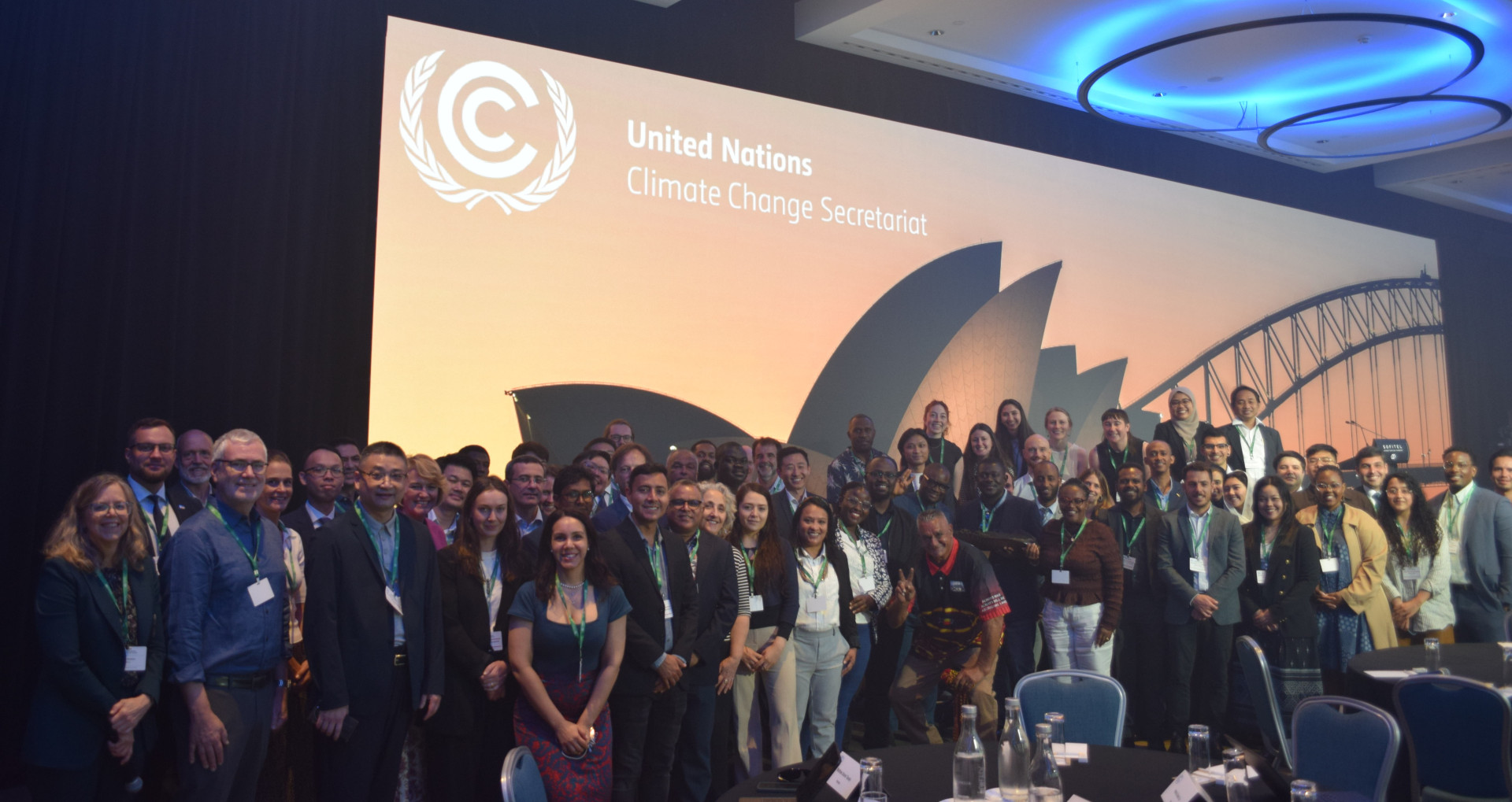
Credit: Australian Government, Department of Climate Change, Energy, the Environment and Water.
SB 64 invited the Chairs of the Subsidiary Body for Scientific and Technological Advice (SBSTA) and the Subsidiary Body for Implementation (SBI) to consider informal intersessional work, prior to SB 65, in appropriate formats and subject to the availability of financial resources. In this context, an intersessional informal workshop on just transition was held from 30 September to 2 October 2026 in Sydney, Australia.
Generously hosted by the Government of Australia, the workshop was organized by the incoming Presidency of COP31 and the incoming President of Negotiations for COP31 under the guidance of the SB Chairs, and with the support of the secretariat.
The workshop was intended to facilitate an informal exchange of views among Parties on matters relating to the United Arab Emirates just transition work programme, including on the process for the operationalization of the just transition mechanism referred to in paragraph 25 of decision 2/CMA.7. Discussions at the workshop were held in an informal setting and will in no way prejudge the consideration of these matters at SB 65 and CMA 8.
DAY 1
| 13:30-14:00 |
Registration for the intersessional informal workshop under the United Arab Emirates just transition work programme |
| Opening Plenary |
| 14:00-14:45 |
-
Welcome to Country
- Group photo
-
Welcome remarks
-
Fatma Tok Lazoğlu, incoming COP31 Presidency
-
Chao Feng, incoming COP31 President of Negotiations
|
| Plenary Session |
| 14:45-15:45 |
Introductions and chairing
- Ken Xie, incoming COP31 President of Negotiations
Presentation on the mapping of relevant instruments, initiatives and processes under the Convention and the Paris Agreement and relevant entities in the United Nations system
Q&A
|
| Coffee break (15:45-16:15) |
| 16:15–18:00 |
Ken Xie, incoming COP31 President of Negotiations
Examples across the just transition landscape – the work of relevant United Nations entities and beyond
- Presentation by Sangji Lee, United Nations Development Programme (virtual)
- Presentation by Camilla Roman, International Labour Organization (virtual)
- Presentation by Katherine Hughes, Asian Development Bank (virtual)
Q&A
Just transition in practice: expert voices on the Australian experience
- Presentation by Amanda Cahill, The Next Economy
- Presentation by Karrina Nolan, First Nations Clean Energy Network
Wrap up of day 1
- Julia Gardiner, SBI Chair
|
| Welcome reception |
| 18:15-19:30 |
Welcome remarks
- Ken Xie, incoming COP31 President of Negotiations
Keynote address
- David Shankey, CEO Net Zero Economy Authority, Australia
|
DAY 2
| Plenary Session |
| 9:00-10:30 |
Encouragement remarks
- Adonia Ayebare, SBSTA Chair (virtual)
Introductory comments
- Joseph Teo and Federica Fricano, co-chairs for the agenda item on the United Arab Emirates just transition work programme at SB64
Building a shared vision for the UAE just transition work programme and just transition mechanism
Before diving into substantive discussions, this session aims to invite general reflections on the vision for the just transition work under the UNFCCC, without prejudice to its ultimate governance or modalities.
Discussion questions
- What does advancing just transition pathways look like at the local, national and international levels?
- What should guide future work on just transition under the UNFCCC to facilitate success at all levels?
Introductions and chairing
- Dharmini Robertson, incoming COP31 President of Negotiations Moderated open discussion
|
| Coffee break (10:30-11:00) |
|
Stakeholder perspectives on just transition (11:00-11:10)
Presentation by Chadli Sadorra, ENGO
Presentation by Emil Sirén Gualinga, IPO
|
| Plenary Session |
| 11:10-12:50 |
Context and purpose of the just transition mechanism
Discussion questions
- What do we want the just transition mechanism to achieve?
- Are the context and purpose of the just transition mechanism adequately reflected in paragraph 2 of decision 3/CMA.5, paragraph 25 of decision 2/CMA.7 and the aspects captured in the informal note?
Introductions and chair
- Dharmini Robertson, incoming COP31 President of Negotiations Moderated open discussion
|
| Lunch break (12:50-14:00) |
| Breakout Session |
| 14:00-15:30 |
Functions of the just transition mechanism
The informal note developed by the co-chairs at SB64 under their responsibility identified a range of views on the potential functions of the mechanism, grouping them around six potential clusters and a placeholder for potential additional elements.
Discussion questions
- Do the clusters identified in the informal note effectively cover the functions of the just transition mechanism as mandated in 2/CMA.7?
- Under each of the identified clusters, what are the essential tasks that the just transition mechanism should be able to deliver on?
Introductions and chairing
- Dharmini Robertson, incoming COP31 President of Negotiations Breakout Group Discussions
Breakout Group Discussions
|
| Coffee break (15:30-16:00) |
|
Stakeholder perspectives on just transition (16:00-16:10)
Presentation by Sinéad Magner, WGC
Presentation by Krista Milne, LGMA
|
| Breakout Session |
| 13:30-14:00 |
Functions of the just transition mechanism (continued)
Reflections on the Breakout Group Discussions (30 mins)
- Facilitators, Breakout Group Discussions
Wrap up of day 2
- Julia Gardiner, SBI Chair
|
DAY 3
| Breakout Session |
| 9:00-10:30 |
Governance and modalities of the just transition mechanism
The informal note developed by the co-chairs at SB64 under their responsibility captured a range of views on the governance and institutional modalities for the mechanism.
Discussion questions
- What institutional modalities could enable the just transition mechanism to successfully deliver on its potential functions?
- What models of governance and institutional arrangements in other parts of the UNFCCC have been effective and could be drawn on for the mechanism?
Introductions and chairing
- Ken Xie, incoming COP31 President of Negotiations
Breakout Group Discussions
|
| Coffee break (10:30-11:00) |
|
Stakeholder perspectives on just transition (11:00-11:10)
Presentation by Bert De Wel, TUNGO
Presentation by Masagus Achmad Fathan Mubina, YOUNGO
|
| Breakout Session |
| 11:10-12:50 |
Governance and modalities of the just transition mechanism (continued)
Reflections on the Breakout Group Discussions (30 mins)
- Facilitators, Breakout Group Discussions
|
| Lunch break (12:50-14:20) |
| Plenary Session |
| 14:20-15:30 |
Relationship between the just transition mechanism and the UAE just transition work programme
Discussion questions
- How should the just transition mechanism and the UAE just transition work programme relate to each other? How can we ensure coherence and complementarity?
- What should be the governance arrangements, if any, between the just transition mechanism and the UAE just transition work programme?
Introductions and chairing
- Ken Xie, incoming COP31 President of Negotiations
Moderated open discussions
|
| Coffee break (15:30-16:00) |
| Closing Plenary |
| 13:30-14:00 |
Timeline for operationalization of the just transition mechanism
Discussion questions
- What could be different pathways for operationalization of the just transition mechanism?
- What elements of the just transition mechanism need to be decided at COP31 to achieve an ambitious outcome on just transition?
Moderated open discussion (45 mins)
Closing reflections
Discussion questions
- What are your key takeaways from this workshop?
- Where has the workshop made most progress? •
- Are there any issues that haven’t been discussed at this workshop that are important to consider as we move towards COP31?
Introductions and chairing
Ken Xie, incoming COP31 President of Negotiations Moderated open discussion (45 mins)
Closing reflections
- Joseph Teo and Federica Fricano, co-chairs for the agenda item on the United Arab Emirates just transition work programme at SB64
Wrap up of workshop
- Julia Gardiner, SBI Chair
|