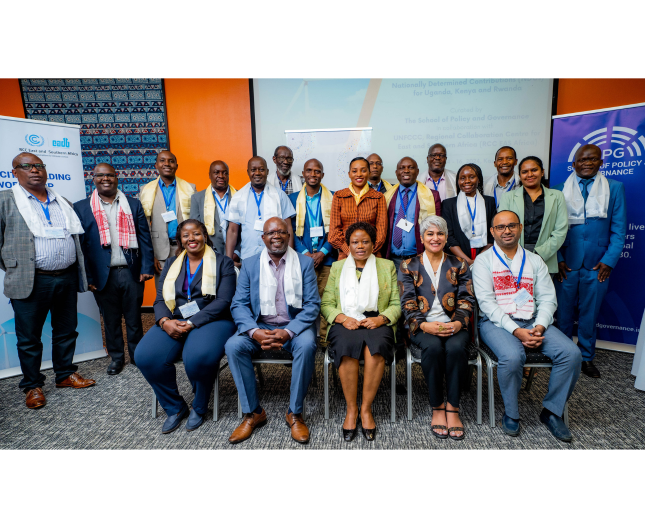
RCC EAS Africa and School of Policy and Governance host capacity-building workshop on net zero Considerations in Nationally Determined Contributions (NDCs) for Uganda, Kenya and Rwanda.
Objectives
- Present key decisions on NDCs, including a roadmap for preparation and submission for NDC 3.0 and GST outcomes as countries prepare NDC 3.0.
- Build capacity for governments to understand, interpret and make decisions on NDC strategies to ensure they are implementable based on practical realities.
- Build capacity for countries to integrate GST outcomes, carbon neutrality and 1.5 Degree considerations into the NDCs, national development and policy advocacy.
Background
The Paris Agreement on climate change requires all parties to prepare, communicate, and maintain successive nationally determined contributions (NDCs). NDCs are the main vehicle for countries to communicate their climate ambitions and actions, and to align them with their national development priorities and the Sustainable Development Goals (SDGs). NDCs are critical tools for countries to align low-emission development with broader sustainability, socio-economic, and climate change adaptation goals. They present an opportunity for countries to achieve low-emissions and climate-resilient development, and short- and medium-term actions needed to get there.
The 2023 NDC Synthesis Report, identified that a significant portion of NDCs are connected with the goal of shifting towards a sustainable, low-carbon, and resilient economy, considering social, environmental, and economic aspects along with the Sustainable Development Goals (SDGs). This is particularly crucial for the African Region, where many countries have aligned their actions and support, but their actions and commitments do not get us to 1.5 degrees. It is important that as countries prepare for NDC 3.0, they consider factoring in the 1.5 degrees goal and carbon neutrality.
Key takeaways
- Increased awareness: Participants gained insights into integrating net-zero targets within national planning frameworks.
- Skill development: The workshop provided tools and knowledge to support the development and implementation of ambitious NDCs.
- Cross-country collaboration: The workshop fostered regional dialogue, offering a platform for open discussions, shared learning, and the formation of new partnerships.
- Technical exposure: Participants were introduced to new approaches and methodologies for the development of climate policies aligned with global goals.
- Practical application of learnings: Several policymakers expressed interest in integrating workshop insights into ongoing draft revisions of their NDC strategies.
- Network building: The workshop was an opportunity for participants to establish professional connections, potentially supporting a coherent approach to future regional climate initiatives.