Article 6 Technical Expert Review

What is the Article 6 Technical Expert Review?

Under the Paris Agreement’s Article 6.2 guidance, countries that participate in cooperative approaches must submit specific information as per the reporting requirements under Article 6.2. This information is then reviewed by independent technical experts in what’s called an “Article 6 Technical Expert Review” (Article 6 TER).

A team of experts, coordinated by the secretariat, reviews the information submitted by participating countries as part of the Article 6 TER process. This review follows the guidelines set out in decision 2/CMA.3, Chapter V (Review), the Article 6 TER guidelines in decision 6/CMA.4, Annex II and decision 4/CMA.6, Chapter VII.

The review process is designed to support transparency, accuracy, completeness, consistency, and comparability. It is carried out in a facilitative, nonintrusive, and non-punitive manner, ensuring it does not place unnecessary burden on countries or interfere with their national sovereignty.


For additional support, contact us at Article-6-Reviews@unfccc.int.

The guiding principles of the guidelines for the Article 6 TER team (Article 6 TERT) are to:

  1. Promote transparency, accuracy, completeness, consistency and comparability (TACCC) principles;
  2. Facilitate the application of robust accounting for engagement in the cooperative approaches;
  3. Acknowledge the importance of facilitating improved reporting and transparency over time; and
  4. Avoid duplication of work and minimize the burden on Parties and the secretariat, including by leveraging capabilities available through the centralized accounting and reporting platform (CARP) in preparing for and carrying out reviews.

Source: Decision 6/CMA.4, annex II, para. 1 

It consists of:

  • A review of the consistency of the information submitted by the participating Party under the annex of decision 2/CMA.3. chapter IV (Reporting), sub-chapters IV.A (Initial report) and IV.C (Regular information);
  • Consideration of the results of the consistency check referred to in decision 2/CMA.3, annex, paragprah 33 (a), performed by the secretariat on the information submitted by the participating Party to be recorded in the Article 6 database referred to in the aforementioned decision and its annex;
  • Specification of recommended actions to be taken by the participating Party, including recommendations on:
    • How to improve consistency with the requirements of the annex to decision 2/CMA.3 and any future relevant decisions of the CMA;
    • How to address identified inconsistencies in quantified information that is reported under chapter IV.B (Annual information) and IV.C (Regular information) of the annex to decision 2/CMA.3 and/or identified by the secretariat as part of the consistency check;
  • Consideration of any recommendations on inconsistency and areas for improvement identified in previous Article 6 technical expert review reports for the participating Party and reiteration of those recommendations in cases of non-responsiveness of the participating Party in its latest submission;
  • Identification of capacity-building needs and areas for improvement in consultation with the participating Party.

Source: Decision 6/CMA.4, annex II, para. 2, 5, 6 and 7

Information submitted by a participating Party is considered to be consistent with the guidelines when all of the following requirements are met:

  • The information is complete, transparent and consistent with the annex to decision 2/CMA.3 and any future relevant decisions of the CMA;
  • The information is consistent across the different reporting requirements, namely the initial report, updated initial report, and annual information and regular information annexes to the biennial transparency report, as well as the structured summary (required pursuant to decision 18/CMA.1, annex, para. 77 (d), as part of the biennial transparency report) in which annual information is included, to the extent possible;
  • The information is consistent across all Parties participating in the same cooperative approach, as relevant and to the extent possible.

Source: Decision 6/CMA.4, annex II, para. 3 

Information submitted by a Party participating in a cooperative approach under Article 6.2, shall undergo an Article 6 TER in line with decision 6/CMA.4, annex II. The reviews comprises:

  • The initial report and updated initial report submitted by each participating Party;
  • Regular information, as an annex to a biennial transparency report submitted by each participating Party;
  • Results of the consistency check, performed by the secretariat on the information submitted by the participating Party for recording in the Article 6 database, including across participating Parties for each cooperative approach in which the Party under review participates.

Source: Decision 6/CMA.4, annex II, para. 11 

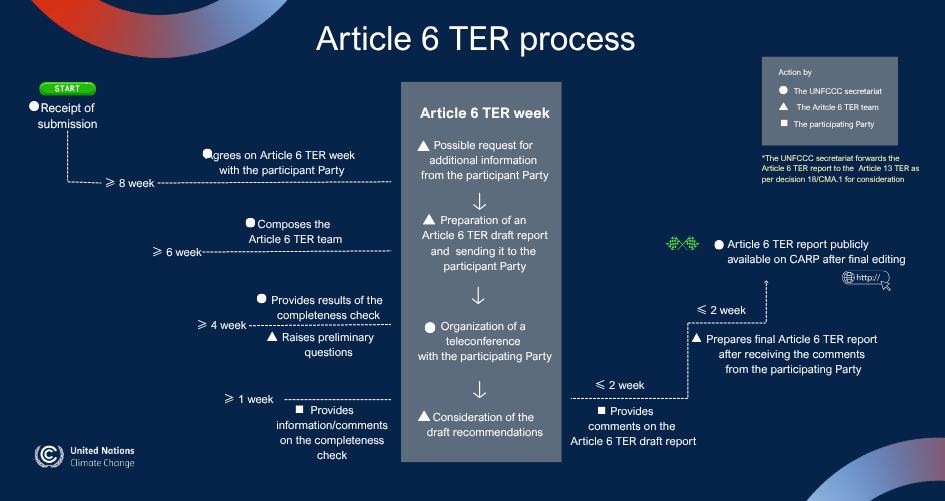
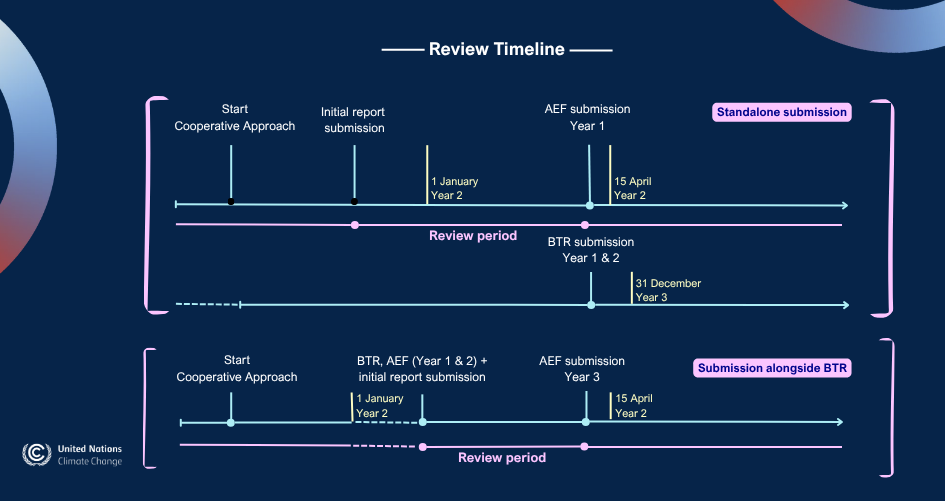
The initial reports and updated initial reports submitted during a three-month calendar period or a six-month calendar period shall undergo an Article 6 TER following the calendar period in which they were submitted.

Click on the visual below to obtain a clear PDF format of it.

Source: Decision 6/CMA.4, annex II, para. 12

An Article 6 TER must be conducted as a centralized review or desk review.

  • A centralized review is when the members of an Article 6 TER conduct the review from a single, centralized location;
  • A desk review is when the members of an Article 6 TER conduct the review remotely from their respective countries.

A centralized review must be conducted:

  • For the regular information annex to the first biennial transparency report or to the biennial transparency report that contains information on a Party’s achievement of its NDC under Article 4;
  • Whenever Parties participating in the same cooperative approach(es) are reviewed simultaneously. 

A centralized or desk review shall be conducted in all cases other than those specified above.

Source: Decision 6/CMA.4, annex II, paras. 13, 14, 16 and 17 

An Article 6 TER report must:

  • contain the results of the Article 6 TER;
  • follow the Article 6 TER outlines (decision 6/CMA.4, annex III);
  • be made publicly available on the UNFCCC website via the CARP.

Source: Decision 6/CMA.4, annex II, paras. 51, 52 and 53 

 Click on the visual below to obtain a clear PDF format of it.

Source: Decision 6/CMA.4, annex II, para. 21

The participating Party may designate information provided to the Article 6 TER team (Article 6 TERT) during the review as confidential.  For handling of information designated by participating Parties as confidential during review-related activities under Article 6.2, a code of practice is stipulated.

Source: Decision 6/CMA.4, annex II, para. 22

about
Eligibility-Participation
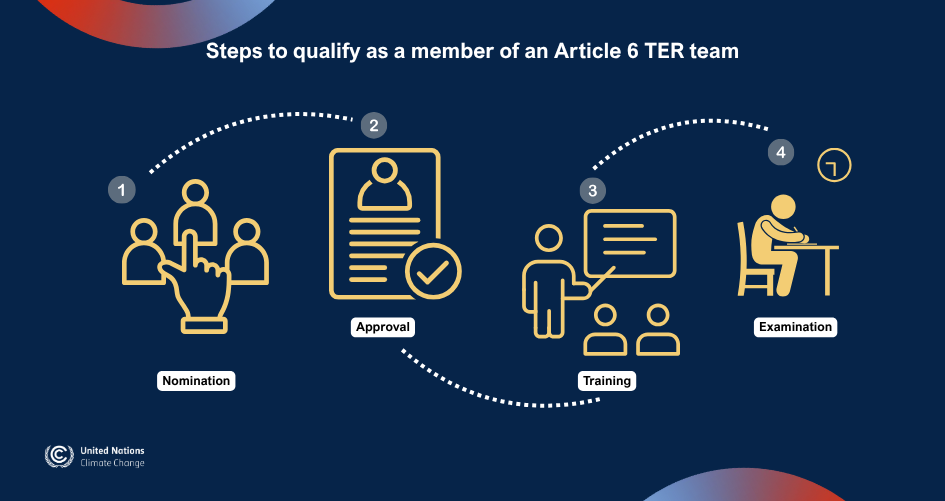
How to become eligible to join an Article 6 TER team (Article 6 TERT)

1. Nomination

A technical expert must be nominated to the UNFCCC Roster of Experts by Parties to the Paris Agreement and, as appropriate, by intergovernmental organizations before becoming an Article 6 expert reviewer. Please find information on the UNFCCC Roster of Experts nomination process here>>.

2. Approval

The nomination must be approved by the national focal point of the nominating Party or an international organization, respectively. With this approval, a technical expert can have an active profile listed in the UNFCCC Roster of Experts.

3. Training programme

Technical experts must complete the respective training programme prior to serving on an Article 6 TERT. Two training approaches will be provided:

  • Participation in the annual instructor-led training session
  • Self-training with:

4. Examination

Upon completion of the training programme, technical experts must take a qualification examination in order to become part of the pool of Article 6 technical reviewers. Two approaches will be available:

  • Examination in conjunction with each instructor-led training session
  • Examination on demand for self-trained experts (under construction)

The secretariat will compose an Article 6 TERT such a way that the collective skills and competencies of the technical expert review teams correspond to the information to be reviewed and that a single Article 6 technical expert team includes at least two experts.

At least one team member should, if possible, be fluent in a language of the participating Party under review.

The secretariat will select the members of the Article 6 TERT to achieve a balance between experts from developed and developing country Parties. The secretariat will ensure geographical and gender balance among the technical experts, to the extent possible. When selecting members of the Article 6 TERT for centralized reviews of submissions from the least developed countries and small island developing States, the secretariat will strive to include technical experts from the least developed countries and small island developing States, while at the same time ensuring that those experts do not participate in reviews for the Party that nominated them to the UNFCCC roster of experts.

The same Article 6 TERT must not perform two successive reviews of a participating Party’s submission.

The Article 6 TERT must include two co-lead reviewers, one from a developed country Party and the other from a developing country Party, neither of whom may have been nominated to the UNFCCC roster of experts by the participating Party under review.
Contenu