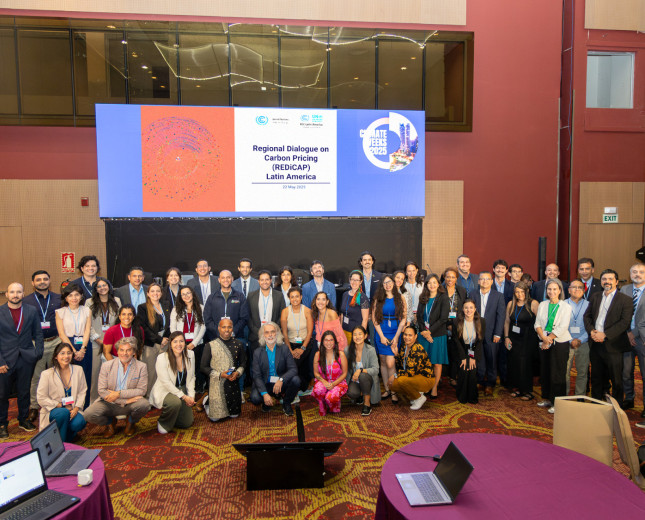
Panama City, Panama, 22 May 2025—As part of Climate Week (Panama, 19-23 May), the Regional Dialogue on Carbon Pricing (REDiCAP) Latin America 2025 gathered 43 participants from 16 national governments, 4 subnational jurisdictions, and prominent international organizations to advance progress on carbon pricing instruments (CPIs) throughout the region.
Held as part of the UN Climate Change Collaborative Instruments for Ambitious Climate Action (CiACA) initiative and hosted by the RCC Latin America, the dialogue focused on aligning CPIs with Nationally Determined Contributions (NDCs), Long-Term Low Emission Development Strategies (LT-LEDS), and Article 6 of the Paris Agreement.
Enabling integration and ambition
Participants shared insights on how national and subnational carbon pricing efforts are evolving in Latin America. Brazil highlighted its recently established Emissions Trading System (SBCE), positioned as a key pillar in its ecological transformation agenda. Bolivia emphasized its constitutional safeguards and newly adopted legal frameworks that prioritize forest conservation and the rights of Indigenous Peoples within carbon markets.
Countries such as Chile, Colombia, Mexico, and Panama, as well as subnational actors like the Government of California, showcased reforms toward hybrid systems that combine carbon taxes with emissions trading and offsetting mechanisms. While they are diverse in structure, these instruments increasingly share a common ambition: inserting carbon pricing at the heart of climate policy.
Despite varying approaches, countries noted common priorities, such the need for robust measurement, reporting and verification (MRV) systems, integration with Article 6 mechanisms, and transparent governance to ensure environmental and social integrity.
Regional cooperation and private sector engagement
The dialogue underscored the growing role of Latin America in voluntary carbon markets, accounting for 23 % of issuances and retirements globally, and highlighted the potential of private sector finance in supporting community-based mitigation, such as regenerative agriculture projects.
Regional collaboration also emerged as a strategic opportunity. Countries expressed interest in building a standardized carbon market architecture across Latin America to improve liquidity, signal policy consistency, and attract investment. Proposals included linking CPIs, aligning regional MRV standards, and exchanging lessons through platforms like the Carbon Pricing in the Americas (CPA).
Toward practical solutions
A dynamic brainstorming session allowed participants to think through some important challenges and co-develop practical recommendations. These included:
- Aligning CPIs with national sectoral targets as well as better pricing signals that support the 1.5°C target.
- Phasing out fossil fuel subsidies so that clean technologies have a level playing field.
- Ensuring social equity that will allow CPIs to consider compensatory measures for vulnerable populations.
- Strengthening institutional capacity, in particular about monitoring, reporting, and verification and regulatory design.
- Optimizing regional integration for harmonization of carbon pricing instruments and more transparency in markets.
A path forward
In closing, representatives from UN ECLAC and the CPA co-chairs emphasized the strategic role of REDiCAP in enabling countries to translate carbon pricing ambition into tangible climate action. Participants agreed on the importance of sustained dialogue, technical cooperation, and inclusive stakeholder engagement to scale up CPIs across the region.
With NDC 3.0 submissions approaching and Article 6 implementation gaining momentum, REDiCAP Latin America 2025 reaffirmed the region’s commitment to using carbon pricing not just as a fiscal instrument, but as a cornerstone of transformative climate policy.