Focus areas: Mitigation; Adaptation
Website
Location: Cato Manor township, Durban, South Africa
Established: Phase 1 completed in December 2011
South Africa's 1st "Green Street" upgrade in a low-income area was completed ahead of the COP17 international climate change talks in December 2011. It involved adapting and retrofitting 30 low-cost houses in a township in Durban. Each household received an energy efficient retrofit in the form of solar water heaters, insulated ceilings, efficient lighting and heat insulation cookers. Rainwater harvesting tanks were added and food gardens established for the production of healthy, home-grown food. The polluted stream was cleaned up and indigenous and fruit trees were planted.
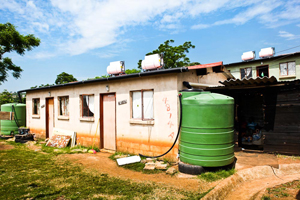
The installation of energy-efficient, food and water security interventions enables this community to build resilience against the effects of climate change and micro / macroeconomic fluctuations. They now have greater access to fresh food supply and use renewable energy sources. The activity addresses the mitigation of climate change by taking initial steps towards reducing carbon consumption, decreasing dependency on coal-generated power sources and if replicated across the country, contributing to a lower carbon future for South Africa.

The objectives of the activity were to demonstrate the range of socio-economic, health and environmental benefits possible through sustainable design and resource-efficient interventions, and to illustrate that people's quality of life can be improved, while keeping the country's development on a low carbon and more "earth-friendly" path. It is a practical demonstration of the need to green low-income housing, and the potential impact that similar interventions could have on a national scale.
Mitigation / Adaptation
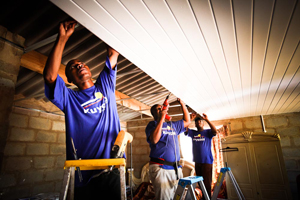
An assessment was undertaken after a few months, and high-level outcomes achieved were: Residents have leap-frogged to a cleaner technology as they don't have to rely on traditional electrical geysers for the hot water they have now on tap for the first time. (Many residents couldn't afford to purchase the energy to heat water regularly before.) Households have reported a saving of up to 25% of their electricity costs. 105 tonnes of carbon have been avoided, and the sale of carbon credits will generate funds for this community. Greater human comfort and aesthetics with improved health and safety has been recorded. The addition of insulated ceilings has dropped peak temperatures on summer days by 4-6 degrees Celsius. Insulated roof paint drops these by a further 2 degrees Celsius. Less need for fuels like paraffin, coal and wood, mean reduced health problems and fire hazards. Unsafe electrical wiring was replaced and efficient security lights installed above the front door of each house. Practical, on-the-job training sessions and community education was conducted, and the project translated into 615 days of local employment created. The rainwater tanks hold 30,000 liters over and average year, equating to 3 months' worth of free water allocation. This boosts water security in times of erratic rainfall and drought, and keeps water costs down in periods of municipal water shortages. Water use is efficient and grey water is being used for food gardens. 60% of homes say they are saving on food costs already.
Benefits
Stakeholder consultation for this project was comprehensive. Consultations were held with the Ward Councilor, the Local Economic Development Committee and the Area Committee for operational issues. Many community meetings were conducted, and a local Community Liaison Officer was appointed. Low-cost homes are built on a large, cost-efficient scale with often low consideration for construction quality, occupant comfort or access to renewable energy supplies. People living in these houses spend high proportions of their small income (average household income of ZAR 3, 013 per month) on energy, while suffering disproportionate health burdens. Many can't afford the electricity-driven services which would improve their quality of life. After the green intervention homes are now more comfortable and safer. Residents have greater convenience, are less reliant on coal-fired energy sources and less dependent on economic circumstances. They are realizing significant energy, water and time savings, thus increasing disposable income & improving their economic status. Fresh, nutritious food grows at their doorstep, reducing the need for transport to shopping hubs, and the local area has been upgraded, instilling community pride and promoting social cohesion. Residents were employed for different roles creating an estimated 615 person days' worth of employment. Community training workshops were conducted to educate residents on the efficient use of resources, the use and maintenance of new technologies, introduction to climate change, how to save money and help save the Earth, the use and benefits of heat insulation cookers, and how to plant trees and food gardens (including permaculture training conducted for 3 months following the implementation). The Cato Manor Green Street project has successfully served as a strong advocacy & awareness-raising tool to demonstrate the benefits of resource-efficiency practices. As a COP17 legacy activity, the Green Street is a permanent demonstration and living learning site. Residents are trained to be tour guides, and educational signboards have been erected. Numerous site tours for local and international delegations have been undertaken. There is significant employment potential if retrofit upgrades just like this were done for all existing low-cost houses. The Property Point enterprise development initiative is committed to further training and business development support to those who worked on the project, to assist them in developing small businesses and "green" enterprises.
Potential for scaling-up and replication
The South African government has built almost 3 million low-cost homes since 1994 and a further 3 million are targeted by 2025. Until fairly recently, green considerations have not been a priority, so people living in these houses continue to spend significant amounts of their income on energy, while suffering disproportionate health burdens. Many can't afford the electricity-driven services of appliances and utilities which would make their lives better (beyond the free basic allocation). This Cato Manor Green Street project is a practical demonstration of the need to green low-income housing, and the potential impact that similar interventions could have on a national scale. The SA Government is looking for ways to promote a "green economy" that will have far reaching environmental, economic and societal benefits, and the Cato Manor Green Street is strongly aligned with this intent. If retrofits like this were done for 3 million existing low-cost houses, then the savings from electricity and water are estimated at about R 3 billion per year (at current tariffs). This is money that would go back into the pockets of poor people and be retained in the local economy. The electricity saving would be over 3400 gigawatt hours (GWH) per annum, which is equivalent to about a third of what a city the size of Durban or Cape Town uses. An estimated 3,45 million tonnes of CO2 would be avoided per year from the electricity saving, to reduce the country's carbon footprint. For the purposes of generating revenue on carbon markets, almost 10 million (9,720,000) tonnes worth of carbon credits are possible. In terms of employment, it is estimated that about 36.5 million days of work could be created, equivalent to employing over 165,000 people for a year of work.


Images owned by the activity partners, all rights reserved.