Project update, October 2012
- To date, a net total of approximately 406,676 trees have been traded, with a total of 333,023 recorded as already planted in an area of over 300 hectares at the Buffelsdraai Landfill Site Community Reforestation project.
- Tree planting is at a density of approximtely 1000 trees per hectare, but in riverine and valley bottom habitats, the density of trees can increase to 2000 trees per hectare.
- The project provides many different job opportunities. 24 fulltime jobs were created in the 3rd phase (2011-2012 financial year) of the project, 10 part time jobs, 58 temporary jobs and 638 treepreneurs.
- Treepreneurs are local community members who trade their home-grown tree seedlings for credit notes, which can later be exchanged for food, building materials, bicycles, basic household goods, or used to pay school fees or driving lessons. In addition to direct employment, the treepreneurs are encouraged to diversify their plant growing skills to include fruits and vegetables for their own use or for selling in the local markets.
- Read a case study on the project here (857 kB).
Project Background
published: 31.1.2012
Website
Location: Africa, South Africa, eThekwini Municipality
Date project established: November 2008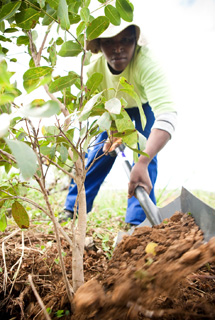
In being selected as one of the host cities for the 2010 FIFA World Cup in South Africa, the eThekwini Municipality (city of Durban) established a target to host the event in a “climate neutral” manner. This meant that the total unavoidable carbon footprint of hosting the event in Durban (declared as 307,208 tCO2 eq), needed to be offset. The municipality has committed to mitigating a portion of this carbon footprint through a series of local natural habitat restoration projects that not only achieve this climate mitigation aim, but also increased climate adaptation capacity within ecosystems and communities. In this regard a “reforestation” project has been established within the buffer area of the municipality’s Buffelsdraai Regional Landfill Site, north of Durban, to create a natural carbon sink. The project was initiated in November 2008 in the 757 hectare municipal-owned buffer area around the landfill site. All land that is being reforested as part of this initiative is either farmland with limited productive capacity, or areas on which invasive alien plants have become established.
The rationale for selecting reforestation as a mitigation tool is linked to the priority placed on adaptation by the eThekwini Municipality. Even mitigation interventions must be seen to have adaptation advantages. Natural habitat restoration projects have the advantage of not only achieving climate mitigation aims, but also increasing climate adaptation capacity within ecosystems and communities. Ecosystem-based-adaptation is seen as one of the most strategic, resilient and cost-effective adaptation mechanisms available to African cities such as Durban. The investment in ecosystem restoration is effectively an investment in enhancing not only the supply of “carbon sequestration” as a single ecosystem service, but in increasing the supply of a large number of other ecosystem services (e.g. flood attenuation, sediment regulation, biodiversity refuge conservation, river flow regulation). This assists significantly in enhancing the resilience and adaptation capacity of the river catchment ecosystem and the communities that depend on the natural resources that it supplies.
The Municipality approached an NGO, the Wildlands Conservation Trust (WCT), to implement the Reforestation Project through the WCT’s well-established Indigenous Trees for Life Programme (ITFL). The ITFL programme assists unemployed people (many of whom are women and children) who are subsequently known as “Tree-preneurs”, to set up small-scale indigenous tree nurseries at their homes. The tree seedlings that they grow are exchanged for credit notes, which can be used to obtain food, basic goods and school fees at regular “Tree Stores” held in each of the participating communities.
The project has also demonstrated the strong and vital link that exists between natural ecosystems and the human communities they support and protect, and between the human communities that support, restore and protect local ecosystems. In this regard the concept of Community Ecosystem Based Adaptation (CEBA) has been developed, and is seen as an important and necessary extension of the existing “Ecosystem Based Adaptation” concept.
Mitigation and/or Adaptation
41% of total reforestable area (215 hectares of 520 hectares) has already been planted. Once the tree planting activities are complete, the area will be maintained until forest canopy is established (approximately 5 – 7 years) and then the forest managed over the long-term. The intention is also to obtain formal protected area status for the project area once the forest has been established.
The project activity is conservatively estimated to reduce the concentration of atmospheric greenhouse gases by 45,007 tCO2e over 20 years.
In terms of the adaptation advantages, these are technically more difficult to measure but monitoring systems are in place to measure the change in ecosystem functioning (using biodiversity indicators for ecosystem health) and additional measuring systems are being established to determine the change in key ecosystem services (sediment flows, river flow regulation etc).
The calculation of net reduction in GHG emissions is based on two datasets. The baseline scenario is based on data from the South Africa Sugar Research Institute and the current land user, Tongaat-Hulett. The sugarcane industry in South Africa is highly commercialised and controlled and the emissions data is based on a long term data set that gets updated annually.
The estimated future increase in biomass carbon stocks due to the additional project activity was based on a field assessment of biomass carbon stocks of the entire municipal area undertaken by Glenday (2007)* and is assumed to provide an adequate estimate of the carbon sequestration potential of the project site. In addition the site was visited by an expert in the field to determine its sequestration potential. The above ground woody biomass will be monitored annually using similar methods to Glenday (2007). Due to the small scale of the project there is no need for remote sensing.
Social Benefits 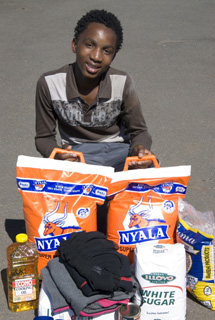
The project has engaged 583 local community members in the surrounding Osindisweni, Buffelsdraai, Ndwedwe and KwaMashu communities as Tree-preneurs, who grow the trees for the Buffelsdraai Landfill Site Community Reforestation Project at their homesteads. Since inception, the project has created 23 fulltime jobs, 10 part time jobs, and 639 temporary work opportunities for previously unemployed members of the surrounding communities as community facilitators and members of the nursery, planting and ecosystem management teams. A recent social impact assessment has found that in the first 2 years of implementation the project has had the following positive impacts on these communities:
- Improved schooling for children
- Additional disposable income to cover additional needs (i.e. transport).
- The level of access to adequate food supply for consumption by project participants in two of the project communities has increased by 40%.
The intention is that once the large scale planting is complete that local community members will become involved in the management of the forest through enterprise development initiatives that create co-ops that can undertake fire control, alien species control, trail development and the initiation of ecotourism interventions.
Three focus groups were conducted in each of the three assessed communities. Each group was formed by a minimum of 15 programme participants or Tree-preneurs. Semi-structured interviews were conducted with minor programme participants to put a special focus on their perceived value of the programme. A representative of the Department of Solid Waste was interviewed as well as two ward counsellors (KwaMashu and Buffelsdraai).
Potential for Scaling-up and replication of project
This project is an initiative of the eThekwini Municipality, which provides the majority of project funding. It is, however implemented in partnership with a NGO, the Wildlands Conservation Trust, who has provided the implementation model. Local communities are considered an integral part of the process and individuals are empowered through job creation and skills development. This process links closely to the national Green Economy objectives.
The initial phases of the project were supported by a grant from the Danish International Development Agency (DANIDA). The Wildlands Conservation Trust is supported by a number of companies who provide additional funding and project support. This corporate funding, from Unilever and Bonitas in particular, catalysed the development of Indigenous Trees for Life project nodes in Durban, which made it possible to implement the project in its current form.
Following the success of the initial project phases, the municipality has successfully motivated for the continued funding from internal sources to expand the project to include the full reforestable area.
Since initiating the Buffelsdraai Landfill Site Community Reforestation Project, the eThekwini Municipality has established a similar community reforestation project at Inanda Mountain (west of Durban) where local communities are being assisted to reforest a 250 hectare area of former coastal scarp forest which has been degraded due to uncontrolled fire and high levels of natural resource harvesting. The municipality is also initiating the “Durban Community-Ecosystem Based Adaptation” (Durban CEBA) initiative in the Umbilo River Catchment, which will form the core of the municipality’s investment into mitigating the climate and ecological impacts of the COP17-CMP7 event in Durban, 2011.


Images owned by the activity partners, all rights reserved.
