Using Climate Budget Tagging and Transparency Tools to Inform Climate-Responsive Budgeting and Track Climate Expenditure
Background
Under the Paris Agreement’s Enhanced Transparency Framework (ETF), Parties are required to regularly report information on climate action and support, including climate finance provided, mobilized and received, through Biennial Transparency Reports (BTRs).
For Caribbean Small Island Developing States (SIDS), strengthening climate finance transparency is essential not only for meeting reporting requirements but also for supporting the implementation of Nationally Determined Contributions (NDCs), National Adaptation Plans (NAPs), and other national climate priorities. Reliable climate finance data helps governments track climate-related expenditures, identify financing gaps, and inform planning and budgeting decisions.
However, many countries in the region continue to face challenges in systematically identifying and tracking climate-related expenditures within national budget systems. Climate Budget Tagging (CBT) offers a practical approach to classify and monitor climate-related spending, strengthening national transparency systems while supporting more informed climate-responsive budgeting.
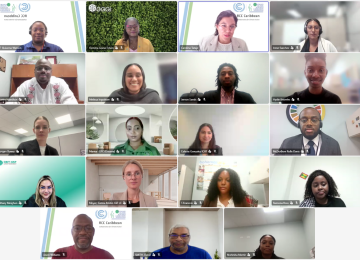
This webinar will introduce key approaches to climate finance tagging and highlight relevant methodologies and country experiences from the Caribbean region.
Objectives
The webinar, organized by the UNFCCC Regional Collaboration Centre Caribbean, in collaboration with CBIT-GSP, and ICAT, aims to demonstrate how Climate Budget Tagging (CBT) can support climate finance transparency across the budget cycle by:
Informing climate-responsive budgeting and resource allocation (ex-ante).
Monitoring, tracking and reporting climate-related expenditures (ex-post).
Expected Outcomes
Participants will:
Gain a clearer understanding of the role of climate finance tagging within national transparency systems.
Become familiar with practical approaches for defining, classifying and tagging climate-related expenditures.
Identify institutional arrangements and data sources needed to support climate finance tracking.
Share country experiences, challenges and good practices.
Explore potential follow-up support, peer learning opportunities and capacity-building activities.
Target Audience
The webinar is designed for:
Officials from ministries of finance, planning, environment and climate change
Climate finance units and national budget coordination teams
National experts responsible for climate finance tracking and reporting
Regional and international partners supporting transparency and climate finance initiatives
Main takeaways from the workshop
Climate Budget Tagging (CBT) is a public financial management tool that enables governments to systematically identify, classify, and track climate-relevant expenditures, enhancing transparency and accountability in climate finance. As highlighted by CBIT-GSP (Capacity-Building Initiative for Transparency – Global Support Programme), CBT serves as an ex-post foundation for tracking domestic and international climate finance, providing traceable budget lines and metadata that strengthen the credibility of Biennial Transparency Reports (BTRs) under the Enhanced Transparency Framework (ETF) of the Paris Agreement. While reporting on support needed and received is not mandatory for developing countries, CBT significantly improves the robustness and reliability of climate finance data, fostering trust among international partners and donors.
Meanwhile, the ICAT Climate Finance Transparency Framework offers a step-by-step approach to help countries build effective transparency systems, from scoping and planning to tracking and reporting climate finance. ICAT’s framework emphasizes flexibility, granularity, and compatibility with global standards like the Paris Agreement and Sustainable Development Goals (SDGs), ensuring countries can mobilize additional resources and optimize public resource management.
Motivations and Entry Points for CBT in The Bahamas and Saint Lucia
In The Bahamas, the introduction of CBT was legally driven by the 2022 Disaster Risk Management (DRM) Act and the 2025 Climate Change and Environmental Advisory Unit (CCEAU) Act, which mandated transparency in climate and disaster spending to improve resilience and access to international funding. The entry point was tied to national compliance requirements and the need to align climate finance with NDCs and global commitments, while avoiding under-reporting (which limits support) or over-reporting (which signals less need). For Saint Lucia, CBT was motivated by the need to strengthen climate finance governance and bridge the gap between available funding and national climate priorities, particularly in vulnerable sectors like tourism and agriculture. The process was initiated as part of technical assistance projects supported by the NDC Partnership and Green Climate Fund (GCF), with a focus on preparing for BTR reporting and improving the credibility of climate finance data to mobilize additional resources.
Institutional Leadership, Digital Tools, and Methodologies
The Ministry of Finance (MOF) led the CBT process in The Bahamas, collaborating with the Disaster Risk Management Authority (DRMA) and CCEAU to ensure inter-ministerial coordination. A centralized approach was adopted, where technical agencies submitted Climate Disaster Tagging (CDT) forms annually, which were reviewed for consistency. Digital tools like Excel-based CDT forms and public financial management systems were critical, with recommendations to further integrate CBT into digital budgeting tools for greater efficiency. In Saint Lucia, the process was led by the Ministry of Finance, Economic Development, and Youth Economy, with support from GGGI and a cross-ministerial committee. Saint Lucia explored integrating CBT into CloudSuite (for expenditure tracking) and Questica (for budgeting), enabling granular classification of climate-related expenditures using Rio Markers and other methodologies. Both countries adopted objective-based approaches to define climate-relevant expenditures, with Saint Lucia tailoring the Rio Markers to align with national climate strategies and integrating them into financial systems.
Addressing Capacity Challenges and Lessons Learned
Both countries faced capacity challenges, including limited technical expertise and data fragmentation. The Bahamas addressed these through training programs and a centralized review process to ensure accuracy, while Saint Lucia focused on upgrading digital infrastructure and stakeholder engagement. Political challenges, such as securing inter-ministerial buy-in and resource constraints, were mitigated through cross-ministerial committees and incremental implementation. Key lessons included the importance of starting small with basic tagging (e.g., Rio Markers) and gradually expanding as capacity grows, as well as leveraging existing financial management tools to minimize disruption. Both countries emphasized the need for capacity-building, stakeholder engagement, and technical assistance from international partners to ensure successful CBT implementation.
Tangible Benefits and Practical Advice for Caribbean SIDS
The implementation of CBT has yielded tangible benefits beyond reporting. In The Bahamas, CBT provided a clearer picture of climate and disaster spending, enabling better alignment with national strategies and attracting international funding. Saint Lucia saw enhanced financial governance due to increased transparency and accountability. By adopting these approaches, Caribbean SIDS can strengthen climate finance transparency, align expenditures with national and global climate goals, and unlock opportunities for mobilizing private sector finance and attracting further climate investments.